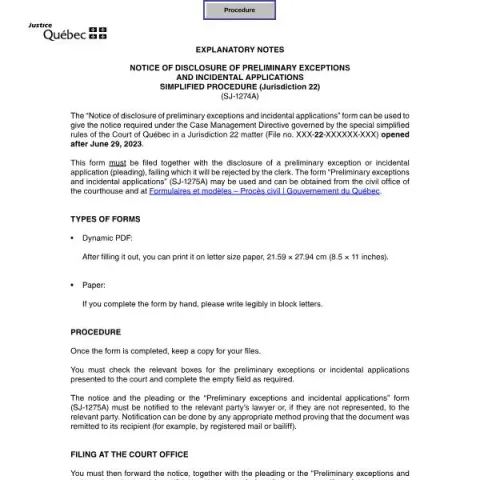
Understanding the Official Court Document: Notice of Disclosure of Preliminary Exceptions and Incidental Applications
If you are involved in a civil proceeding before the Court of Québec, particularly under the simplified procedure governed by Jurisdiction 22, you may encounter the Notice of Disclosure of Preliminary Exceptions and Incidental Applications (form SJ-1274A). This official document plays a crucial role in the procedural management of your case, ensuring transparency and proper scheduling of preliminary issues raised by the parties.
What Is the Purpose of This Document?
This form serves as a formal notice that a party intends to raise certain preliminary exceptions or incidental applications during the course of a civil lawsuit. These issues could potentially delay, modify, or dismiss parts of the proceedings before the main case is fully examined. The notice is mandated by the Court’s case management directives and aims to inform the opposing party and the court of these preliminary matters early in the process.
When and Why Should You Use This Form?
The SJ-1274A form is specifically used in cases filed after June 29, 2023, under the simplified procedures of Jurisdiction 22. It must be filed in conjunction with the disclosure of the preliminary exception or incidental application (using the SJ-1275A form). If not submitted together, the court clerk will reject the filing. This ensures that all parties are aware of potential procedural obstacles or requests before the main hearing begins.
Key Elements to Fill Out in the Form
Parties Identification
- Indicate whether the party is a plaintiff, defendant, or intervenor.
- Provide the party’s name and whether they are represented by a lawyer.
- Include contact details such as address, telephone, and email.
Type of Preliminary Exceptions or Incidental Applications
- Specify if you plan to request a referral to another court, mediator, or arbitrator.
- Indicate if you are requesting a stay of proceedings until a certain judgment becomes final, and specify which judgment.
- Describe other preliminary exceptions, such as requests for disclosure, particulars, or dismissals, along with the reasons.
Specific Requests and Reasons
You must clearly specify the preliminary exception or incidental application you intend to raise, such as:
- Request for disclosure of a document
- Request for particulars related to a specific pleading
- Request to strike allegations in a pleading
- Request for dismissal based on jurisdiction, lis pendens, capacity, or legal grounds
Additionally, you should provide the reasons for each request, which might include jurisdictional issues, procedural defects, or legal insufficiencies.
How to Submit and Notify
Once completed, the form must be:
Fill in your form directly online
No printing: type your details into the boxes of the official form, tick, then download the PDF ready to send.
- 1Type into the form boxes
- 2Tick in one click
- 3Save and download the PDF
- Printed or completed digitally, ensuring legibility.
- Kept for your records.
- Notified to the opposing party or their lawyer through an appropriate method (e.g., registered mail or bailiff), with proof of delivery.
- Filed at the appropriate court office within 45 days of receiving the summons or as soon as possible if the deadline cannot be met.
Filing Methods and Digital Tools
Parties are encouraged to use the Québec Court’s Digital Court Office (GNJQ) platform for electronic filing, accessible at: Québec.ca/justice-et-etat-civil/systeme-judiciaire/processus-judiciaire/services-judiciaires-numeriques. This digital process facilitates timely submission and tracking of your filings, especially in the context of ongoing court modernization efforts.
Points of Attention and Best Practices
- Timeliness: Ensure the form and accompanying pleadings are filed within the prescribed 45-day window.
- Completeness: Check all relevant boxes and accurately fill in all required fields to avoid rejection.
- Notification proof: Keep proof of service to demonstrate proper notification to the other party.
- Legal clarity: Clearly specify the nature of your exceptions or applications and the legal basis for each.
Using this form correctly helps streamline the court process, clarifies procedural issues early on, and ensures your rights are protected under the Court of Québec’s civil procedures.