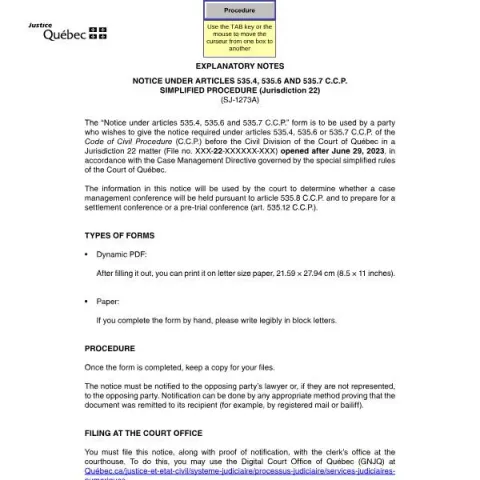
Understanding the Official Court Form SJ-1273A for Simplified Civil Procedures in Québec
The Notice under Articles 535.4, 535.6, and 535.7 of the Civil Procedure Code (C.C.P.), identified by the form number SJ-1273A, is a crucial document used within the Civil Division of the Court of Québec, specifically under the jurisdiction of Jurisdiction 22. This form is part of the simplified procedure introduced to streamline case management and facilitate dispute resolution before trial.
Purpose and When to Use the SJ-1273A Form
This form serves as a formal notice submitted by a party involved in a civil dispute that has been initiated after June 29, 2023. Its primary purpose is to inform the court of the party’s position regarding dispute resolution processes, settlement negotiations, or procedural requests related to the case. It is especially relevant in cases subject to the special simplified rules governed by the Case Management Directive of the Court of Québec.
Parties involved in a civil dispute—whether plaintiffs, defendants, intervenors, or warranty claimants—must complete and file this notice to comply with articles 535.4, 535.6, and 535.7 of the C.C.P. when their case falls under Jurisdiction 22.
Key Information Requested in the Form
The form gathers essential details to help the court manage the case effectively and prepare for upcoming procedural steps, such as settlement or pre-trial conferences. The main sections include:
- Identification of the Parties: Names and roles of the involved parties, such as plaintiff, defendant, or intervenor.
- Dispute Details: Description of the nature of the dispute and the value in dispute.
- Dispute Prevention and Resolution Processes: Whether the parties have agreed on a pre-court protocol, participated in settlement conferences, or resorted to private dispute resolution methods.
- Settlement Conference Preferences: Whether the parties consent to replacing a settlement conference with a pre-trial conference or wish to participate in a settlement process.
- Procedural Requests: Requests to add supplementary pages, conduct pre-trial written or oral examinations, seek expert opinions, or file affidavits.
How to Complete and Submit the Form
The form can be filled electronically using the dynamic PDF available on the official court platform or completed manually in block letters if printed. After completion:
- Keep a copy: Retain a copy for your records.
- Notify the opposing party: Send the completed form to the opposing party’s lawyer or, if unrepresented, directly to the opposing party. Proof of notification (such as registered mail or bailiff service) is required.
- File with the court: Submit the form along with proof of notification at the court clerk’s office, either physically or via the Digital Court Office of Québec (GNJQ).
Points of Attention and Best Practices
When completing the SJ-1273A form, it is important to:
Fill in your form directly online
No printing: type your details into the boxes of the official form, tick, then download the PDF ready to send.
- 1Type into the form boxes
- 2Tick in one click
- 3Save and download the PDF
- Ensure legibility: Whether filling electronically or manually, all information must be clear and legible.
- Be precise: Provide accurate details about the dispute and procedural preferences to facilitate smooth case management.
- Respect deadlines: File the form promptly after case initiation to comply with procedural rules and avoid delays.
- Use appropriate notification methods: Ensure proof of notification is obtained to demonstrate proper service to the opposing party.
Additional Resources and Support
For further information about the SJ-1273A form, filing procedures, or court locations, you can consult the official website of the Ministry of Justice of Québec or contact the relevant court registry. The Digital Court Office (GNJQ) offers online submission options to streamline the process and reduce administrative delays.
Understanding and correctly completing this form is vital for effective case management under the simplified procedures introduced in Québec’s civil justice system. Proper use ensures that disputes are addressed efficiently, with clear communication between parties and the court guiding the process toward resolution.