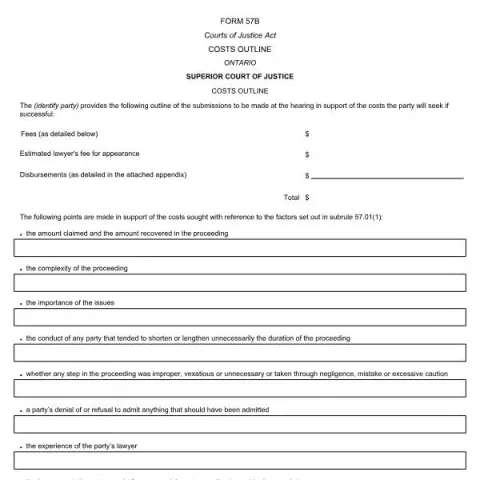
Understanding the Ontario Superior Court of Justice Costs Outline (Form RCP-57B-E)
If you're involved in a legal proceeding within the Ontario Superior Court of Justice, you may encounter the Costs Outline form, identified as RCP-57B-E. This official document plays a key role in the process of claiming costs associated with a case, whether you are seeking reimbursement for legal expenses or defending against such claims. Understanding how to properly complete and submit this form ensures your costs are accurately reflected and considered during the hearing.
What Is the Purpose of the Costs Outline?
The Costs Outline serves as a detailed statement of the expenses a party intends to claim if they are successful in their case. It provides a structured summary of fees, disbursements, and supporting points that justify the costs sought. This document is essential because it informs the court of the basis for the costs claim, facilitating a fair assessment aligned with the factors set out under subrule 57.01(1) of the Rules of Civil Procedure.
Who Should Fill Out This Form?
Typically, the party seeking costs, often represented by their lawyer, is responsible for completing the Costs Outline. The lawyer must ensure that all relevant costs are itemized, supported by appropriate documentation, and that the points in support of the costs claim are clearly articulated. If you are representing yourself, you may prepare this outline, but legal advice is recommended to ensure compliance with court requirements.
How to Complete the Costs Outline
Step 1: Fill in Basic Cost Details
- Fees: List all legal fees incurred, as detailed in your records.
- Estimated Lawyer's Fee for Appearance: Provide an estimate of the costs for your lawyer's attendance at the hearing.
- Disbursements: Include all out-of-pocket expenses such as filing fees, courier charges, or expert reports, attaching an appendix if necessary.
- Total: Sum all amounts to reflect the total costs claimed.
Step 2: Support Your Cost Claim with Subrule 57.01(1) Factors
In the section for points in support, you should address the following considerations:
- The amount claimed versus the amount recovered.
- The complexity and importance of the case.
- The conduct of the parties, especially if it affected the duration or conduct of proceedings.
- Whether any procedural steps were improper, vexatious, or unnecessary.
- Any denials or refusals to admit facts that should have been accepted.
- The experience level of your legal counsel.
- The hours spent, the rates sought, and the actual rates charged.
Step 3: Itemize Fee Items
Break down each service or item, such as pleadings, affidavits, cross-examinations, or hearings. For each, specify:
- The person providing the service (lawyer, law clerk, student) along with their year of call.
- The hours claimed for each individual.
- The partial indemnity rate being sought for each person.
- The actual rate charged to the client, if different.
Step 4: Certification and Submission
The lawyer responsible must certify that the hours claimed are accurate, the rates are correct, and all disbursements are properly incurred. The form must be signed and dated by the lawyer before submission.
Fill in your form directly online
No printing: type your details into the boxes of the official form, tick, then download the PDF ready to send.
- 1Type into the form boxes
- 2Tick in one click
- 3Save and download the PDF
Where and How to Submit the Form
The completed Costs Outline should be filed as part of your court submissions or in accordance with the court's procedural instructions. Ensure that all supporting documentation, such as invoices or receipts for disbursements, are attached or referenced appropriately. Submission can typically be done through the court's electronic filing system or in person at the courthouse, depending on local procedures.
Common Errors to Avoid
- Omitting detailed descriptions or supporting documents for disbursements.
- Failing to address the factors under subrule 57.01(1) comprehensively.
- Incorrectly calculating or misrepresenting hours or rates.
- Not certifying the form properly with the lawyer's signature.
By carefully completing the Costs Outline (Form RCP-57B-E), you help ensure that your costs claim is transparent, justified, and ready for court review. If you are unsure about any aspect of this process, consulting a legal professional familiar with Ontario civil procedure can be beneficial to avoid common pitfalls and to present a well-supported costs submission.