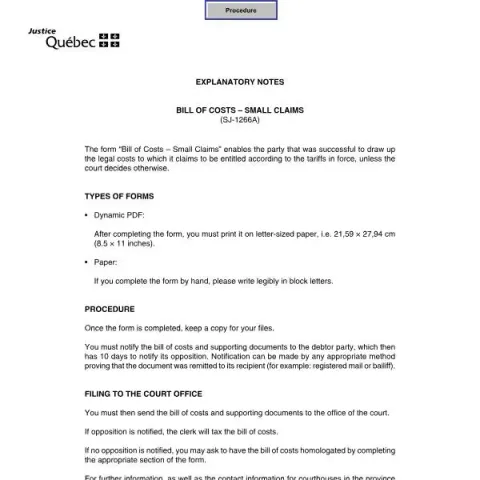
Understanding the Small Claims Court Bill of Costs Form in Québec
If you are involved in a small claims case before the Court of Québec and have been awarded a judgment, you may need to submit a Bill of Costs to recover expenses incurred during the process. The official form for this purpose is titled Bill of Costs – Small Claims (form code SJ-1266A). This article explains when and how to complete this form, what information it requires, and the procedural steps to ensure your costs are properly claimed and recognized by the court.
What Is the Purpose of the Bill of Costs Form?
The Bill of Costs serves as a detailed statement of expenses that a successful party claims to be entitled to recover from the opposing side. These costs are calculated based on tariffs applicable under Quebec law, unless the court rules otherwise. The form helps to standardize the process, ensuring transparency and fairness in recovering legal expenses such as court fees, witness indemnities, expert fees, and other related costs.
When Should You Use This Form?
You should complete and submit the Bill of Costs – Small Claims after a judgment has been rendered in your favor. It is used to formally request reimbursement for costs incurred during the lawsuit. If you believe certain expenses are justified and fall within the prescribed tariffs, this form is your official document to detail and claim those costs.
How to Complete the Form
Preparation and Format
- The form can be completed electronically as a dynamic PDF or handwritten in block letters if you prefer a paper version.
- When filling out by hand, ensure your writing is legible to avoid delays or disputes.
- Print the completed form on standard letter-sized paper (8.5 x 11 inches).
Key Information to Provide
- Case Details: District, Locality, File Number, and the names of the plaintiff and defendant.
- Parties Involved: Contact information of the party or their legal representative.
- Costs Claimed: Break down of expenses, including court costs, witness indemnities, expert fees, interpreter fees, registration costs, and other relevant expenses.
- Judgment Date: The date when the court rendered the judgment.
Supporting Documents
Attach all relevant receipts, invoices, or proof of payment supporting each claimed expense. These documents are essential for the court to verify the costs before homologation.
Notification and Filing Procedures
Once completed, you must notify the opposing party of your bill of costs. This notification can be done via registered mail, bailiff, or any method that provides proof of delivery. The opposing party then has 10 days to oppose the bill by submitting their objections in writing.
After notification, you must file the original bill of costs and supporting documents with the court office. If the opposing party does not oppose within the specified period, you can request the court clerk to homologate (approve) your bill by completing the relevant section of the form.
What Happens Next?
If There Is Opposition
The clerk will review and tax the bill of costs, ensuring the claimed expenses align with applicable tariffs. This process may involve a hearing or review if disputes arise.
Fill in your form directly online
No printing: type your details into the boxes of the official form, tick, then download the PDF ready to send.
- 1Type into the form boxes
- 2Tick in one click
- 3Save and download the PDF
If No Opposition
You can request homologation, which officially recognizes the costs as approved by the court. Once homologated, the court will issue an order for the opposing party to pay the amount claimed.
Important Points to Remember
- Keep a copy of the completed bill and all supporting documents for your records.
- Ensure the notification to the opposing party is properly documented.
- Adhere to the 10-day opposition period strictly to avoid delays.
- Consult the official website or court office for specific contact information and procedural details.
For more information, visit the official portal of the Quebec Ministry of Justice, which provides guidance on court procedures and contact details for local courthouses.