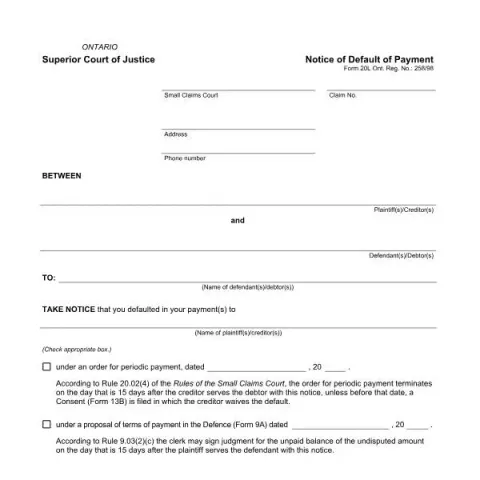
Understanding the Notice of Default of Payment (Form 20L) in Ontario's Superior Court of Justice
If you are involved in a legal proceeding at the Superior Court of Justice in Ontario, particularly in a small claims case, you may come across the Notice of Default of Payment (Form 20L). This official court form is used to inform a defendant or debtor that they have failed to comply with a court-ordered payment. Knowing how this form functions, who should fill it out, and what steps to take afterward can help you navigate this legal process effectively.
What is the purpose of the Notice of Default of Payment (Form 20L)?
The primary purpose of Form 20L is to notify a debtor that they have defaulted on a court-ordered payment. This notice is issued by the court or the creditor (plaintiff) to the defendant or debtor. It serves as an official record that the debtor has not made the required payments according to the court's order or proposal of payment.
Specifically, this form is used in two situations:
- When the debtor has defaulted under an order for periodic payments, such as ongoing installment payments ordered by the court.
- When the debtor has defaulted under a proposal of payment, which is an agreement or arrangement made as part of the defense process.
Who should fill out the Form 20L?
The form is typically completed by the plaintiff or creditor, or their legal representative. It is then served to the defendant or debtor to formally notify them of the default. The court may also prepare and issue this form in accordance with the Rules of the Small Claims Court.
It is important that the information filled out on the form is accurate, including the claim number, details of the payment order or proposal, and the date of the default. Incorrect or incomplete information can delay legal proceedings or lead to misunderstandings.
How to fill out the Notice of Default of Payment
Filling out Form 20L involves several key steps:
- Claim Number: Enter the specific claim number associated with your case.
- Parties Involved: Clearly identify the plaintiff/creditor and defendant/debtor by name.
- Details of Payment Default: Check the appropriate box indicating whether the default is under an order for periodic payments or a proposal of terms.
- Order or Proposal Date: Provide the date of the original payment order or proposal.
- Service Details: Include the date when the debtor was served with this notice.
- Signature: The form must be signed by the plaintiff, creditor, or their authorized representative.
Ensure all information is correct and legible before serving the document to the debtor.
What are the next steps after serving the Notice of Default?
Once the debtor has been served with the notice, specific legal timelines apply:
Fill in your form directly online
No printing: type your details into the boxes of the official form, tick, then download the PDF ready to send.
- 1Type into the form boxes
- 2Tick in one click
- 3Save and download the PDF
- If the default relates to an order for periodic payments, the order will terminate 15 days after the debtor is served, unless the creditor waives the default by filing a consent (Form 13B) before that period ends.
- If the default concerns a proposal of payment, the court clerk may sign judgment for the unpaid amount 15 days after service if no waiver is filed.
It is crucial for the debtor to respond within this timeframe. If the debtor contacts the creditor and arranges payment or if they obtain the creditor's written consent to waive the default, they can prevent further legal action.
Additional information and resources
For forms, self-help materials, or further guidance, you can visit the official Ontario Court Forms website at www.ontariocourtforms.on.ca. This site provides access to all necessary court forms and instructions for completing them properly. It is advisable to review the specific rules and procedures related to your case to ensure compliance and avoid delays.
Remember, if you are a debtor, it is important to respond promptly to a Notice of Default of Payment to protect your legal rights and explore possible payment arrangements or defenses.