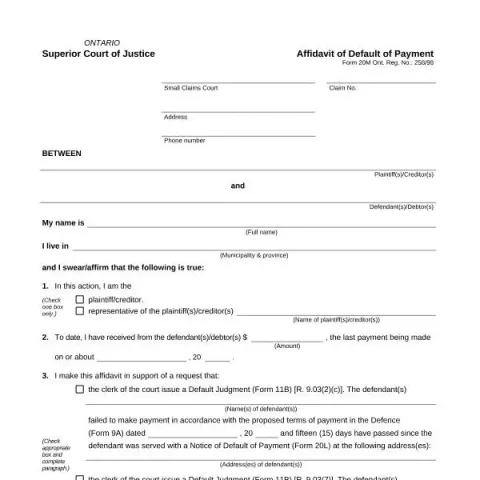
Understanding the Affidavit of Default of Payment (Form 20M) in Ontario's Superior Court of Justice
If you're involved in a small claims case in Ontario and seeking to enforce a judgment for unpaid debts, the Affidavit of Default of Payment (Form 20M) is a crucial legal document. It serves as a sworn statement that the debtor has failed to meet their payment obligations, enabling the creditor to request the court to issue a default judgment. This article guides you through the purpose, eligibility, and step-by-step process of completing this form.
Purpose and Usage of the Form 20M
The primary function of the Affidavit of Default of Payment is to provide the court with a sworn declaration that a debtor has not made scheduled payments as ordered or agreed upon. It is used in various circumstances, such as:
- When the debtor has failed to pay the amount owed after a certain period following a notice of default.
- To support a request for the court to issue a Default Judgment (Form 11B), which allows the creditor to enforce the debt without further hearings.
- To enforce payment orders or judgments related to periodic payments, including costs and interest calculations.
Eligibility Criteria for Filing the Affidavit
To complete and file the Form 20M, you must meet specific criteria:
- You are a creditor or plaintiff in a small claims action before the Ontario Superior Court of Justice.
- The debtor has failed to make payments in accordance with the court order or the terms of the defence.
- At least fifteen (15) days have passed since the debtor was served with a Notice of Default of Payment (Form 20L).
- The amount owed, including any applicable interest and costs, has been calculated and documented.
Step-by-Step Procedure for Filling Out the Form
Completing the Affidavit of Default of Payment involves several precise steps to ensure it is legally valid and effective:
1. Identifying Information
- Enter your full name and residential address.
- Specify your role as the plaintiff/creditor or their representative.
- Provide the case's claim number and court address.
2. Statement of Default
- State the total amount received from the debtor to date and the date of the last payment.
- Clearly indicate the specific payment default you are addressing, including the date of the last missed or unpaid installment.
3. Request for Court Action
- Check the appropriate box to specify whether you are requesting the court to issue a Default Judgment (Form 11B) or enforce an existing order.
- Provide details about the debtor(s), including their name(s) and address(es).
- Specify the order or payment agreement that has not been fulfilled, including dates and relevant court forms.
4. Calculation of the Unpaid Balance
- Detail the principal amount owed.
- Calculate any pre-judgment interest based on the applicable rate and period.
- Include costs incurred to date, such as service fees or court costs.
- Account for any payments received after judgment and calculate post-judgment interest if applicable.
- Sum all components to determine the total amount due.
5. Swearing or Affirming the Affidavit
The affidavit must be sworn or affirmed before a commissioner for taking affidavits, either in person or via video conference. You will need to sign the document in the presence of the commissioner, who will also sign and stamp it. If sworn remotely, ensure all procedures comply with the applicable regulations.
Important Deadlines and Legal Considerations
Once the affidavit is filed, the court may process your request for a default judgment if the debtor remains in default for at least fifteen (15) days after being served with the Notice of Default of Payment. It is essential to ensure all information is accurate and complete to avoid delays or challenges.
Note that knowingly providing false information in the affidavit is a criminal offence under the Criminal Code of Canada. Always verify your calculations and statements before swearing the document.
Fill in your form directly online
No printing: type your details into the boxes of the official form, tick, then download the PDF ready to send.
- 1Type into the form boxes
- 2Tick in one click
- 3Save and download the PDF
After Filing the Affidavit
Following the submission of the Form 20M, the court will review your application. If all criteria are met, and the debtor remains in default, the court can issue a default judgment, enabling you to pursue enforcement actions such as garnishments or liens. Keep copies of all documents and proof of service for your records.
For more detailed instructions or access to official forms, visit the Ontario Court Forms website or consult with a legal professional familiar with small claims procedures.