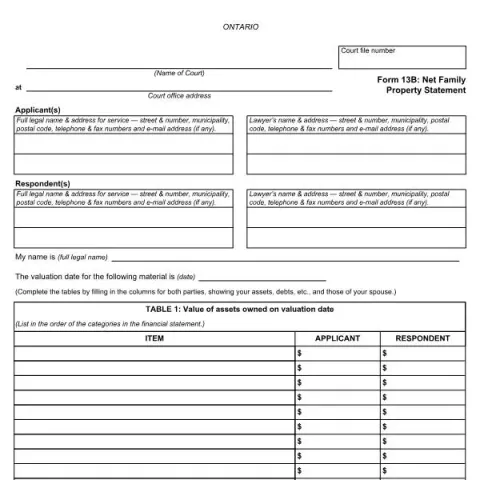
Understanding the Purpose of Form 13B: Net Family Property Statement
The Form 13B: Net Family Property (NFP) Statement is a crucial legal document used in Ontario family law proceedings, particularly during divorce or separation cases. Its primary purpose is to provide a comprehensive overview of each spouse’s assets, debts, and net worth as of a specific valuation date. This information is essential for determining the division of property under the Family Law Act.
When spouses decide to divorce or separate, they often need to settle how their property will be divided. The NFP statement helps the court assess the financial situation of each party, ensuring an equitable distribution based on the assets accumulated during the marriage. It also facilitates transparency and fairness by requiring both parties to disclose their financial details accurately.
Who Must Complete the Form and When?
The Form 13B must be completed by each spouse involved in the family law proceedings. Both parties are responsible for providing truthful and complete information about their financial circumstances, including assets, debts, and other property considerations. This form is typically filed early in the divorce process, often alongside other financial disclosure documents, and must be updated if there are significant changes before the final division.
The form is generally completed on the valuation date specified in the case, which is usually the date of separation or another date determined by the court. Accurate completion ensures the court has a clear picture of the financial landscape at the relevant time.
How to Fill Out the Form: Step-by-Step Guide
1. Fill in Court and Party Details
Start by entering the court file number, the name of the court, and the address of the court office. Then, provide your full legal name, address for service, contact details, and, if applicable, your lawyer’s information. Repeat this for the respondent (your spouse).
2. Indicate the Valuation Date
Specify the date on which the assets and debts are valued. This date is crucial because it determines the snapshot of your financial situation used for property division.
3. Complete Asset and Debt Tables
Using the provided tables, list all assets owned on the valuation date, such as real estate, bank accounts, investments, vehicles, and personal property. For each item, include its value for both you and your spouse.
- Table 1: List assets and their values.
- Table 2: List debts and liabilities, including mortgages, loans, and credit card debts.
4. Calculate Net Values
In Table 3, record the value of property owned before the marriage and any debts related to that property, excluding the matrimonial home. Subtract debts from property values to find the net value of property owned prior to marriage.
In Table 4, list any property excluded under subsection 4(2) of the Family Law Act, such as gifts or inheritances received during the marriage that are exempt from division.
Finally, compute the total assets, debts, and net family property by summing the respective totals from each table. The net family property is obtained by subtracting the total liabilities and excluded property from the total assets.
Important Tips and Common Errors to Avoid
When completing the Form 13B, accuracy is paramount. Ensure all information is complete, truthful, and supported by documentation where necessary. Common mistakes include:
Fill in your form directly online
No printing: type your details into the boxes of the official form, tick, then download the PDF ready to send.
- 1Type into the form boxes
- 2Tick in one click
- 3Save and download the PDF
- Omitting assets or debts, which can lead to an incomplete picture.
- Incorrect valuation of assets due to outdated or inaccurate appraisals.
- Failing to update the form if financial circumstances change before the court proceedings conclude.
Remember, both parties are under a legal obligation to disclose full and honest financial information. Providing false or misleading data can have serious legal consequences and may affect the court’s decision regarding property division.
Where and How to Submit the Form
The completed Form 13B should be filed with the court handling your family law case. It must be signed and dated by the filer to certify the accuracy of the information. Ensure that copies are provided to the other party as part of the disclosure process, and retain copies for your records.
In some cases, the form can be submitted electronically via the court’s digital platform, or in person at the court office. Confirm the specific procedures with your court’s registry or legal counsel.
By carefully completing and submitting the Form 13B, you contribute to a transparent and fair property division process, helping to resolve family law matters efficiently and equitably.