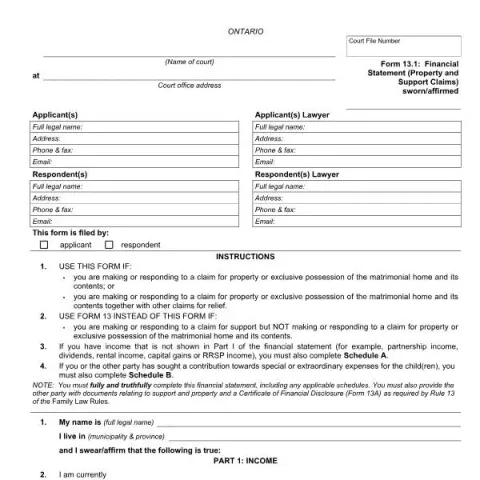
Understanding Form 13.1: Financial Statement for Property and Support Claims in Ontario Courts
If you are involved in a family law dispute in Ontario that concerns property division or exclusive possession of the matrimonial home, you may be required to complete Form 13.1: Financial Statement (Property and Support Claims). This official court form is crucial for providing a comprehensive picture of your financial situation, which the court will consider when making decisions about property division, support, or other related issues.
Who Needs to Fill Out Form 13.1?
This form must be completed by either the applicant (the person initiating the claim) or the respondent (the person responding to the claim) when:
- You are making or responding to a claim for property or exclusive possession of the matrimonial home and its contents.
- You are making or responding to such a claim along with other relief claims.
It is important to note that if your case involves only support claims without property or exclusive possession issues, you should instead complete Form 13.
How to Complete Form 13.1: Step-by-Step Guide
1. Basic Information
Begin by providing your full legal name, current address, and contact details. Indicate whether you are filling out the form as an applicant or respondent. You will also need to specify the court file number, the court location, and the court office address.
2. Disclosing Income
Part 1 focuses on your income. You must declare your current employment status, employer details, or if self-employed, your business information. Attach proof of income such as pay stubs, tax returns, or notices of assessment from the Canada Revenue Agency (CRA) for the past three years.
If you have additional income sources like rental income, dividends, or capital gains, you must complete Schedule A and attach supporting documents.
3. Listing Expenses
Part 2 requires a detailed account of your monthly expenses, including housing costs (rent or mortgage), utilities, transportation, health care, and personal expenses. This information helps the court understand your financial needs and obligations.
Supporting Documentation and Attachments
Completing Form 13.1 fully and accurately is essential. You must attach:
Fill in your form directly online
No printing: type your details into the boxes of the official form, tick, then download the PDF ready to send.
- 1Type into the form boxes
- 2Tick in one click
- 3Save and download the PDF
- Proof of income for the past three years (tax returns, notices of assessment, CRA income statements).
- Current pay stubs or income statements.
- Documents supporting your expenses, such as lease agreements, bills, or receipts.
Additionally, a Certificate of Financial Disclosure (Form 13A) must be provided to the other party, confirming that all relevant financial information has been exchanged.
Where and How to File Form 13.1
The completed form, along with all supporting documents, must be filed with the court handling your case. This can typically be done in person at the court office or via the court's electronic filing system if available. Ensure you keep copies for your records and serve a copy to the other party as required by the Family Law Rules.
Common Errors to Avoid
- Failing to attach all required proof of income and expenses.
- Providing incomplete or inaccurate information, which can delay proceedings.
- Not completing all applicable schedules, such as Schedule A for additional income or Schedule B for special expenses.
- Neglecting to serve the other party with the financial disclosure documents.
Conclusion
Completing Form 13.1 thoroughly and truthfully is vital for a fair resolution of property and support issues in family law proceedings. Accurate financial disclosure ensures that the court has a clear understanding of your financial situation, facilitating an equitable division of assets and support arrangements. If you have questions or need assistance, consider consulting a family law professional or legal aid services.