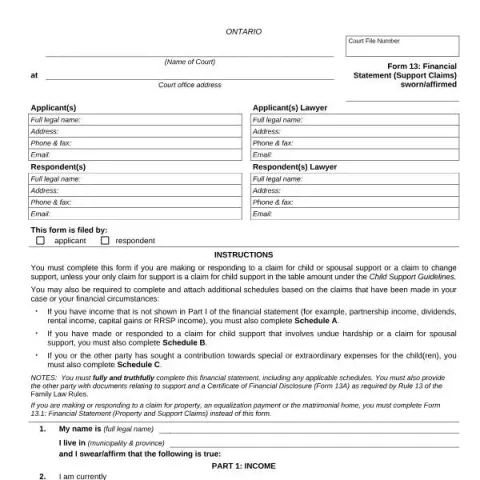
Understanding the Purpose of Form 13: Financial Statement (Support Claims)
Form 13 is an official document used within Ontario courts to provide a detailed declaration of financial circumstances related to child or spousal support claims. If you are involved in a family law case where support payments are being claimed or contested, completing this form accurately is essential. It helps the court assess your financial situation to determine appropriate support arrangements.
When Should You Complete Form 13?
You are required to fill out Form 13 if:
- You are making a claim for child or spousal support.
- You are responding to such a claim.
- You seek to change existing support arrangements.
Note that if your only support claim involves child support calculated under the Child Support Guidelines, you might not need to complete this form. However, for claims involving support modifications, undue hardship, or special expenses, additional schedules are often necessary.
What Information Does the Form Request?
Part 1: Income Details
This section captures your current income from all sources, including employment, self-employment, government benefits, and other income streams. You will need to:
- Indicate your employment status and provide employer details if applicable.
- Attach proof of income such as pay stubs, tax returns, or notices of assessment.
- List income from other sources, including dividends, rental income, or capital gains, especially if not reflected in Part 1.
Additional schedules (Schedule A) may be required if you have income not shown in Part 1.
Part 2: Expenses
This section requires you to disclose your monthly expenses, including housing, utilities, transportation, and health costs. Providing accurate expense details helps the court understand your financial obligations and capacity to pay support.
Expenses are categorized as follows:
- Housing costs such as rent or mortgage payments, property taxes, and insurance.
- Utilities like water, heat, and electricity.
- Transportation costs including public transit, vehicle expenses, and car loans.
- Health-related expenses such as insurance premiums.
Supporting Documentation and Additional Schedules
Completing Form 13 requires attaching relevant proof of income and expenses, which may include:
Fill in your form directly online
No printing: type your details into the boxes of the official form, tick, then download the PDF ready to send.
- 1Type into the form boxes
- 2Tick in one click
- 3Save and download the PDF
- Tax returns and notices of assessment for the past three years.
- Income statements, pay stubs, or benefit notices.
- Additional schedules if you have income sources or expenses not fully captured in the main form:
- Schedule A for other income sources.
- Schedule B if there are claims involving undue hardship or spousal support.
- Schedule C for claims related to extraordinary expenses for children.
All information provided must be truthful and complete, as it forms the basis for the court's decision regarding support payments.
How to Submit Form 13
The completed form must be filed with the Ontario court handling your case. It is also necessary to serve the other party with the form and supporting documents, along with a Certificate of Financial Disclosure (Form 13A). This process ensures transparency and fairness in family support proceedings.
Points of Attention and Tips
- Be meticulous when listing income and expenses; inaccuracies can affect the court's support determination.
- Attach all relevant proof documents to substantiate your claims.
- If your financial situation involves complex income sources, consider completing Schedule A for full disclosure.
- Ensure all information is current and reflects your financial status as of the date of filing.
Remember, the goal of Form 13 is to provide a clear picture of your financial circumstances to facilitate a fair support arrangement. Accurate and complete submissions help avoid delays or disputes in your family law case.