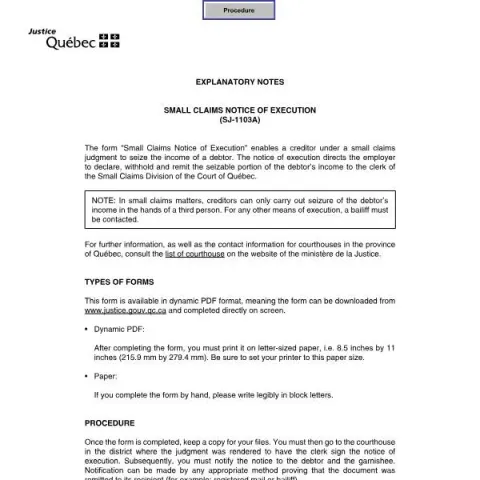
Understanding the Small Claims Notice of Execution (SJ-1103A) in Québec
If you are involved in a small claims case in Québec and have a judgment against a debtor, you might need to enforce this judgment through a process called a "Notice of Execution." Specifically, the Small Claims Notice of Execution (form SJ-1103A) allows a creditor to seize the income of the debtor by instructing the debtor’s employer to withhold a portion of wages. This article explains when and how to use this form, what information it requires, and key points to consider to ensure proper legal procedure.
When to Use the Small Claims Notice of Execution
This form is used primarily when a judgment has been issued against a debtor in small claims court, and the creditor wishes to enforce it by garnishing the debtor’s income. It is applicable only when the income is in the hands of a third person, typically the debtor’s employer. Other methods of enforcement, such as seizing property or bank accounts, require contacting a bailiff and are not covered by this form.
Before proceeding, ensure that the judgment is final and that the debtor has not satisfied the debt voluntarily. The notice of execution is a legal step to compel payment through income garnishment, which can be an effective way to recover owed amounts.
Key Information Required in the Form
The form SJ-1103A is a detailed document that must be completed carefully to avoid delays or rejection. It captures essential details about the case, the parties involved, and the judgment. Here are the main sections:
- File Identification: Record numbers, district, and whether the notice is an initial or amended version.
- Parties’ Details: Names and addresses of the seizor (creditor), debtor, and garnishee (employer).
- Judgment Details: Judgment number, date, amount owed, interest, legal costs, and any additional costs incurred for enforcement.
- Amount to be Seized: The total sum owed after deductions and payments.
- Income Garnishment: Information about the employer and the court where the judgment was issued.
It is important to fill out the form legibly, either digitally or by hand, and to double-check all entries for accuracy. Errors or incomplete information can delay the enforcement process.
Procedure for Using the Notice of Execution
Filling Out and Submitting the Form
Once completed, you must print the form on letter-sized paper (8.5 x 11 inches). If filling it out digitally, ensure all fields are correctly completed before printing. Afterward, visit the courthouse in the district where the judgment was made to have a court clerk sign the notice of execution.
Notification to the Debtor and Garnishee
After obtaining the clerk’s signature, the next step is to notify the debtor and the employer (garnishee). This notification must be sent through a method that proves delivery, such as registered mail or by a bailiff. Proper notification is crucial to comply with legal requirements and to avoid disputes over the enforcement process.
Fill in your form directly online
No printing: type your details into the boxes of the official form, tick, then download the PDF ready to send.
- 1Type into the form boxes
- 2Tick in one click
- 3Save and download the PDF
Paying Court Costs
Filing the notice of execution incurs court costs, which vary depending on the district and the specifics of the case. It is advisable to consult the courthouse clerk or the ministère de la Justice’s website for current fee information.
Points of Attention and Practical Tips
- Accuracy is key: Double-check all details, especially names, addresses, and amounts.
- Legal compliance: Remember that this process only applies to income in the hands of a third party. For other enforcement methods, contact a bailiff.
- Timeliness: File and serve the notice promptly after judgment to avoid delays in enforcement.
- Keep copies: Always keep a copy of the completed form and proof of notification for your records.
By following these steps carefully, you can effectively enforce a small claims judgment through income garnishment, ensuring the debtor’s obligations are met in accordance with Québec law.