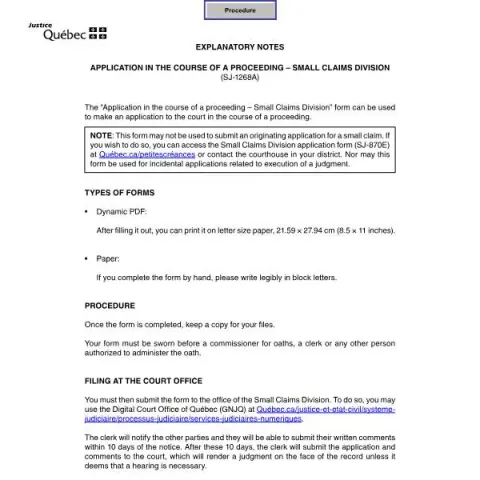
Understanding the Application in the Course of a Proceeding – Small Claims Division (Form SJ-1268A)
The Application in the Course of a Proceeding – Small Claims Division form, identified as SJ-1268A, is an official document issued by the Court of Québec’s Civil Division Small Claims Division. It serves as a tool for parties involved in an ongoing small claims proceeding to formally request specific actions or access to court-related documents during the course of their case. This article aims to clarify when and how this form should be used, what information it requires, and the key points to consider when submitting such an application.
When to Use the SJ-1268A Form
This form is not intended for initiating a new small claim. Instead, it is used during an active proceeding to make informal requests to the court. Examples of appropriate uses include asking for access to certain court records, requesting clarification on procedural issues, or seeking specific court orders related to the ongoing case.
It is important to note that the SJ-1268A cannot be used for incidental applications related to the enforcement or execution of a judgment, nor for submitting an initial claim for damages or other substantive matters. For initiating a new small claim, parties must use the Small Claims Division application form (SJ-8 70E), available online or at courthouse offices.
How to Complete the Form
1. Basic Information
The top section requires details about the court district and locality, along with the file number associated with the proceeding. Accurate identification ensures the application is correctly linked to the ongoing case.
2. Identification of Parties
Provide the full names and addresses of all parties involved, as recorded in the existing court record. This typically includes the plaintiff and defendant, or their representatives if applicable.
3. Nature of the Application
Clearly specify the purpose of your request in the section titled “Specify the nature of your application.” For example, you might request access to a document or ask for clarification on a procedural point.
4. Content and Grounds
Describe the object of your application—what you are requesting—and the grounds justifying it. This could include relevant facts, legal arguments, or procedural reasons supporting your request.
5. Conclusions
State precisely what you are asking the court to do. Typical conclusions might include granting access to a document, issuing an order, or declaring a certain fact. Be specific about the outcome you seek.
6. Sworn Statement
The applicant must sign a sworn declaration affirming the truth of the facts presented. This statement must be signed in front of an authorized person, such as a court clerk or commissioner for oaths, and includes the applicant’s full name and address.
Fill in your form directly online
No printing: type your details into the boxes of the official form, tick, then download the PDF ready to send.
- 1Type into the form boxes
- 2Tick in one click
- 3Save and download the PDF
Filing and Procedure
Once completed and sworn, the form should be kept for your records. You can submit it to the Small Claims Division office either in person or electronically via the Digital Court Office of Québec. After submission, the court clerk will notify the other parties, who then have 10 days to submit written comments or responses.
Following this period, the court will review the application and comments to decide whether a hearing is necessary or if a decision can be made based on the record. The court’s decision will be rendered in writing, based on the submitted documentation.
Points of Attention and Tips
- Ensure all sections of the form are completed accurately and legibly, especially if filling out by hand.
- Always swear the declaration before an authorized person to validate the application.
- Keep copies of all submitted documents for your records.
- Use the official online platforms or visit your courthouse for assistance or further information.
For more details on the process, visit the official website of the Québec justice system or contact your local courthouse. Properly using this form can facilitate smoother proceedings and ensure your requests are formally recognized by the court.