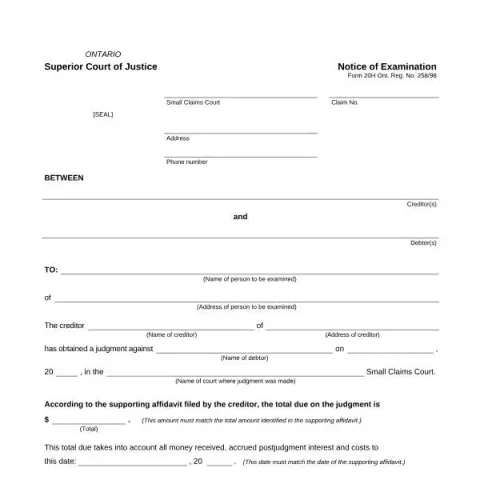
Understanding the Ontario Superior Court of Justice Notice of Examination (Form 20H)
If you have recently received a Notice of Examination from the Ontario Superior Court of Justice, it is essential to understand its purpose, the steps involved, and how to prepare effectively. This official form is a critical part of the enforcement process following a judgment in small claims court, designed to gather information about the debtor’s financial situation and facilitate the collection of owed amounts.
Purpose of the Notice of Examination
The primary goal of the Notice of Examination (Form 20H) is to compel the debtor to attend a court hearing where they will be asked to provide detailed information regarding their income, assets, debts, and expenses. This process helps the creditor understand the debtor’s financial capacity and explore options for enforcing the judgment if the debtor has not paid voluntarily. The examination is a vital step in the enforcement chain, enabling creditors to identify assets that can be seized or garnished to recover the owed amount.
Preparing for the Examination
1. Review Your Court Documents
Before attending the hearing, ensure you have all relevant documentation, including:
- The original judgment document.
- The Notice of Examination (Form 20H) with the scheduled date, time, and location.
- The Affidavit for Enforcement Request (Form 20P), detailing the debt.
- Proof of service, such as the Affidavit of Service (Form 8A) or a Certificate of Service from your lawyer or paralegal.
2. Complete the Financial Information Form
If you are the debtor, you are required to complete the Financial Information Form (Form 20I) and serve it on the creditor at least 7 days before the hearing. Remember, this form is not filed with the court but must be made available to the judge during the examination. Collect supporting documents, such as pay stubs, bank statements, or proof of assets, to substantiate your answers.
3. Serve the Notice Properly
The Notice of Examination must be served on the debtor at least 30 days prior to the scheduled hearing. Proper service includes delivering the notice personally or through registered mail, following the rules outlined in the Small Claims Court’s Guide to Procedure. If the debtor is an individual, the notice must be accompanied by a blank Financial Information Form (Form 20I).
Filing and Serving the Documents
Once the hearing date is set, the creditor must:
- File the Notice of Examination at the court office at least 3 days before the scheduled date.
- File proof of service, such as an Affidavit of Service or a Certificate of Service, to confirm that the notice was properly delivered.
These steps ensure the court has all necessary documentation to proceed with the examination and enforce the judgment effectively.
Attending the Examination
On the day of the hearing, both parties should attend at the scheduled time and location, which may be in person or via videoconference. During the examination, the debtor will be asked questions about their financial situation, including:
- Employment status and income sources
- Bank accounts, property, and assets
- Outstanding debts and expenses
- Reasons for non-payment, if applicable
The court may issue an order requiring the debtor to make payments on specific dates or take other enforcement actions, such as garnishment or seizure of property, if necessary.
Fill in your form directly online
No printing: type your details into the boxes of the official form, tick, then download the PDF ready to send.
- 1Type into the form boxes
- 2Tick in one click
- 3Save and download the PDF
Legal and Accessibility Considerations
Failure to attend or answer questions during the examination can lead to contempt of court charges, which may include jail time. Debtors are also required to produce supporting documentation at the hearing to verify their financial disclosures.
For individuals with disability-related needs, the court provides accessible services. Contact the court at the provided telephone numbers to arrange accommodations.
Additional Resources
For more information about the process, including how to file documents online or enforce judgments, visit the official Ontario court forms website or consult the Guide to Procedure in the Small Claims Court – After Judgment. These resources offer detailed instructions to help you navigate the enforcement process efficiently.