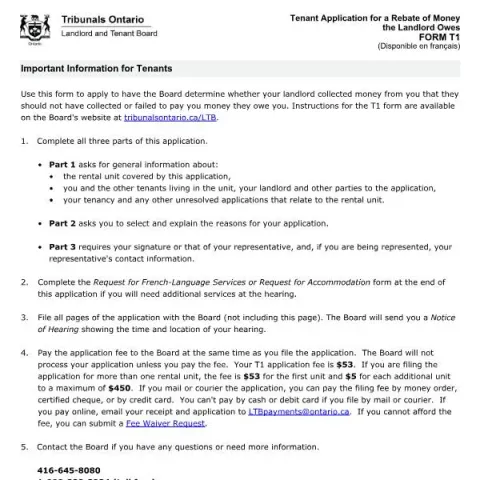
Understanding the Ontario Landlord and Tenant Board FORM T1: Tenant Application for a Rebate of Money the Landlord Owes
If you are a tenant in Ontario and suspect that your landlord has collected money unlawfully or failed to pay you money owed, the Landlord and Tenant Board (LTB) provides a formal process to address these issues. The official FORM T1 is a crucial document designed for tenants to request a rebate of funds they believe are owed to them by their landlord. This article explains the purpose of the form, who should use it, and how to complete it effectively.
What is the purpose of the FORM T1?
The Tenant Application for a Rebate of Money the Landlord Owes is intended for tenants who want the LTB to determine whether their landlord has improperly charged or retained money. Examples include overpayment of rent, illegal charges, or amounts the landlord has failed to return. The form is a formal request for the Board to assess whether the landlord owes the tenant money and to order the repayment if applicable.
Who should use this form?
This form is suitable for tenants who:
- Have paid rent or other charges that they believe were illegal or excessive;
- Have paid fees or charges to their landlord, property manager, or superintendent that they believe are unlawful;
- Want the Board to review and decide if they are owed money based on their payments and charges.
It is essential to have evidence supporting your claim, such as rent receipts, bank statements, or any correspondence with your landlord regarding charges.
How to complete the FORM T1: Step-by-step guide
Part 1: General Information
This section gathers basic details about your rental unit, tenants, and landlord:
- Rental Address: Provide the full address of the rental unit, including street number, name, type, municipality, and postal code.
- Tenant Details: Fill in your name, mailing address (if different), phone numbers, and email address.
- Landlord Information: Enter your landlord's name, address, and contact details. If there are multiple landlords, a Schedule of Parties form must be filed.
- Related Applications: List any other unresolved applications related to this rental unit.
Part 2: Reasons for Filing
This is the core of your application, where you specify why you believe the landlord owes you money. You can select multiple reasons, such as:
- Overcharged Rent: If your landlord charged you more than the legal rent, and you have paid the excess.
- Illegal Charges: Payments made for fees or costs that are not permitted under Ontario's Residential Tenancies Act.
For each reason, you must provide details including the amount owed, the rent history (dates and amounts), and any payments made. Be precise and include supporting documents where possible.
Part 3: Signature and Representation
Sign the application yourself or through a legal representative. If someone is acting on your behalf, include their contact information and authorization. This step confirms that the information provided is accurate and complete.
Filing the Application and Fees
Once completed, all pages of the form must be submitted to the Landlord and Tenant Board. The Board will then send a Notice of Hearing, informing you of the date, time, and location of your case. The current fee for filing is $53, payable at the time of submission. If you are filing for multiple rental units, additional fees apply, up to a maximum of $450.
Fill in your form directly online
No printing: type your details into the boxes of the official form, tick, then download the PDF ready to send.
- 1Type into the form boxes
- 2Tick in one click
- 3Save and download the PDF
Payments can be made via credit card, money order, or certified cheque if mailing or couriering the application. Online payments are also accepted, with receipts emailed to the Board. If the fee presents a barrier, you may request a fee waiver.
Additional Considerations
Before submitting, review all information carefully to ensure accuracy. Incomplete or incorrect applications may delay processing. For questions or assistance, contact the Board directly via phone or visit their website.
By properly completing and submitting FORM T1, tenants in Ontario have a clear legal pathway to recover money owed by their landlord. This process helps uphold tenants’ rights and ensures fair treatment in rental agreements.