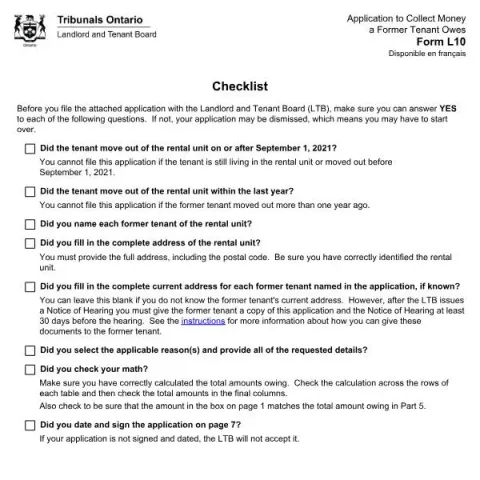
Understanding the Landlord and Tenant Board Form L10: Application to Collect Money a Former Tenant Owes
If you're a landlord in Ontario seeking to recover money owed by a former tenant, the Application to Collect Money a Former Tenant Owes (Form L10) is your official tool. This form helps you request an order from the Landlord and Tenant Board (LTB) to recover unpaid rent, damages, or other charges after the tenant has moved out. Properly preparing and submitting this form ensures your claim is considered efficiently and within legal guidelines.
Purpose and Scope of the Form
The primary goal of Form L10 is to facilitate the collection of amounts owed by a former tenant. This includes unpaid rent, charges related to NSF cheques, utility bills, damages to the rental unit, or costs incurred due to interference with your lawful rights or enjoyment of the property. It is crucial to note that this application can only be filed if the tenant moved out within the last year and after September 1, 2021.
Preparing Your Application: Key Considerations
Eligibility and Timing
- The tenant must have moved out on or after September 1, 2021.
- The move-out date must be within the past year.
- You must have completed the application within one year of the tenant’s departure.
Gathering Necessary Information
- Full address of the rental unit, including postal code.
- Complete details of each former tenant, including current address if known.
- Accurate calculations of the total amount owed, supported by clear documentation.
- Details of the reasons for your claim, whether rent arrears, damages, or other charges.
Completing the Form
Ensure each section is filled out accurately and completely. The form is divided into several parts:
- Part 1: Rental unit address and details of the former tenant(s).
- Part 2: Total amount you believe is owed.
- Part 3: Your contact information and details about the former tenant’s move-out date and current address.
- Part 4: Reasons for the claim and explanation of how the amount was calculated.
- Part 5: Detailed calculation of the total amount owed.
- Part 6: Your signature and date, or that of your authorized representative.
Filing and Serving the Application
Submission Process
The completed application must be filed with the LTB within 365 days of the tenant’s move-out date. You can submit the form in person, by mail, or through the online platform if available. The application fee at the time of filing is specified by the LTB, and payment methods include money order, certified cheque, or credit card.
Serving the Former Tenant
You are responsible for providing each named former tenant with a copy of the application and the Notice of Hearing at least 30 days before the scheduled hearing date. This can be done via mail, personal service, or other approved methods. After service, you must file a Certificate of Service with the LTB at least 20 days before the hearing, confirming how and when the documents were served.
Follow-up and Hearing Process
Once your application is filed and served, the LTB will issue a Notice of Hearing with details about the date, time, and location. If there are any issues or delays, the LTB contact information is available for assistance. During the hearing, both parties can present their case, and the Board will decide whether to issue an order for the amount owed.
Fill in your form directly online
No printing: type your details into the boxes of the official form, tick, then download the PDF ready to send.
- 1Type into the form boxes
- 2Tick in one click
- 3Save and download the PDF
Important Tips for a Successful Application
- Double-check all calculations and ensure the total amount matches across the form.
- Include all relevant charges and supporting documentation.
- Sign and date the application to avoid rejection.
- Start the process early to meet the one-year deadline from the tenant’s departure.
Using Form L10 correctly helps streamline your claim and increases the likelihood of recovering the money owed. For detailed instructions, visit the official Landlord and Tenant Board website or contact their support services for guidance.