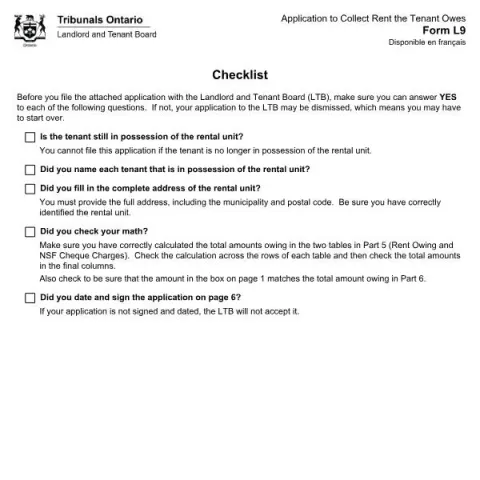
Understanding the Application to Collect Rent Owed (Form L9) in Ontario
If you are a landlord in Ontario and have a tenant who owes rent, the Application to Collect Rent the Tenant Owes (Form L9) is an essential legal document designed to help you recover unpaid rent through the Landlord and Tenant Board (LTB). This form is used specifically when you want to seek an order for the collection of rent owed, without necessarily initiating eviction proceedings. Understanding how to properly complete and submit this form can streamline your efforts to recover outstanding payments.
When to Use Form L9
This form is applicable in situations where the tenant is still residing in the rental unit but has unpaid rent. It is important to note that if your goal is to also terminate the tenancy and evict the tenant due to non-payment, you should instead use Form L1. The L9 focuses solely on the recovery of rent owed, making it a targeted approach for landlords seeking unpaid rent without immediate eviction.
Key Sections and Information Required
Part 1: Address of the Rental Unit
Begin by accurately filling out the full address of the rental property, including the street number, street name, unit or suite number, municipality, province, and postal code. Precise identification of the rental unit is crucial to ensure the application is correctly processed.
Part 2: Total Amount Owed
In this section, you must specify the total amount of rent you believe the tenant owes as of a specific date. This total should include any unpaid rent, NSF cheque charges, and any applicable fees. Be sure to double-check your calculations for accuracy to prevent delays or dismissal of your application.
Part 3: Landlord and Tenant Information
Provide your full name and contact details, along with the names of all tenants currently in possession of the rental unit. Accurate and complete information helps facilitate communication and proper processing of your claim.
Part 4: Reasons for the Application
Select the reasons for your application, such as unpaid rent or NSF cheque charges. You will also need to provide details about the rent payments and any related charges, ensuring your claim is well-supported.
Part 5: Calculation of the Owed Amount
This part requires you to clearly outline how you arrived at the total amount owed, including detailed calculations for each component. This transparency helps the LTB verify the claim and reduces the chance of rejection.
Part 6: Final Total
Reiterate the total amount owed, ensuring it matches the sum of the calculations provided in Part 5. Consistency across sections is essential for a valid application.
Fill in your form directly online
No printing: type your details into the boxes of the official form, tick, then download the PDF ready to send.
- 1Type into the form boxes
- 2Tick in one click
- 3Save and download the PDF
Part 7: Signature and Submission
Finally, sign and date the application on the designated page. If you are representing yourself or have a legal representative, their contact information should also be included. Unsigned or undated applications will not be accepted by the LTB.
Filing and Payment Process
Once completed, you must submit all pages of the application to the LTB. The application fee as of 2026 is $201, payable at the time of filing. Payments can be made via money order, certified cheque, or credit card if submitting in person or online. If mailing or couriering the application, ensure payment is included accordingly. The LTB will then schedule a hearing and send you a Notice of Hearing with details about the date, time, and location.
Points of Attention and Tips
- Ensure all information is accurate and complete to prevent delays or dismissal.
- Double-check your calculations in Part 5 to verify the total amount owed.
- Sign and date the application; unsigned forms will not be processed.
- Keep copies of all documents and receipts related to payments made or charges claimed.
- If you cannot afford the application fee, inquire about the possibility of a fee waiver with the LTB.
For additional guidance or questions about completing Form L9, contact the Landlord and Tenant Board directly through their helpline or visit their website for detailed instructions and resources.