Understanding the Request for Discontinuance Order Form
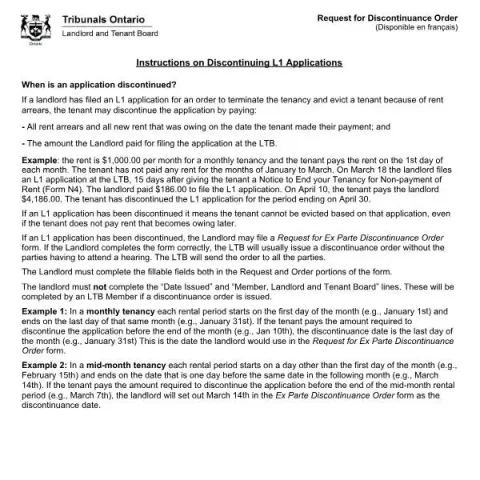
The Request for Discontinuance Order is an official document used within the framework of residential tenancy disputes managed by the Landlord and Tenant Board (LTB) in Canada. This form allows a landlord to formally withdraw an eviction application (L1 application) when the tenant has paid all owed rent and associated fees, thereby ending the legal proceedings related to rent arrears.
Purpose and Scope of the Form
This form is designed for landlords who have initiated an eviction process due to rent arrears but then receive full payment from the tenant. Once completed and submitted, the form facilitates the discontinuance of the eviction application without the need for a hearing, streamlining the resolution process and preventing unnecessary legal proceedings.
When to Use the Request for Discontinuance Order
The form should be used when:
- The landlord has filed an L1 application to terminate a tenancy and evict a tenant for unpaid rent.
- The tenant has paid all rent owed, including any new rent due for the relevant period.
- The tenant has also reimbursed the landlord for the filing fee associated with the eviction application.
By completing this form, the landlord formally requests the LTB to issue a discontinuance order, effectively halting the eviction process.
Key Conditions for Discontinuance
To successfully request a discontinuance order:
- The tenant must have paid all rent arrears and any new rent owing up to a specific date.
- The tenant must have reimbursed the landlord for the filing fee paid to initiate the eviction application.
- The landlord must submit the form before any hearing takes place, as the order is usually issued without a hearing if the form is correctly completed.
Step-by-Step Procedure for Filling Out the Form
1. Complete the Landlord Information
- Indicate whether you are the landlord or a legal representative.
- Provide your full name and the original L1 application number.
2. Detail the Payment
- Specify the date when the tenant paid all rent arrears and the new rent owing, including the date of payment.
- Confirm that the tenant paid the landlord for the filing fee.
3. Declare the Payment and Request
- Sign the declaration affirming the accuracy of the information provided.
- Request the LTB to issue a discontinuance order based on the payment details.
4. Submit the Form
- The form must be signed and dated by the landlord or their legal representative.
- Do not fill out the "Date Issued" or "Member, Landlord and Tenant Board" fields; these are reserved for LTB officials.
Important Examples and Clarifications
For a monthly tenancy starting on the first day of each month, if the tenant pays the full amount owed before the end of the month, the discontinuance date will be the last day of that month. For example, if payment occurs on March 18, the discontinuance date is March 31.
In a mid-month tenancy, where the rental period does not align with calendar months, the discontinuance date corresponds to the end of the rental period. For instance, if the rent period ends on March 14, and payment is made on March 7, the discontinuance date is March 14.
Fill in your form directly online
No printing: type your details into the boxes of the official form, tick, then download the PDF ready to send.
- 1Type into the form boxes
- 2Tick in one click
- 3Save and download the PDF
Post-Submission Process
After submitting the completed form, the LTB reviews the information. If everything is in order, a discontinuance order is issued, which officially ends the eviction process. This order is sent to all parties involved and signifies that the landlord cannot proceed with eviction based on the original application.
Additional Information
If you have questions about completing the form or the process, you can contact the Landlord and Tenant Board at 416-645-8080 or toll-free at 1-888-332-3234. It is crucial to ensure all details are accurate to avoid delays or issues with the discontinuance process.