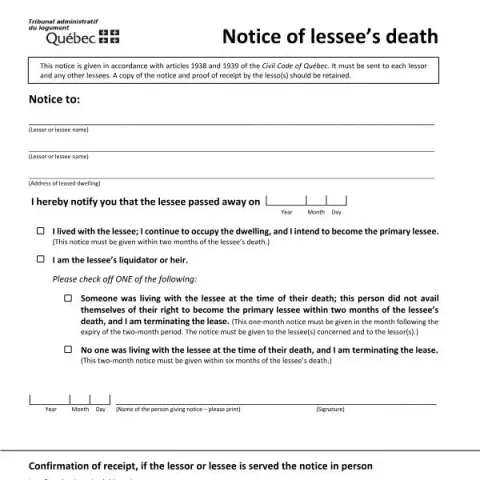
Understanding the Notice of Lessee’s Death Form (TAL-804A-E) in Quebec Housing Law
If you are involved in a rental situation in Quebec and a tenant passes away, it’s essential to understand the legal procedures for notifying the landlord or lessor about the death. The official form known as the Notice of Lessee’s Death (TAL-804A-E) is designed to facilitate this process, ensuring that all parties are informed and that the lease can be managed appropriately according to the Civil Code of Quebec.
When to Use this Form
This form is to be completed and submitted to the landlord or lessor when a lessee has died. It is particularly relevant for individuals who lived with the deceased at the time of death, heirs, or liquidators responsible for settling the estate. The form helps clarify the status of the lease and the rights of those remaining in the dwelling.
According to articles 1938 and 1939 of the Civil Code of Quebec, the notice must be sent within specific timeframes depending on the circumstances:
- If someone was living with the lessee at the time of death and wishes to continue occupying the dwelling, they must notify the lessor within two months.
- If no one was living with the lessee, the liquidator or heir can terminate the lease by giving a two-month notice within six months of the death.
- If the person living with the lessee does not exercise their right to become the primary lessee, the liquidator or heir can terminate the lease with a one-month notice, following the two-month period.
Key Information Required on the Form
The form requests specific details to ensure proper identification and communication:
- Names of the lessor and lessee or their representatives
- Address of the leased dwelling
- Date of the lessee’s death
- Declaration of the relationship of the person submitting the notice to the deceased (e.g., heir, liquidator, or cohabitant)
- Choice of action: whether the occupant is continuing to live in the dwelling or whether the lease is being terminated
Filling Out and Submitting the Form
Step-by-Step Process
- Complete all sections of the form, including the date of death and your relationship to the deceased.
- Check the appropriate box indicating whether you are continuing to occupy the dwelling or terminating the lease.
- Sign and date the form to certify the accuracy of the information provided.
- Deliver the completed form to the landlord or lessor, either in person or via registered mail to ensure proof of receipt.
- Obtain and keep a copy of the notice and proof of delivery for your records.
Confirming Receipt
The form includes a section for the lessor or lessee to confirm receipt of the notice, which should be signed and dated upon delivery. This confirmation helps avoid disputes regarding whether the notice was properly communicated.
Fill in your form directly online
No printing: type your details into the boxes of the official form, tick, then download the PDF ready to send.
- 1Type into the form boxes
- 2Tick in one click
- 3Save and download the PDF
Points of Attention and Practical Tips
- Timeliness: Ensure the notice is sent within the legally prescribed timeframes—two months for those living with the deceased and six months for others wishing to terminate the lease.
- Proof of Delivery: Always send the notice via a method that provides proof of receipt, such as registered mail or personal delivery with acknowledgment of receipt.
- Retain Documentation: Keep copies of the completed form and any correspondence related to the notice for future reference or potential legal proceedings.
- Legal Guidance: If you are uncertain about your rights or obligations, consider consulting a legal professional familiar with Quebec housing law.
Conclusion
The Notice of Lessee’s Death (TAL-804A-E) is a crucial document for managing the end-of-life transition in rental agreements in Quebec. Properly completing and submitting this form ensures compliance with civil law provisions and helps protect your rights or those of the estate. Always adhere to the specified timelines and keep thorough records to facilitate a smooth transition during this sensitive time.