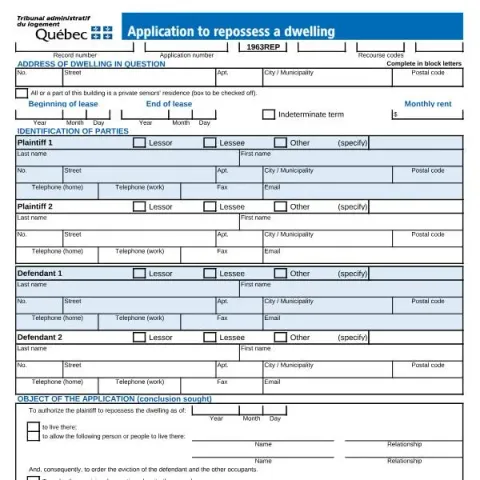
Understanding the Application to Repossess a Dwelling (Form TAL-102A-E)
If you are a landlord seeking to regain possession of a rental unit in Quebec, the Application to Repossess a Dwelling form (TAL-102A-E) is an essential document to initiate legal proceedings before the Tribunal administratif du logement (TAL). This official form guides landlords through the process of requesting eviction and clarifies the grounds for repossession. Here, you will find a detailed overview of the purpose of this form, who should complete it, how to fill it out correctly, the necessary supporting documents, and where to submit it.
What is the purpose of this form?
This form is used by landlords (lessors) to formally request the Tribunal administratif du logement to order the repossession of a dwelling. It is applicable in cases where the landlord needs to regain possession for reasons such as non-payment of rent, breach of lease terms, or other legal grounds. The form also allows the landlord to specify whether they seek to evict the tenant and any other occupants, or to permit certain individuals to continue living in the unit under specific conditions.
Who should fill out the form?
The primary applicant must be the landlord, owner, or an authorized representative acting on their behalf. The form is also relevant for tenants or other parties involved, especially if they wish to participate in conciliation or contest the application. It’s important that the applicant provides accurate and complete information to avoid delays or rejection of the application.
How to complete the application form?
1. Fill in the property details
Begin by entering the address of the dwelling in question, including street, apartment number, city or municipality, and postal code. Indicate if part of the building is a private seniors' residence by checking the appropriate box.
2. Provide party information
Input your details as the applicant, including full name, mailing address, telephone numbers, email, and if applicable, your lawyer’s contact information. Next, identify the defendant(s)—the tenant(s) or occupant(s)—by providing their full names, addresses, and contact information.
3. Specify the lease details
Include the start and end dates of the lease, the monthly rent amount, and the legal basis for your application. If applicable, specify whether the lease is for an indeterminate term or fixed period.
4. State your grounds for repossession
Clearly explain why you are requesting the court to repossess the dwelling. Common grounds include non-payment of rent, breach of lease conditions, or other legal reasons recognized by the Tribunal.
5. Describe the request
Indicate whether you seek an order for eviction, permission for specific persons to reside in the dwelling, or other relief. You can also specify if you want the Tribunal to order provisional execution of the eviction despite an appeal.
6. Attach relevant notices and evidence
You must attach copies of any notices sent to the tenant, such as the notice of intent to repossess, along with supporting documents or exhibits that substantiate your claims.
Fill in your form directly online
No printing: type your details into the boxes of the official form, tick, then download the PDF ready to send.
- 1Type into the form boxes
- 2Tick in one click
- 3Save and download the PDF
Supporting documents and exhibits
All relevant notices, lease agreements, payment records, and correspondence should be included as exhibits. These serve as evidence to support your application and facilitate the Tribunal’s review process. The application form mentions that exhibits will be sent together with the application or made available upon request, at no cost.
Where and how to submit the application?
The completed form, along with all supporting documents, must be filed with the Tribunal administratif du logement. This can be done in person at the Tribunal’s offices located at 5199 Sherbrooke East in Montreal or at 1434 boul. Daniel-Johnson in Laval. It is recommended to keep copies of all submitted documents for your records. You can also send the application via mail or through the Tribunal’s online platform if available, following their specific procedures.
Common errors to avoid
- Failing to complete all mandatory fields, which can delay processing.
- Submitting inaccurate or incomplete information about the parties or property.
- Not attaching required notices or evidence supporting your grounds for repossession.
- Neglecting to sign the application form, which is necessary for validity.
In summary, the TAL-102A-E form is a vital legal document for landlords seeking to repossess a dwelling in Quebec. Properly completing and submitting this form ensures that your application is clear, complete, and ready for review by the Tribunal. If you are unsure about any step, consulting a legal professional or the Tribunal’s resources can help ensure your application meets all legal requirements.