Understanding the Written Notice of Pleading Form in New South Wales
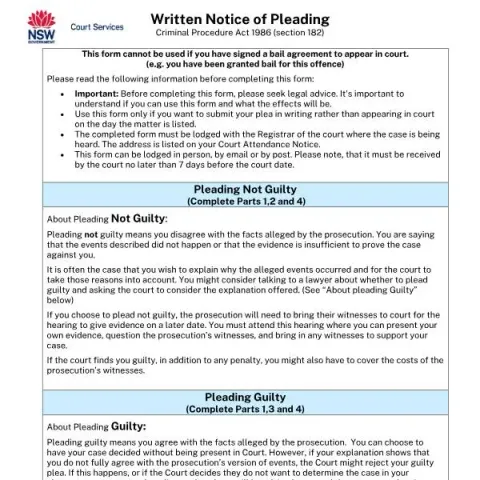
The Written Notice of Pleading is an official legal document used within the criminal justice process in New South Wales (NSW), Australia. Managed by the Local Court of NSW, this form allows defendants to formally communicate their plea—whether guilty or not guilty—without needing to appear in court on the scheduled date. This article explains the purpose, eligibility, and step-by-step process for completing this form, ensuring clarity for individuals involved in NSW criminal proceedings.
Purpose and Usage of the Form
The primary purpose of the Written Notice of Pleading is to provide defendants with an option to submit their plea in writing. This is particularly useful when the defendant prefers to avoid court appearances or when circumstances prevent attendance. The form is applicable only when the defendant has not signed a bail agreement to appear in court, such as those granted bail for the offence in question.
Before completing the form, it is strongly advised to seek legal advice. Understanding the implications of pleading guilty or not guilty is crucial, as each choice affects the legal process and potential outcomes. The form must be lodged with the court’s Registrar, as specified in the Court Attendance Notice (CAN), and can be submitted in person, by email, or by post. It must be received at least 7 days prior to the scheduled court hearing.
Eligibility and Restrictions
This form cannot be used if the defendant has entered into a bail agreement to appear in court, such as being granted bail for the offence. Additionally, the form is only suitable for defendants wishing to communicate their plea in writing rather than attending court on the scheduled date.
Step-by-Step Guide to Filling Out the Form
Part 1: Personal and Case Details
- Provide your full name and address. If you prefer to be notified by email, tick the relevant box and supply your email address.
- Include your contact phone number for court communication.
- State the offences you are charged with, the name of the court handling your case, and the scheduled court date as listed on your Court Attendance Notice.
Part 2: Pleading Not Guilty
Complete this section if you wish to plead not guilty:
- Confirm that you are the person named in the Court Attendance Notice.
- Indicate your desire to plead not guilty and request the court to schedule a hearing at a later date.
- Specify the number of witnesses you intend to call and any dates within the next 12 months when you cannot attend court.
- Provide a contact number for court communication.
- Choose whether you will be represented by a solicitor or barrister, or if you will proceed without legal representation.
Part 3: Pleading Guilty
Complete this section only if you wish to plead guilty:
- Confirm your identity as the defendant.
- Indicate your plea of guilty and whether you want the court to decide the matter in your absence.
- Provide any relevant information the court should consider when determining your sentence, such as personal circumstances or explanations related to the offence.
- State your contact number for court communication.
Signing and Submitting the Form
Once completed, the form must be signed by the defendant. The signature confirms the accuracy of the information provided and the understanding of the legal process. The form must be submitted to the court’s Registrar before the deadline—at least 7 days before the scheduled hearing.
Fill in your form directly online
No printing: type your details into the boxes of the official form, tick, then download the PDF ready to send.
- 1Type into the form boxes
- 2Tick in one click
- 3Save and download the PDF
Important Considerations
Submitting a written plea does not eliminate the defendant’s right to a court hearing, especially if the plea is not accepted or if the court requires further proceedings. It is essential to consult with a legal professional to understand the potential consequences of each plea and to ensure that the form is filled out correctly.
In summary, the Written Notice of Pleading offers a streamlined way for defendants in NSW to communicate their plea in writing, facilitating an efficient legal process while respecting the rights of the accused. Proper completion and timely submission of this form are vital steps in managing criminal proceedings within the NSW Local Court system.