Understanding the Notice of Defence in the Magistrates' Court of Victoria
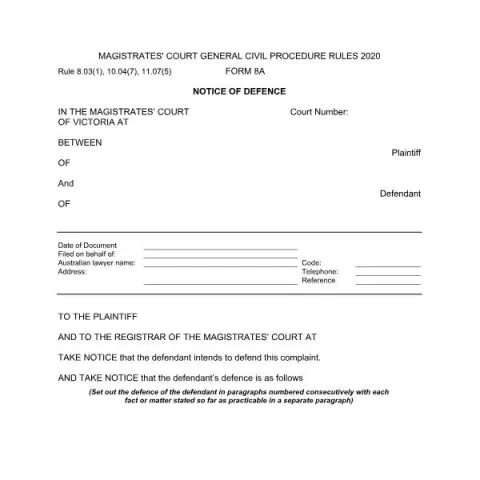
The Notice of Defence (Form 8A) is a crucial legal document used within the Magistrates' Court of Victoria, designed for defendants who wish to contest a claim brought against them. This form plays a vital role in the civil justice process, allowing defendants to formally communicate their intention to defend a case and outline their specific arguments or objections.
When to Use the Notice of Defence
This form should be completed and filed when a defendant receives a statement of claim or complaint from the plaintiff and intends to dispute the allegations or claims made. It is an essential step in the litigation process, ensuring that the defendant's position is officially recorded and considered by the court. Failure to file a Notice of Defence within the prescribed timeframe may result in a default judgment being entered against the defendant.
Key Components of the Form
Parties and Court Details
- Court and Case Number: The form requires the specific Magistrates' Court location and the case number assigned to the proceeding.
- Parties' Details: Names and addresses of both the plaintiff and the defendant must be clearly provided.
Notice of Defence and Response
The core of the form involves the defendant's formal declaration of their intention to defend the claim, followed by a detailed statement of their defence. This section must be set out in numbered paragraphs, each addressing specific facts or matters relevant to the case.
- Admitted facts: The defendant indicates which facts in the statement of claim they accept as true.
- Denied facts: The facts they contest, with reasons for denial, should be clearly explained.
- Unadmitted facts: Facts not admitted may be treated as accepted unless explicitly denied.
- Additional facts or matters: Any facts that challenge the claim's validity or raise new issues should be included with specific particulars.
Legal and Procedural Considerations
If the defence relies on specific legislation, such as an Act of Parliament, the relevant statutory provisions must be identified within the form. This ensures clarity and proper legal grounding for the defence.
Filing and Service Requirements
The completed Notice of Defence must be filed with the court by the specified deadline, which is typically within 14 days of being served with the statement of claim, unless an extension is granted. The form must be signed by the defendant or their authorised legal representative, such as an Australian lawyer.
Furthermore, the defendant must provide an address for service within Australia, ensuring that all court communications and notices are directed to the correct location. If the defendant is represented by a lawyer, the lawyer’s details, including their business address and contact information, must be included.
Fill in your form directly online
No printing: type your details into the boxes of the official form, tick, then download the PDF ready to send.
- 1Type into the form boxes
- 2Tick in one click
- 3Save and download the PDF
Points of Attention and Practical Tips
- Timeliness: Ensure the Notice of Defence is filed within the court's prescribed period to avoid a default judgment.
- Clarity and Specificity: Clearly state admitted and denied facts, providing reasons where necessary, and include specific particulars for any new facts or legal points raised.
- Legal Advice: While the form can be completed independently, consulting a legal professional can help ensure that the defence is comprehensive and correctly formatted.
- Record Keeping: Keep copies of all documents filed and served, including proof of service, in case of future disputes or procedural queries.
Conclusion
The Notice of Defence (Form 8A) is a fundamental document in the civil litigation process within the Magistrates' Court of Victoria. Properly completing and timely filing this form allows defendants to present their case, challenge claims, and participate actively in the judicial process. Understanding its structure and requirements can significantly influence the outcome of a legal dispute, making careful attention to detail and adherence to procedural rules essential.