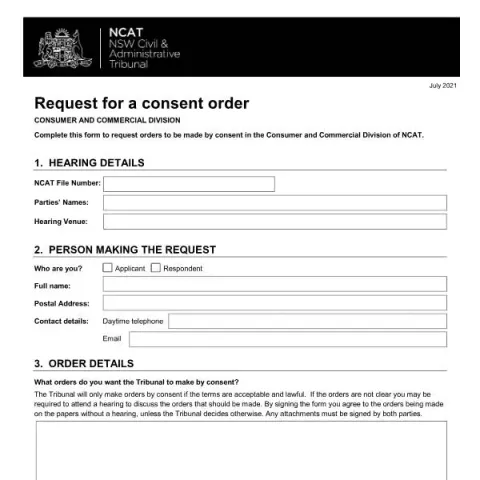
Understanding the "Request for a Consent Order" Form at NCAT
The NSW Civil and Administrative Tribunal (NCAT) provides a streamlined process for parties involved in a dispute to seek an agreement that is formalized as a consent order. This process is particularly useful when both parties agree on the outcome and want to avoid lengthy hearings. The form titled "Request for a Consent Order" is designed to facilitate this agreement, allowing the Tribunal to make legally binding orders based on mutual consent.
When to Use the "Request for a Consent Order" Form
This form is appropriate in situations where the parties involved have reached an understanding and wish to formalize their agreement through the Tribunal. Typical circumstances include:
- Disputes over consumer rights or commercial transactions where both parties agree on the resolution.
- Contractual disagreements that can be resolved through agreed terms.
- Parties seeking to formalize an arrangement without the need for a full hearing.
It is important to note that the Tribunal will only approve orders by consent if the terms are lawful and acceptable to all parties. If the terms are unclear or contentious, the Tribunal may require a hearing to clarify or resolve the issues.
Key Sections of the Form and Required Information
1. Hearing Details
This section captures essential case information, including:
- NCAT File Number: The reference number assigned to your case.
- Parties’ Names: Full legal names of the applicant and respondent.
- Hearing Venue: The location where the hearing is scheduled or will be held.
2. Person Making the Request
The individual completing the form must specify whether they are the applicant or respondent and provide:
- Full Name: The complete legal name.
- Postal Address: The mailing address for correspondence.
- Contact Details: Including daytime telephone number and email address.
3. Order Details
This section is critical as it outlines the specific orders the parties agree upon for the Tribunal to formalize. It is essential that the terms are clear, lawful, and acceptable to both sides. The form notes that:
- The Tribunal will only make orders by consent if the terms are lawful and agreeable.
- If the terms are ambiguous, a hearing may be required.
- Parties must sign the form, indicating their agreement to the orders being made on the papers, without a hearing, unless the Tribunal determines otherwise.
Any attachments, such as additional explanations or agreements, must be signed by both parties.
4. Signatures and Submission
Both parties involved in the dispute must sign the form to confirm their agreement. The form requires:
- Applicant Name and Signature: The person requesting the consent order.
- Respondent Name and Signature: The opposing party’s acknowledgment.
- Date: When each signature is provided.
Once completed, the form should be submitted to the NCAT registry. Contact details and locations are available on the NCAT website or by telephone at 1300 006 228.
Fill in your form directly online
No printing: type your details into the boxes of the official form, tick, then download the PDF ready to send.
- 1Type into the form boxes
- 2Tick in one click
- 3Save and download the PDF
Office Use and Decision-Making
NCAT staff will review the request and decide whether to approve the consent orders. The decision is recorded in the office use section, where:
- The orders made by consent are documented.
- If the Tribunal declines, reasons are noted, and parties may need to attend a hearing or consider other options.
Points of Attention and Practical Tips
When completing the "Request for a Consent Order" form, it is advisable to:
- Ensure the orders are clear, specific, and lawful.
- Both parties should review the proposed orders carefully before signing.
- Attach any relevant agreements or supporting documents, signed by both parties.
- Keep copies of the completed form for your records.
Using this form can significantly expedite the resolution process, avoiding the need for a contested hearing. However, the Tribunal retains the authority to refuse consent orders if they do not meet legal standards or if there are concerns about fairness.