Understanding the Request for Bail Refund Form in New South Wales
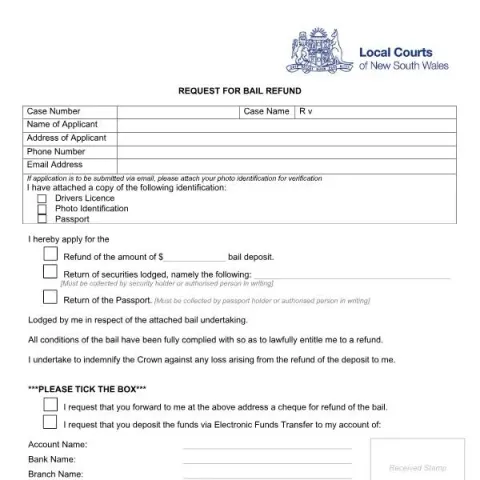
If you have been involved in a legal case in the Local Court of New South Wales and have previously paid a bail deposit, you may be eligible to request a refund of that bail amount once all conditions of your bail have been met. The Request for Bail Refund form is the official document used to initiate this process. This article provides a detailed overview of the form’s purpose, how to complete it, and key points to consider to ensure a smooth application.
When to Use the Bail Refund Request Form
This form is applicable in situations where:
- You have been released on bail in a NSW court case and have lodged a bail undertaking.
- All conditions of your bail have been fully satisfied, making you eligible for a refund of your bail deposit or securities.
- You wish to recover your bail deposit, securities lodged, or passport, which may have been provided as part of your bail arrangement.
It is important to note that the refund process is only initiated after the court confirms that all bail conditions have been met and the case has been resolved or the bail revoked or dispensed with.
Key Information Required for the Application
The form requests specific details to accurately identify the applicant and process the refund:
- Case details: including the case number and case name.
- Applicant details: full name, address, phone number, and email address.
- Identification: a copy of photo ID such as a driver’s license, passport, or other approved identification must be attached, especially if submitting by email.
- Refund specifics: whether you are requesting a refund of the bail deposit, securities lodged, or the passport.
- Bank account information: if you prefer an electronic transfer, details such as account name, bank name, BSB, and account number are required.
- Signature and date: the applicant’s signature and the date of application.
If a third party, such as a solicitor, is to receive the refund, written authorisation from the surety must be provided to approve the transfer.
How to Submit the Bail Refund Application
The application can be submitted either in person or via email. When submitting electronically, ensure that you attach a clear copy of your photo identification for verification purposes. If you request a cheque, the form provides a checkbox to select this option; alternatively, you can specify your bank details for an electronic funds transfer.
Once completed, the form should be sent to the appropriate court office. The court staff will process your application, verify the details, and carry out the necessary administrative actions, including confirming your identity and checking the case finalisation details.
Points of Attention and Tips for Applicants
- Accuracy of Information: Double-check all details, especially your case number, identification copies, and banking information, to prevent delays.
- Identification Attachments: Ensure that the ID copies are clear and legible, as these are crucial for verification.
- Legal Conditions: Confirm that all bail conditions have been fulfilled before applying for a refund. The court will not process refunds if bail remains active or conditions are unmet.
- Authorization for Third Parties: If someone else is collecting the refund on your behalf, proper written authorisation must be provided.
- Timing: The refund process may take some time after the court has finalised the case or dispensed with bail. Patience is advised.
Final Steps and Court Processing
After submission, the court’s designated officer will verify the application, compare signatures, and check the attached identification. If everything is in order, the refund will be processed either via cheque or electronic transfer, based on your preference indicated on the form.
Fill in your form directly online
No printing: type your details into the boxes of the official form, tick, then download the PDF ready to send.
- 1Type into the form boxes
- 2Tick in one click
- 3Save and download the PDF
For refunds exceeding certain amounts, written approval from the Registrar or Regional Director may be required, and this will be indicated in the court’s finalisation notes.
Conclusion
The Request for Bail Refund form is a straightforward yet important document that allows individuals to recover their bail deposits or securities after fulfilling all legal obligations. Carefully completing the form with accurate information and providing the necessary identification will help ensure a smooth and timely refund process. If unsure about any step, consulting with legal counsel or contacting the court directly can provide additional guidance.