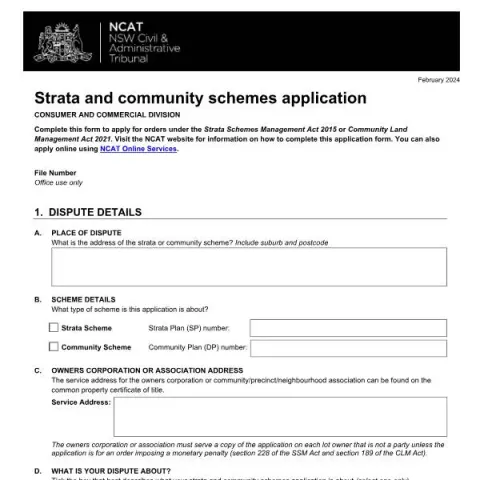
Understanding the Strata and Community Schemes Application Form in New South Wales
If you are involved in a dispute related to a strata or community scheme in New South Wales (NSW), the Strata and Community Schemes Application form is an essential legal document to initiate proceedings before the NSW Civil and Administrative Tribunal (NCAT). This guide explains when and how to use this form, what information it requires, and important points to consider during the application process.
When Should You Use This Application Form?
This form is designed for individuals or entities seeking orders under the Strata Schemes Management Act 2015 or the Community Land Management Act 2021. Typical scenarios include:
- Applying for general orders to resolve disputes within a strata or community scheme
- Addressing issues related to property management or maintenance
- Seeking enforcement of by-law breaches or penalties for non-compliance
- Requesting orders related to meetings of owners corporations or associations
- Disputes over records or other property-related matters
Before submitting an application, applicants are generally required to attempt to resolve the dispute through mediation. Evidence of this attempt must be attached if mediation has been tried. Certain exemptions may apply if mediation is not appropriate or feasible.
How to Complete the Application Form
1. Dispute Details
Provide the address of the scheme involved, including suburb and postcode. Specify whether the scheme is a strata scheme (with a Strata Plan number) or a community scheme (with a Community Plan number). Clearly describe the nature of the dispute by ticking the relevant box, such as property management, breach of by-laws, or records access.
2. Applicant Information
The applicant can be a lot owner, an owners corporation, an association, or other parties involved. You must supply your full name, contact details, and if applicable, organization name and ABN/ACN. If you are represented by a legal practitioner or agent, their details should also be included, along with written authority to act on your behalf.
3. Respondent Details
Identify the respondent—usually the lot owner, owners corporation, or association involved in the dispute. Accurate contact details are crucial for effective communication and service of documents.
4. Orders Sought and Reasons
Specify precisely which orders you are requesting from NCAT, referencing the relevant sections of the applicable legislation. Include a clear explanation of why these orders are necessary, providing context for the tribunal to understand your case.
5. Interim Orders
If urgent action is needed before the hearing, you can request interim orders. You must justify the urgency by describing the potential harm or ongoing issues that require immediate intervention.
Fill in your form directly online
No printing: type your details into the boxes of the official form, tick, then download the PDF ready to send.
- 1Type into the form boxes
- 2Tick in one click
- 3Save and download the PDF
Important Points to Keep in Mind
- Completeness: Ensure all sections are filled out accurately, including contact details and dispute descriptions.
- Evidence: Attach relevant documentation, such as proof of attempted mediation or records supporting your claim.
- Service of Application: The owners corporation or association must serve a copy of the application on each lot owner not involved in the dispute unless the application involves monetary penalties.
- Fees and Submission: Applications can be lodged online via NCAT Online Services or at a local NCAT Registry. Payment of applicable fees is required at the time of lodgment.
Support and Assistance
If you require an interpreter or have specific support needs during the hearing, indicate this in the relevant sections of the form. NCAT is committed to accessible processes for all parties involved.
Final Steps
Once completed, sign the application or have your authorized representative sign it. Submit the form along with the necessary fee either online or at your nearest NCAT Registry. For more detailed information, including fee schedules and specific procedural guidance, visit the official NCAT website or contact their customer service helpline.
Using the correct application process ensures your dispute is formally recognized and processed efficiently, helping you seek resolution through the NSW Civil and Administrative Tribunal.