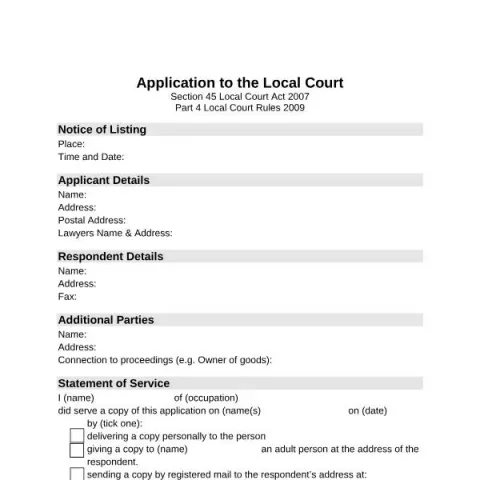
Understanding the Application to the Local Court of New South Wales
The Application to the Local Court is a formal legal document used within the judicial system of New South Wales (NSW), Australia. Managed under the Local Court Act 2007 and the Local Court Rules 2009, this form serves as a crucial step for parties seeking to initiate or respond to proceedings before the Local Court. Whether you are a defendant, a claimant, or involved as an additional party, understanding the purpose, process, and requirements of this application can help ensure your case proceeds smoothly.
What is the Purpose of the Application?
This application form is primarily used to:
- Request the Court to review or set aside a previous order made by the Local Court.
- Provide notice of proceedings scheduled before the Court, including details about the hearing.
- Introduce additional parties involved in the case, such as co-claimants or interested parties.
It is a formal document that ensures all relevant parties are notified and that the Court has a clear understanding of the issues involved.
Who Can Use This Form?
The application form is applicable to individuals or entities involved in proceedings under the Crimes (Local Courts Appeal and Review) Act 2001, particularly section 4. It is typically used by:
- Parties seeking to challenge or appeal a Court order.
- Parties requesting the Court to make specific orders or to vary existing ones.
- Legal representatives acting on behalf of their clients.
Note that the form can also be used by police officers or public officers, but their signatures are not required on the application.
Steps to Fill Out the Application Form
1. Complete the Applicant and Respondent Details
Begin by providing your full name, address, and postal address. If you have legal representation, include your lawyer’s name and contact details. Similarly, specify the respondent’s name and address, as well as any additional parties involved, along with their connection to the case (for example, owner of goods).
2. Provide Service Details
In the section titled "Statement of Service," you must declare how and when you served a copy of the application to the respondent. This can be done through personal delivery, giving a copy to an adult at the respondent’s address, registered mail, or facsimile (if applicable). You will also need to record the date of service and sign the statement.
3. Specify the Legal Grounds and Orders Sought
Next, specify under which legal act and section the application is made. For example, under the Crimes (Local Courts Appeal and Review) Act 2001, s4. Clearly state the orders you are requesting the Court to make, such as annulling a previous order, and provide details about the original case, including the date and place of the order, as well as the type of case or offences involved.
4. State the Grounds for Your Application
Choose from the provided grounds or specify your own reasons. Common grounds include being unaware of proceedings, being hindered from attending due to exceptional circumstances, or believing that it is in the interests of justice to annul the order.
5. Sign and Date the Application
Finally, sign and date the form. If you are a police officer or public officer, your signature may not be required. The form also requires signatures from the applicant and the registrar at the time of filing.
Fill in your form directly online
No printing: type your details into the boxes of the official form, tick, then download the PDF ready to send.
- 1Type into the form boxes
- 2Tick in one click
- 3Save and download the PDF
Filing and Service of the Application
Once completed, the application must be filed at the court registry. The registry will stamp the document with the date of filing and assign a court reference number. Fees may apply, or the application may be waived or exempted, depending on your circumstances.
After filing, you are responsible for serving a copy of the application on all involved parties, ensuring they are properly notified of the proceedings. Service can be done personally, by mail, or facsimile, as appropriate.
Post-Submission Procedures
Following submission, the Court will review your application. If the application is accepted, a hearing date will be scheduled, and all parties will be notified. It is important to adhere to any deadlines specified by the Court to ensure your application is considered timely.
In summary, the Application to the Local Court is a vital legal document that allows parties to seek review, challenge, or initiate proceedings within NSW’s local justice system. Accurate completion and proper service are essential to ensure your case is effectively advanced through the Court process.