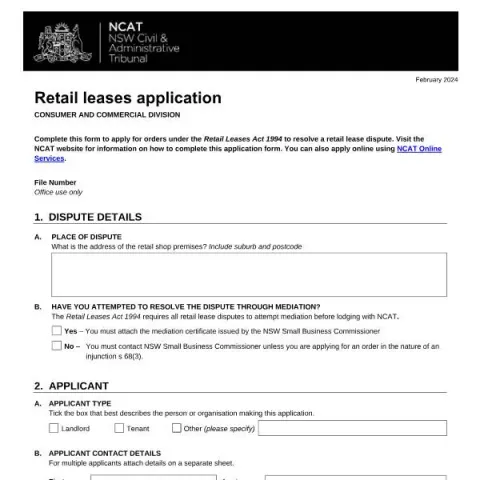
Understanding the Retail Leases Application Form for NCAT Consumer and Commercial Division
If you are involved in a retail lease dispute in New South Wales, Australia, you may need to submit a formal application to the NCAT Consumer and Commercial Division. This process is governed by the Retail Leases Act 1994, which provides a streamlined pathway for resolving disagreements between landlords and tenants of retail premises. This article offers a comprehensive overview of the application form, guiding you through its purpose, eligibility criteria, and the step-by-step process for completing and submitting your claim.
Purpose and Scope of the Retail Leases Application Form
The primary purpose of this form is to initiate legal proceedings before NCAT (New South Wales Civil and Administrative Tribunal) for disputes related to retail leases. Typical issues addressed include rent disagreements, lease terms, repairs, and other contractual obligations. The form facilitates the applicant’s request for specific orders under the Retail Leases Act, which may include remedies such as rent reductions, lease variations, or termination orders.
It is important to note that before lodging an application, the law mandates that parties attempt to resolve disputes through mediation. Applicants must attach proof of this effort, specifically a mediation certificate issued by the NSW Small Business Commissioner, unless applying for an urgent injunction or similar order.
Eligibility and Conditions for Applying
To be eligible to use this application form, the dispute must fall within the scope of the Retail Leases Act 1994 and involve a retail shop premises located in New South Wales. Both landlords and tenants, as well as other parties with a legal interest in the lease, can apply, provided they have attempted to resolve the dispute through mediation first.
Applicants should also ensure they have the correct contact details for all parties involved, including the respondent (the opposing party). The form requires details such as name, organisation (if applicable), address, and contact information, which must be accurate for effective communication and service of documents.
Step-by-Step Guide to Completing the Application Form
1. Dispute Details
Begin by providing the address of the retail shop and confirming whether you have attempted mediation. If not, you will need to contact the NSW Small Business Commissioner before proceeding.
2. Applicant Information
- Specify whether you are the landlord, tenant, or another relevant party.
- Provide your full name, organisation details, contact number, and email address. If you have a legal representative, include their contact details and attach authority documentation.
- Indicate if you identify as Aboriginal or Torres Strait Islander, as this information may be relevant for support or procedural considerations.
3. Respondent Details
- Identify the respondent by their role (landlord, tenant, or other) and provide their contact information.
- Ensure accuracy, as this information will be used for service and correspondence.
4. Orders Requested and Reasons
Specify the legal sections of the Retail Leases Act that support your application and describe the orders you seek. Clearly explain the reasons for your application to help NCAT understand the context and urgency.
5. Interim Orders (if relevant)
If your case involves urgent matters, you can request interim orders. Describe the nature of the urgency and the potential consequences if the order is not granted.
Fill in your form directly online
No printing: type your details into the boxes of the official form, tick, then download the PDF ready to send.
- 1Type into the form boxes
- 2Tick in one click
- 3Save and download the PDF
Additional Support and Signatures
Applicants requiring language assistance or disability support should specify their needs in the relevant sections. The form must be signed by the applicant or their authorized representative, confirming the accuracy of the information provided.
Submitting Your Application
Once completed, the application can be lodged either through the NCAT Online Services portal or in person at your nearest NCAT Registry. Payment of the applicable fee is required at the time of lodging. For further assistance, applicants can contact NCAT by telephone or visit their official website for detailed location information.
In summary, the retail leases application form is a vital tool for resolving lease disputes efficiently within the legal framework established by NSW law. Proper completion, including adherence to the mediation requirement and accurate information provision, ensures a smoother process and increases the likelihood of a favorable outcome.