Understanding the General List Application Form for NCAT
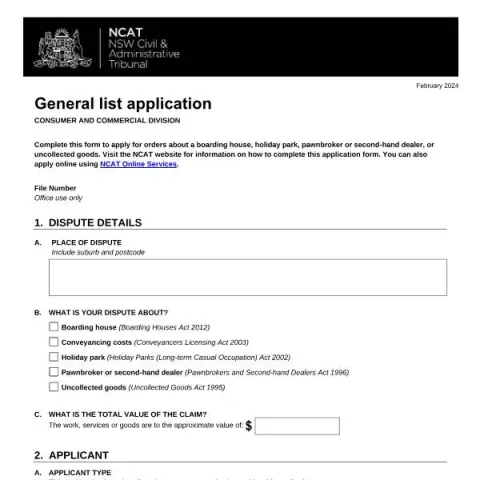
The New South Wales Civil and Administrative Tribunal (NCAT) provides a streamlined process for resolving disputes related to various consumer and commercial matters through its General List Application form. This official document is essential for individuals or organisations seeking NCAT's intervention to settle disagreements involving boarding houses, holiday parks, pawnbrokers, second-hand dealers, or issues concerning uncollected goods.
When to Use the General List Application
This form is designed for specific types of disputes falling under the jurisdiction of the NCAT Consumer and Commercial Division. It is applicable in situations such as:
- Disputes with a boarding house operator regarding tenancy or services, under the Boarding Houses Act 2012.
- Claims related to conveyancing costs, often involving property transactions, governed by the Conveyancers Licensing Act 2003.
- Issues with holiday parks, especially long-term casual occupation, under the Holiday Parks (Long-term Casual Occupation) Act 2002.
- Disagreements involving pawnbrokers or second-hand dealers, regulated by the Pawnbrokers and Second-hand Dealers Act 1996.
- Claims about uncollected goods, as per the Uncollected Goods Act 1995.
Applicants should consider whether their dispute falls within these categories before completing the form, as this ensures the application is directed to the appropriate NCAT division for resolution.
Key Sections of the Application Form
1. Dispute Details
This section requires information about the location of the dispute, including suburb and postcode, and a brief description of the issue. Additionally, applicants must specify the total value of the claim, which helps NCAT assess the case's scope.
2. Applicant Information
Applicants must identify themselves, whether as residents, consumers, licensees, or other relevant parties. Contact details—including name, organisation (if applicable), address, phone number, and email—are essential, especially since email addresses are used for service notices. Applicants can also specify if they identify as Aboriginal or Torres Strait Islander, which may influence support provisions during hearings.
3. Respondent Details
Similar to the applicant section, this part gathers information about the respondent—be it an individual or organisation—including name, address, and contact details. Accurate information is critical for NCAT to serve notices and progress the case effectively.
4. Orders and Reasons
Applicants must specify the type of orders they seek from NCAT, citing relevant sections of the applicable legislation. They should also provide a clear explanation of why they are applying, which assists NCAT in understanding the dispute's context and the desired outcome.
Additional Support and Signatures
The form includes sections for language assistance and disability support needs. Applicants requiring an interpreter or special accommodations should specify their requirements to ensure accessible hearings.
Fill in your form directly online
No printing: type your details into the boxes of the official form, tick, then download the PDF ready to send.
- 1Type into the form boxes
- 2Tick in one click
- 3Save and download the PDF
Finally, the application must be signed by the applicant or their authorised representative. Signatures can be submitted electronically via NCAT Online Services or physically at a local NCAT Registry. Once completed, the form must be lodged along with the applicable fee, which varies depending on the case.
Submitting Your Application
Applications are generally lodged online through the NCAT Online Services portal, offering a convenient and efficient process. Alternatively, applicants can visit their nearest NCAT Registry location to submit a paper form. It is advisable to review the detailed instructions on the NCAT website to ensure all sections are correctly completed and supporting documents are attached.
For further assistance or inquiries, applicants can contact NCAT by phone or visit the official website. Proper completion of this form is vital for a smooth resolution process, ensuring that NCAT can effectively review and determine the appropriate orders to resolve the dispute.