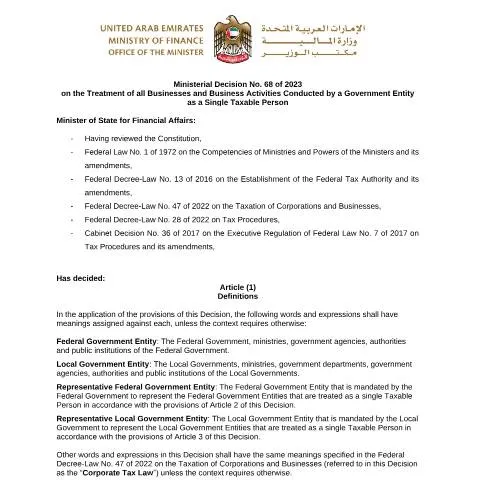
Understanding Ministerial Decision No (68) of 2023 on the Tax Treatment of Government-Operated Businesses in the UAE
The United Arab Emirates (UAE) continues to refine its tax legislation framework to promote clarity, compliance, and administrative efficiency. A recent key development in this area is the issuance of Ministerial Decision No (68) of 2023, which addresses the tax treatment of all business activities conducted by government entities. This guide aims to elucidate the scope, implications, and procedural considerations associated with this decision, providing clarity for businesses, government entities, and tax professionals operating within the UAE.
Objective and Scope of the Decision
Ministerial Decision No (68) of 2023 establishes a comprehensive framework for the tax treatment of businesses and activities that are conducted by government entities. Its primary objective is to unify the tax approach applicable to government-related business activities, ensuring consistency and alignment with the UAE's broader tax policies. The decision applies to all federal and emirate-level government entities engaged in commercial or economic activities that may have tax implications under UAE law.
This decision is part of the UAE’s ongoing efforts to enhance transparency and streamline tax administration, particularly by clarifying the classification of government-run businesses as a single taxable person. It underscores the importance of compliance and proper tax reporting for these entities, aligning them with the principles applicable to private sector businesses.
Key Provisions and Principles
Unified Tax Treatment of Government Activities
The decision mandates that all business activities conducted by a government entity are to be treated as a single taxable person for tax purposes. This means that instead of treating each activity separately, the government entity’s activities are aggregated into one tax entity, simplifying compliance and audit processes.
Scope of Taxable Activities
Activities covered under this decision include all economic, commercial, or service-oriented operations undertaken by government entities, whether directly managed or through subsidiaries. This encompasses activities such as procurement, service provision, and other revenue-generating operations, provided they fall within the scope of UAE tax legislation.
Implications for Tax Registration and Filing
Government entities are required to register as a single taxable person if their activities meet the criteria outlined in the decision. This registration facilitates unified tax reporting and payment obligations, thereby reducing administrative burdens and potential discrepancies in tax filings.
Impact on Government Entities and Business Operations
This decision signifies a shift towards greater standardization and transparency in the tax treatment of government-related business activities. For government entities, it necessitates a review of their operational structures to ensure compliance with the new classification and reporting requirements.
From a practical standpoint, this unified approach simplifies the tax compliance process, as government entities will now manage their tax obligations through a consolidated framework. It also facilitates better oversight and auditing by tax authorities, ensuring that all government-related activities are appropriately taxed and reported.
Procedural Considerations and Next Steps
While the decision emphasizes the importance of compliance, it also highlights the need for government entities to coordinate with relevant authorities, such as the Federal Tax Authority (FTA), for registration and ongoing tax obligations. Entities should review their activities to determine whether they qualify as a single taxable person under this decision and initiate the registration process accordingly.
Tax professionals and government entities are encouraged to stay informed about updates from the FTA and other relevant authorities to ensure seamless compliance and to understand any procedural updates or clarifications issued subsequently.
Conclusion
Ministerial Decision No (68) of 2023 marks a significant step in the UAE’s tax policy landscape by clarifying the treatment of government business activities. Through the establishment of a unified taxable person framework, the decision aims to promote transparency, simplify compliance, and align government operations with the UAE’s broader tax objectives. Government entities and businesses engaged with or within the public sector should review their activities and coordinate with tax authorities to ensure adherence to this new regulatory environment.