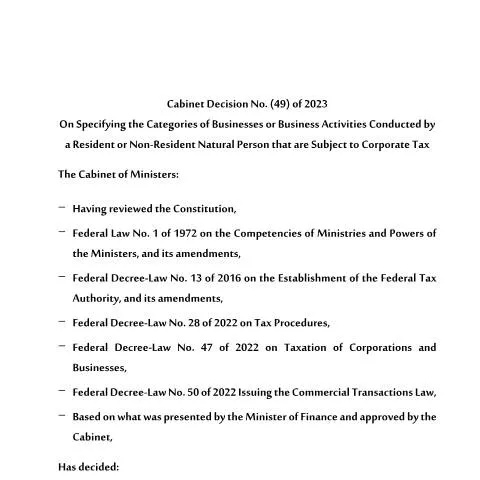
Understanding the New Corporate Tax Regulations in the United Arab Emirates
The United Arab Emirates has recently introduced a significant update to its tax legislation through the issuance of Cabinet Decision No (49) of 2023. This decision delineates the specific categories of business activities and entities that are subject to corporate tax, marking a pivotal step in the country’s ongoing efforts to align its fiscal framework with international standards and diversify its economy.
Scope and Objectives of the Legislation
The primary aim of Cabinet Decision No (49) of 2023 is to clarify the types of business activities that will fall under the scope of corporate taxation. While the UAE has historically maintained a tax-free environment for many sectors, this new regulation establishes clear boundaries and classifications for entities and activities that will be taxed. The decision seeks to promote transparency, compliance, and a fair taxation system, ensuring that both resident and non-resident natural persons engaged in specified activities contribute appropriately to the national revenue.
Categories of Business Activities Subject to Corporate Tax
The legislation specifies that certain categories of business activities, whether conducted by residents or non-residents, are now explicitly identified as taxable under the UAE’s corporate tax regime. These categories encompass a broad spectrum of economic activities, particularly those involving significant commercial or financial operations. Examples include, but are not limited to, activities related to:
- Trade and commerce involving goods and services
- Financial services, including banking and investment activities
- Real estate development and property management
- Industrial manufacturing and processing
- Technology and digital services
It is important to note that the decision emphasizes that activities not explicitly listed may still be subject to corporate tax if they are deemed to have a substantial economic presence or generate taxable income within the UAE.
Implications for Businesses and Natural Persons
For businesses and individuals operating within the UAE, this decision clarifies the scope of their tax obligations. Entities engaged in the specified activities must ensure compliance with the new regulations by registering with the relevant authorities, such as the Federal Tax Authority (FTA), and adhering to reporting and payment requirements.
Non-resident individuals conducting taxable activities within the UAE are now explicitly included under the definition of taxable persons. This means that even if they do not have a physical presence or a local entity, their income derived from activities falling under the specified categories may be subject to corporate tax obligations.
Implementation and Compliance
The legislation underscores the importance of compliance with the UAE’s tax laws and highlights the role of the Federal Tax Authority in overseeing and enforcing these regulations. Businesses should review their activities to determine if they fall within the taxable categories outlined in Cabinet Decision No (49) of 2023. It is advisable for entities to seek guidance from tax professionals or legal advisors to ensure proper registration, accurate reporting, and timely tax payments.
The UAE’s commitment to digital government services facilitates this process, allowing businesses and individuals to access relevant information and complete necessary procedures via the official portals of the Federal Tax Authority and other federal agencies.
Conclusion
The issuance of Cabinet Decision No (49) of 2023 marks a significant development in the UAE’s tax landscape. By clearly defining the categories of businesses and activities subject to corporate tax, the legislation aims to foster a transparent, compliant, and equitable tax environment. Stakeholders engaged in the specified sectors should stay informed about their obligations and leverage the digital tools provided by the UAE government to ensure smooth compliance with the new regulations.