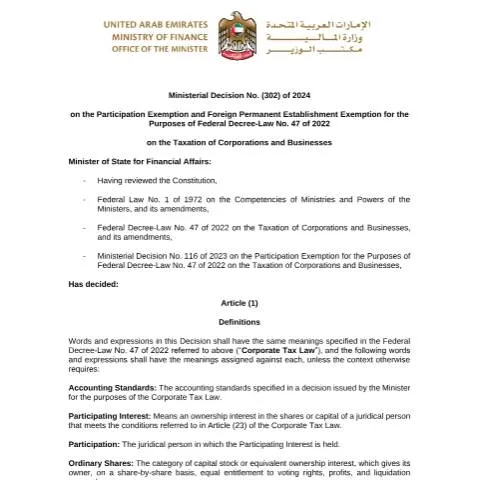
Overview of Ministerial Decision No (302) of 2024 on Tax Exemptions
The United Arab Emirates has issued a significant update to its corporate tax legislation through Ministerial Decision No (302) of 2024. This decision clarifies and expands the scope of participation exemption and foreign permanent establishment exemption provisions within the framework of Federal Decree-Law No (47) of 2022 concerning the taxation of corporations and businesses. It aims to streamline the application of tax exemptions, promote foreign investment, and ensure compliance with the UAE’s strategic fiscal policies.
Context and Purpose of the Decision
As part of the UAE’s ongoing efforts to create a competitive and attractive business environment, the Ministerial Decision provides detailed guidance on the eligibility criteria, scope, and procedures related to participation and foreign permanent establishment exemptions. These exemptions are designed to prevent double taxation and facilitate cross-border trade and investment, aligning with the UAE’s commitment to maintain a transparent, efficient, and investor-friendly tax system.
The decision complements existing federal legislation by offering clearer definitions and operational procedures for entities seeking to benefit from these exemptions. It emphasizes the importance of compliance with both federal and emirate-level regulations, leveraging the UAE’s advanced digital infrastructure for efficient application and processing.
Who is Affected by the Decision?
This legislation primarily concerns corporate taxpayers operating within the UAE, including multinational companies with foreign subsidiaries or branches, as well as local entities engaged in international trade. It applies to entities that possess or are seeking to establish foreign permanent establishments or participate in foreign investments that may be eligible for tax exemptions under the new provisions.
Additionally, tax consultants, legal advisors, and financial institutions involved in cross-border transactions should stay informed of these updates to ensure proper guidance and compliance for their clients.
Key Provisions and Points of Clarification
Participation Exemption
- The decision delineates the conditions under which a UAE resident company can benefit from exemption on dividends received from qualifying foreign subsidiaries.
- It specifies the criteria related to ownership percentage, duration of holding, and the nature of the subsidiary’s activities.
- The exemption aims to avoid double taxation on income that has already been taxed at the subsidiary level abroad.
Foreign Permanent Establishment Exemption
- The decision clarifies when income attributable to a foreign permanent establishment (PE) may be exempt from UAE corporate tax.
- It details the procedural requirements for establishing the existence of a PE and the necessary documentation for exemption claims.
- The exemption supports UAE-based companies engaging in international operations by reducing tax liabilities on foreign income attributable to PEs.
Implementation and Compliance
The decision emphasizes the use of digital platforms, particularly the Federal Tax Authority’s (FTA) online services, for the submission and management of exemption applications. Entities are encouraged to maintain comprehensive documentation to substantiate their claims, including ownership records, foreign tax paid certificates, and operational details of foreign establishments.
Taxpayers should review their corporate structures and international transactions to determine eligibility and ensure adherence to the new guidelines. The FTA provides resources and support to facilitate understanding and compliance with these provisions.
References and Regulatory Framework
Ministerial Decision No (302) of 2024 operates within the broader context of the UAE’s tax legislation, particularly Federal Decree-Law No (47) of 2022. It aligns with the UAE’s strategic goals of fostering foreign investment, enhancing transparency, and maintaining a competitive fiscal environment.
For detailed legal interpretations and procedural guidance, entities are advised to consult the Federal Tax Authority and relevant emirate-level authorities responsible for tax administration and compliance.