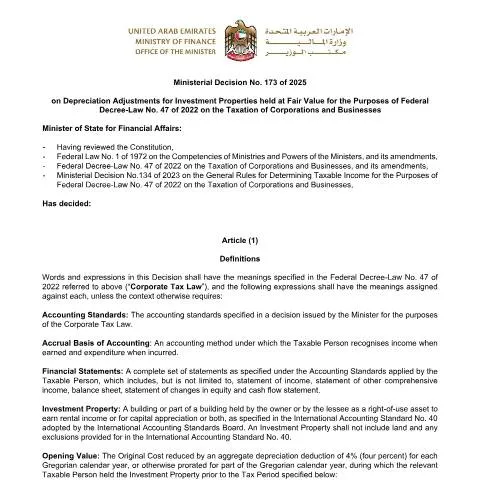
Overview of Ministerial Decision No. 173 of 2025 on Depreciation Adjustments for Investment Properties Held at Fair Value
The United Arab Emirates (UAE) has issued a new legislative measure aimed at clarifying the treatment of depreciation for investment properties held at fair value. Ministerial Decision No. 173 of 2025, issued by the Ministry of Finance (MOF), establishes specific guidelines for how depreciation adjustments should be applied to such properties in compliance with the Federal Decree-Law No. 47. This decision reflects the UAE’s ongoing commitment to aligning tax legislation with international accounting standards and ensuring transparency and consistency within the property investment sector.
Legal and Regulatory Context
This decision operates within the framework of the UAE’s broader tax legislation, particularly under the provisions of Federal Decree-Law No. 47 concerning corporate tax and related financial treatments. It complements existing regulations by providing detailed guidance on the depreciation practices applicable to investment properties that are accounted for at fair value, rather than historical cost. The legislation emphasizes the importance of accurate asset valuation and depreciation treatment to ensure proper tax compliance and reporting.
Scope and Applicability
Ministerial Decision No. 173 of 2025 applies primarily to entities that hold investment properties at fair value on their financial statements. This includes real estate investment firms, property management companies, and other corporate entities engaged in property investment activities within the UAE. The decision specifies how depreciation adjustments should be made in the context of changing fair values, ensuring that tax calculations accurately reflect the economic reality of property holdings.
Key Provisions and Guidelines
Depreciation Methodology for Investment Properties
The decision clarifies that depreciation for investment properties held at fair value should be aligned with the adjustments in the property's fair value over time. It emphasizes that depreciation should not be based solely on historical cost but should incorporate the current fair value as reflected in the financial statements. This approach aims to provide a more accurate depiction of asset value and income generation potential.
Adjustments for Fair Value Changes
When the fair value of an investment property changes, entities are required to recognize the corresponding depreciation adjustments in their financial statements and tax filings. The decision stipulates that such adjustments should be systematically recorded, ensuring consistency in financial reporting and tax compliance. It also highlights the importance of maintaining detailed documentation of valuation methods and fair value assessments.
Tax Implications and Compliance
The legislation underscores that depreciation adjustments for investment properties at fair value have direct implications for taxable income calculations. Entities must ensure that their tax filings reflect these adjustments accurately, in accordance with the guidance provided by the Ministry of Finance. This measure aims to prevent discrepancies and promote transparency in tax reporting related to property investments.
References and Authority
The decision is issued by the Ministry of Finance (MOF) and aligns with the overarching tax framework established by the UAE government. It is part of the broader efforts to modernize tax regulations and enhance fiscal discipline within the real estate and investment sectors. Entities involved in property investment are encouraged to consult the official legislative texts and seek professional advice to ensure full compliance with the new provisions.
Conclusion
Ministerial Decision No. 173 of 2025 marks a significant development in the UAE’s tax legislation concerning investment properties. By defining clear guidelines for depreciation adjustments at fair value, the decision promotes greater transparency, accuracy, and consistency in financial and tax reporting. Stakeholders in the property investment sector should review these provisions carefully to align their accounting practices with the new legal requirements and ensure compliance with federal tax regulations.