Understanding the Official Guidance for Non-Residents Applying for Tax Relief in South Africa
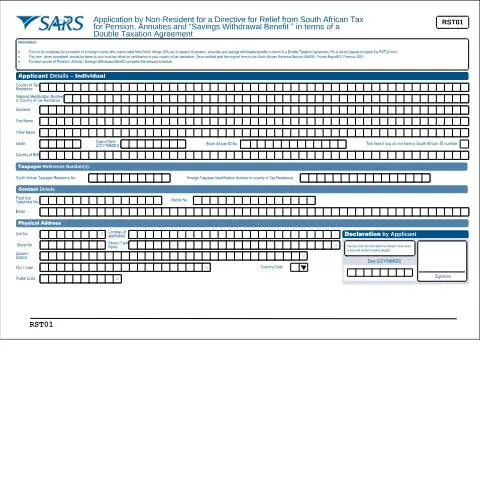
The South African Revenue Service (SARS) provides a structured process for non-residents seeking relief from South African tax obligations concerning pensions, annuities, and savings withdrawal benefits, especially under the provisions of Double Taxation Agreements (DTAs). The official document titled "Application by Non-Residents for a Directive for Relief from SA Tax for Pension and SWB - External Form" (form code: RST01) serves as the primary instrument for such applications.
Scope and Purpose of the RST01 Form
The RST01 form is designed for individuals residing outside South Africa who wish to claim exemption or reduction of withholding tax on pension, annuities, or savings withdrawal benefits sourced from South Africa. This application aligns with the provisions of applicable DTAs that South Africa has entered into with various countries to prevent double taxation and promote cross-border economic cooperation.
It is important to note that this form is not intended for claiming refunds; applicants should instead use the RST02 form for refunds after their claim is processed. The RST01 form facilitates the initial application process, which involves certification by the applicant’s local tax authority and subsequent submission to SARS.
Who Should Use the RST01 Form?
The form is specifically tailored for non-residents who:
- Receive pension, annuities, or savings withdrawal benefits from South African sources.
- Are seeking relief from South African tax under a relevant DTA.
- Are required to obtain certification from their local tax authority confirming their residency and tax status.
This process ensures that the applicant’s claim is substantiated by the tax authority in their country of residence, which is a prerequisite before SARS can process the relief application.
Key Components and Procedure
Applicant Details
The form requires comprehensive personal information, including full name, date of birth, country of birth, and contact details. A critical element is the applicant’s tax residence country and the corresponding taxpayer identification number, which validates their residency status.
Certification by Local Tax Authorities
Once completed, the applicant must take the form to their local tax office for certification. The certifying tax authority confirms the applicant’s residency and tax liability status by endorsing the form with an official stamp and signature. This step is essential for SARS to accept the application and process the relief request.
Submission to SARS
After certification, the original form must be mailed to SARS at the specified address in Pretoria. The process emphasizes the importance of maintaining the integrity and authenticity of the document to ensure a smooth review process.
Details Required for Pension, Annuities, and Savings Benefits
The form includes dedicated schedules for each type of income:
- Pensions: Details of the pension fund, including the registered postal address, policy number, and the history of employment with occupational funds, if applicable.
- Annuities: Information about the retirement fund or insurer, the nature of the annuity, and related employment history.
- Savings Withdrawal Benefits: Details of the fund from which savings are withdrawn, including postal address and fund type.
Applicants must specify the tax period for which the relief is sought, generally aligned with the South African fiscal year (March to February).
Legal and Procedural References
The application process is governed by South Africa’s Promotion of Administrative Justice Act 3 of 2000 (PAJA), ensuring that decisions made by SARS are lawful, reasonable, and procedurally fair. The process underscores the importance of accurate and truthful information, with declarations required from both the applicant and the relevant tax authorities in the applicant’s country of residence.
Summary
The RST01 form is a crucial document for non-residents seeking to benefit from South Africa’s tax treaties concerning pension and related income. It facilitates a formal, documented approach to claiming tax relief, ensuring compliance with both South African law and international agreements. Applicants should prepare all necessary documentation carefully, obtain proper certification from their local tax authorities, and submit the original form to SARS to initiate their claim.