Understanding the NR03 Tax Directive Application for Non-Resident Sellers of Immovable Property in South Africa
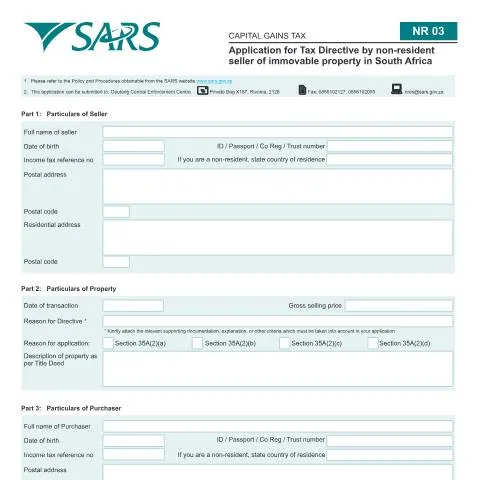
The NR03 – Tax Directive Application by Non-Resident Seller of Immovable Property in South Africa is an official form issued by the South African Revenue Service (SARS) designed for non-resident individuals or entities selling immovable property within South Africa. This document serves as a formal request to obtain a tax directive, which determines the amount of tax to be withheld from the sale proceeds. It plays a crucial role in ensuring compliance with South Africa’s tax laws, particularly regarding capital gains tax (CGT) and withholding tax obligations for non-residents.
Scope and Purpose of the NR03 Form
The primary objective of the NR03 form is to facilitate the application process for a tax directive in cases where a non-resident seller disposes of immovable property in South Africa. The form is applicable to individuals, companies, trusts, or other legal entities that are not ordinarily resident in South Africa but are involved in property transactions within the country. By submitting this application, the seller seeks clarity on the withholding tax rate applicable to the transaction and ensures that the correct amount is deducted at source by the purchaser or the relevant authority.
Key Sections and Required Information
The NR03 form is divided into four main parts, each capturing essential details necessary for processing the application:
Part 1: Particulars of Seller
- Full name of the seller
- Identification number (ID, passport, company registration, or trust number)
- Date of birth or registration
- Tax reference number (if available)
- Country of residence (for non-residents)
- Residential and postal addresses
- Contact details (telephone number)
Part 2: Particulars of Property
- Description of the property as per the Title Deed
- Property location and postal code
- Purchase price and sale price
Part 3: Particulars of Purchaser
- Full name of the purchaser
- Identification or registration number
- Country of residence (if non-resident)
- Postal and residential addresses
- Contact details
Part 4: Declaration by Seller
This section requires the seller’s signature, confirming the accuracy of the provided information, and includes details regarding the reason for the application under specific legal sections (Section 35A(2)(a) to (d)). The seller must attach supporting documentation relevant to their reason for requesting a tax directive, such as proof of residence or specific transaction details.
Calculation and Submission of the Application
The form also includes a section to calculate the amount to be withheld, based on the gross selling price, with different withholding rates applicable depending on the type of entity:
- Individuals: 7.5%
- Companies: 10%
- Trusts: 15%
For transactions exceeding R2 million, the gross selling price must be declared, and the applicable withholding rate is applied to determine the total payable amount.
Once completed, the application can be submitted via email, fax, or physically delivered to the SARS Gauteng Central Enforcement Centre at the address provided. The official SARS website offers further guidance on policies and procedures related to tax directives.
Implications for Non-Resident Sellers
By applying for an NR03 tax directive, non-resident sellers can ensure that the correct amount of tax is withheld at source, in accordance with South African tax legislation. This process helps prevent potential disputes or penalties related to underpayment of taxes on property transactions. It also provides clarity on tax obligations, enabling sellers to plan their finances accordingly.
It is essential for non-resident sellers to complete the NR03 application accurately and attach all necessary supporting documents to facilitate a smooth process. Consulting with a tax professional or legal advisor familiar with South African property and tax law is recommended to navigate this process effectively.
In conclusion, the NR03 form is a vital tool for non-residents involved in property transactions in South Africa, ensuring compliance with the country's tax laws and providing transparency in withholding procedures. Proper understanding and timely submission of this application can significantly ease the administrative burden and safeguard the interests of foreign property sellers.