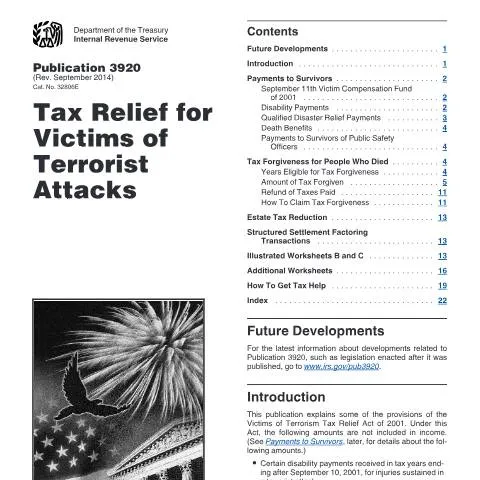
Navigating IRS Publication 3920: A Crucial Guide for Tax Relief After Terrorist Attacks
When tragic events unfold, the aftermath can leave victims and their families grappling with not just emotional and physical consequences but also significant financial burdens. In the wake of such crises, the IRS Publication 3920 provides essential guidance and tax relief measures for those affected by terrorist attacks. This document serves as a critical resource, clarifying what relief is available and how to access it.
Understanding the Unique Role of Publication 3920
Publication 3920 stands out among IRS documents due to its specific focus on tax relief related to victims of terrorism, a topic often confused with general disaster relief publications. Unlike broader IRS publications that cover various tax topics, Publication 3920 hones in on the provisions of the Victims of Terrorism Tax Relief Act of 2001. This legislation outlines various tax exclusions, benefits, and forgiveness measures aimed at alleviating the financial strain on individuals and families affected by targeted acts of violence.
The Legal Framework Behind Publication 3920
The foundation of Publication 3920 lies in the Victims of Terrorism Tax Relief Act, enacted in response to the tragic events of September 11, 2001. This act was a legislative response not only to the attacks on American soil but also addressed subsequent terrorist acts, such as the anthrax attacks and the Oklahoma City bombing. This context is vital for understanding the provisions and exemptions detailed within the publication.
- Exemptions and Relief: The publication specifies exemptions on certain disability payments and compensation from designated funds, which are critical for survivors seeking financial assistance.
- Tax Forgiveness: It outlines circumstances under which the IRS forgives tax liabilities for individuals who perished in these attacks.
Who Should Reference This Publication?
Publication 3920 is primarily targeted at the survivors of victims of terrorist attacks, as well as beneficiaries who may be entitled to compensation as a result of these tragedies. These can include:
- Family members of those who have died due to terrorist acts.
- Individuals receiving disability payments following a terrorist attack.
- Survivors who received compensation from the September 11th Victim Compensation Fund.
By identifying who can benefit from the provisions outlined in this publication, the IRS ensures that eligible individuals can claim the assistance they rightfully deserve.
Steps to Claim Benefits: An In-Depth Process
To access the tax relief options outlined in Publication 3920, beneficiaries must follow a specific process. Although it may seem daunting, understanding each step can simplify the experience.
1. Determine Eligibility
Eligibility is the cornerstone of any claim. It's essential for victims and their families to ascertain whether they qualify for the specific provisions detailed in the publication. For example:
- Disability payments must be for injuries sustained directly as a result of terrorist acts.
- Compensation from the September 11th Victim Compensation Fund is exempt from income reporting.
2. Gather Necessary Documentation
Effective claims hinge on thorough documentation. This includes:
- Proof of the individual’s relationship to the deceased victim.
- Records of disability payments received.
- Correspondence from the September 11th Victim Compensation Fund.
Completing this step accurately will prepare claimants for a smoother experience when submitting their applications.
3. Completing IRS Forms
When filing for the benefits outlined in Publication 3920, it's crucial to complete the relevant IRS forms accurately, such as the Form 1040 for individual income tax returns. Depending on the situation, other forms might also be necessary. Ensure your filings reflect any exempt funds you’re receiving.
4. Submission Channels
Claims can be submitted via various channels, including:
- Online Submission: The IRS provides a platform for e-filing, which can expedite the process.
- Mail: Paper submissions should be sent to the appropriate IRS address as detailed in the publication.
- In-Person: Although limited, some IRS offices accept in-person submissions for direct assistance.
Common Challenges and How to Overcome Them
Facing administrative hurdles can be overwhelming, especially during such distressing times. Claimants may encounter issues such as missing documentation or denied claims. Here’s how to navigate these difficulties:
1. Addressing Denied Claims
If a claim is denied, it is crucial to understand the reason. Common reasons include:
- Insufficient documentation.
- Ineligibility based on publication criteria.
Once the issue is identified, claimants should:
- Review the denial letter carefully.
- Gather additional documentation as needed.
- Submit a formal appeal through the IRS procedures outlined in the denial letter.
2. Correcting Errors
Should any errors occur during the filing process, correcting them swiftly is imperative to avoid prolonged complications. If you discover a mistake:
- Use Form 1040-X to amend the return.
- Provide an explanation for the changes.
Ensure that amendments are submitted as soon as possible to facilitate necessary adjustments to your tax account.
Long-Term Considerations for Survivors
Beyond immediate relief, survivors should consider the long-term implications of the benefits they receive. Understanding their rights and obligations is essential for effective financial planning.
Tax Obligations Post-Compensation
While certain compensation payments are tax-exempt, it’s crucial to remain vigilant regarding future tax filings. Survivors should:
- Keep detailed records of any payments received.
- Consult with a tax professional to navigate potential tax implications in future years.
Estate Planning Considerations
In the wake of losing a loved one, survivors often face the additional task of managing their estates. It is wise to:
- Consult with estate planning professionals to ensure proper management of inherited assets.
- Understand how any debts or obligations should be handled, especially those related to tax liabilities.
Resources and Support for Claimants
Tax relief can be complicated, particularly for those navigating the complexities of grief and financial recovery. Fortunately, several resources are available to assist:
- IRS Assistance: The IRS has dedicated resources for tax relief inquiries. Using the number 1-866-562-5227 for questions specifically related to Publication 3920 can provide immediate assistance.
- Community Support Groups: Many organizations offer support for victims of terrorism, which can also provide guidance on navigating tax relief.
- Legal Aid Services: For complex cases, seeking help from legal experts specializing in tax relief may be beneficial.
Conclusion: Empowerment Through Knowledge
Understanding IRS Publication 3920 is vital for anyone affected by terrorist attacks, as it opens avenues for critical financial relief. By familiarizing themselves with the provisions and processes outlined in this publication, victims and their families can navigate the aftermath of tragedy with greater confidence. The act of filing a claim for relief is not just a bureaucratic task; it represents a vital step towards rebuilding lives that have been disrupted by violence.
In this context, knowledge truly is power. Claimants are encouraged to approach the application process with diligence and care, maximizing their potential to receive the benefits meant to provide financial stability after a devastating event.
Understanding the Tax Implications of Family Member Transfers Under IRS Publication 3920
IRS Publication 3920 primarily addresses the tax implications of property transfers between family members, particularly focusing on situations involving the transfer of property and the tax responsibilities incurred. When you transfer property to a family member, it’s important to understand how these transactions are treated under federal tax law. The IRS mandates that only certain types of transfers are exempt from taxes, while others may have various implications on gift taxes and capital gains.
In essence, when a property exchange occurs, the IRS treats it as a potentially taxable event. However, you may not be required to report the transfer under specific exclusions. For instance, if the fair market value of the property transferred is below the annual gift exclusion amount, no gift tax applies. As of 2023, this amount is set at $17,000 per recipient. Should the fair market value exceed this limit, the excess counts against your lifetime exemption limit, which is currently $12.92 million in 2023.
Moreover, if the transfer involves real estate and it was your primary residence, it’s crucial to note how this affects capital gains. If the recipient eventually sells the property, they may need to report any gain based on your initial purchase price, adjusted for any improvements made over the years. The IRS also provides guidelines on how to calculate and document these sales to ensure compliance with tax laws.
It’s vital to maintain accurate records of any property transfers. Documentation should include the date of transfer, the value of the property at the time of the transaction, and any associated costs. This can help mitigate any issues with the IRS in the event of an audit. Furthermore, if you’re considering a property transfer to a family member, it may be wise to consult with a tax professional to navigate the complexities of these regulations accurately.
Alternative Strategies to Minimize Tax Liability on Property Transfers
When considering property transfers to family members, it's essential to explore alternative strategies that can effectively minimize tax liability. One of the most effective methods is structuring the transfer as a loan rather than a gift. This approach allows you to charge an interest rate that meets or exceeds the Applicable Federal Rate (AFR), which is established by the IRS. By doing so, you can mitigate the potential gift tax implications while also earning interest income.
Another strategy is to take advantage of the spousal exclusion. If you're married, you can transfer property between spouses without incurring any gift tax obligations, provided that both individuals are U.S. citizens. This can be particularly beneficial in cases where one spouse is in a different tax bracket, as it allows for a more strategic allocation of assets. Additionally, you might consider utilizing a trust to manage the property transfer. By placing the property in a trust, you can maintain control over the asset while also providing your family members with potential tax benefits.
Furthermore, if you are transferring an asset with appreciated value, such as stocks or real estate, it might be beneficial to gift them during a year when your overall income is lower. This could potentially reduce the capital gains tax that your family member may incur upon sale. For individuals with significant wealth, consulting with an estate planning attorney can provide tailored strategies to optimize the tax implications of property transfers while also ensuring compliance with IRS regulations.
Common Misconceptions about IRS Publication 3920
Understanding IRS Publication 3920 can be tricky, and there are several misconceptions that persist, which can lead to misunderstandings regarding property transfers. One common myth is that all property transfers to family members are tax-free. While certain exclusions may apply, such as the annual gift exclusion, many people fail to recognize that significant transfers can still incur gift tax liabilities or impact the recipient's tax situation later.
Another misconception is that if you don’t report a transfer, the IRS won’t know. While it’s true that the IRS is primarily reliant on taxpayer self-reporting, certain transactions can still be scrutinized during audits or upon the sale of the property. For example, if the recipient sells the transferred property and fails to report capital gains based on the original purchase price, this could trigger an IRS review.
Moreover, some individuals believe that only cash transactions are subject to tax reporting. In reality, even non-cash properties such as stocks, real estate, or personal property are included in the IRS's purview. Understanding the nuances of these regulations is critical to prevent unintentional non-compliance with federal tax laws.
To clarify these misconceptions, consider consulting relevant IRS publications, including Publication 3920, or engaging a tax professional who can provide tailored advice based on your personal circumstances.