Understanding the Role of IRS Form 8995 in Tax Deductions
Imagine you are a small business owner navigating the complexities of the U.S. tax system. You’ve worked hard throughout the year, generating income from your trade, but now you’re faced with the daunting task of filing your taxes. Among the multitude of forms you encounter, IRS Form 8995 stands out as a critical document that could directly impact your bottom line through the Qualified Business Income (QBI) deduction.
IRS Form 8995 is designed for individuals who earn qualified business income from a qualified trade or business, including certain dividends and partnership income. Understanding the nuances of this form can not only ensure compliance but also maximize your tax benefits. This article breaks down the details of Form 8995, offering a comprehensive guide to who needs it, how to complete it, and what to expect after submission.
The Lifecycle of Form 8995: From Preparation to Submission
The journey of Form 8995 begins long before you sit down to file your taxes. This form is integral to claiming the QBI deduction, which allows eligible taxpayers to deduct up to 20% of their qualified business income. This deduction can result in significant tax savings, making it crucial for small business owners and certain other taxpayers to understand the prerequisites for filing.
Before you can complete Form 8995, it is essential to determine whether you have the necessary qualified business income. This typically includes:
- Income from a qualified trade or business.
- Dividends from real estate investment trusts (REITs).
- Income from publicly traded partnerships (PTPs).
Moreover, eligibility for the deduction is contingent upon your taxable income. Specifically, if your taxable income is at or below $197,300 for single filers or $394,600 for married couples filing jointly, you can utilize Form 8995 to claim the deduction without needing to fill out more complex forms. This simplicity is a significant advantage, as it streamlines the tax filing process for qualifying taxpayers.
Steps to Complete Form 8995: A Detailed Walkthrough
Completing Form 8995 requires attention to detail and an understanding of your business's financial situation. The form comprises several lines where you will input specific financial data. Here’s a breakdown of the essential sections:
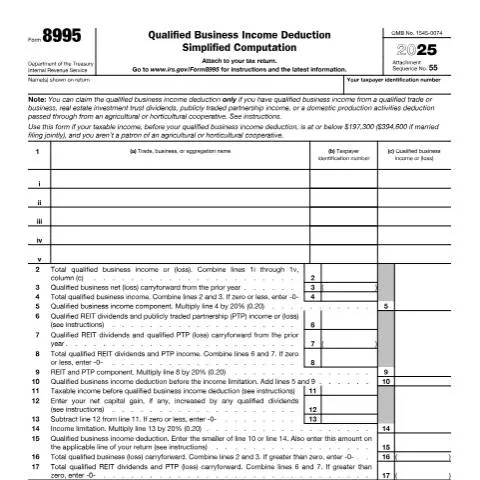
- Trade or Business Identification: You need to provide the name of your trade or business and your taxpayer identification number in the first section.
- Qualified Business Income: You will list your qualified business income or loss. This is done over multiple lines (1i through 1v) depending on how many trades or businesses you have.
- Combining Income: After entering individual income amounts, combine them to find your total qualified business income on line 2.
- Loss Carryforward: If you had a net loss from the previous year, report that on line 3, and then combine this with your current year’s income on line 4 to determine your total qualified business income.
- Calculating the Deduction: The deduction itself is calculated by multiplying the total qualified business income by 20% on line 5. You will need to repeat this process for any qualified REIT dividends or PTP income as indicated on the form.
- Income Limitation: On lines 11 through 14, you'll assess your taxable income and apply any limitations to the deduction based on your total taxable income.
- Final Deduction Amount: The lesser of your calculated deduction or the income limitation will be your final deduction, recorded on line 15 of the form.
By following these steps and ensuring accurate data is entered, you can effectively complete Form 8995 and take full advantage of the QBI deduction.
Where and How to Submit Your Form 8995
Once Form 8995 is completed, the next step is to determine the best method for submission. Taxpayers have several options for submitting their forms, each with its own pros and cons:
| Submission Method | Advantages | Disadvantages |
|---|---|---|
| Online Filing | Quick processing; immediate confirmation; reduces errors | Dependent on technology; potential software costs |
| Paper Filing | Traditional method; no technology required | Longer processing times; risk of lost documents |
| In-Person Submission | Direct interaction; immediate feedback | Limited to certain locations; possible wait times |
For most taxpayers, e-filing is the recommended method. It allows you to benefit from automated calculations, reducing the risk of errors significantly. Nonetheless, it’s essential to verify that the software or service you use supports Form 8995, as not all platforms do.
The Crucial Timeline: When to File and What Follows
Understanding the timeline for filing your tax returns and Form 8995 is vital. The due date for most individual tax returns, including Form 8995, is typically April 15 of the following year. However, if this date falls on a weekend or holiday, it may shift to the next business day.
After submitting your tax return along with Form 8995, several outcomes can follow:
- If accepted without issue, your refund, if applicable, will be processed according to the IRS's schedule.
- Should any errors be found, the IRS may send a notice requesting additional information or clarifications.
- If your deduction is questioned or denied, the IRS will inform you, and you may have the option to appeal or rectify the situation by providing additional documentation.
It’s advisable to keep all records and a copy of your submitted Form 8995 for at least three years, as the IRS can audit returns within that timeframe.
Dealing with Errors and Denials: What to Do Next
Finding out that your submission of Form 8995 has been denied or flagged for errors can be disheartening. However, understanding the steps to rectify such situations can ease your stress:
- Review the Communication: The IRS will typically send a letter outlining the reason for the denial or error. Carefully read this document to understand what is needed next.
- Gather Your Documentation: Collect any documents that support your claim or correct the issue. This may include financial statements, previous year tax returns, or any correspondence related to your business income.
- Respond Promptly: If the IRS requests more information, respond as soon as possible to avoid further complications. You usually have a limited time frame to provide the necessary documentation.
- Consult a Tax Professional: If the situation is complex or if you disagree with the IRS's findings, it may be beneficial to consult with a tax professional who can offer guidance tailored to your specific circumstances.
Errors can often be corrected, and appeals can be filed if necessary. Maintaining a proactive approach can help resolve issues effectively.
Distinguishing Form 8995 from Other Related IRS Forms
Form 8995 is often confused with other IRS forms related to business income and deductions, such as Form 1040 or Form 8995-A. Understanding the distinctions can help ensure you are using the correct form:
| Form | Purpose | Who Should File |
|---|---|---|
| Form 8995 | Claim the Qualified Business Income deduction for eligible taxpayers | Individuals with QBI below income thresholds |
| Form 8995-A | Calculate the QBI deduction for higher-income taxpayers needing more complex calculations | Individuals exceeding the income thresholds or in specified service trades |
| Form 1040 | Individual income tax return | All individual taxpayers, including those claiming the QBI deduction |
Each form has its own specific requirements and purposes, so it’s essential to select the right one to avoid complications and ensure you’re maximizing your eligible deductions.
The Regulatory Framework Supporting Form 8995
Form 8995 exists within a framework shaped by various laws and regulations governing tax deductions in the United States. The Qualified Business Income deduction was introduced as part of the Tax Cuts and Jobs Act of 2017, which significantly altered the landscape of business taxation.
The foundation for this deduction lies in the drive to support small businesses, enabling them to reinvest in their operations and encourage economic growth. The IRS provides guidelines that detail the eligibility criteria, calculation methods, and submission procedures, all of which are crucial for taxpayers and their advisers to understand fully.
In navigating this framework, it’s also important to stay updated on any changes that may occur in future tax laws, as adjustments could directly affect your eligibility for deductions and the overall tax strategy for your business.
Understanding IRS Form 8995: A Comprehensive Overview
IRS Form 8995, officially titled "Qualified Business Income Deduction," is designed for taxpayers who qualify for the Qualified Business Income (QBI) deduction under Section 199A of the Internal Revenue Code. This form is essential for those who are sole proprietors, partners in a partnership, or S corporation shareholders to calculate and claim the QBI deduction correctly. This deduction allows eligible taxpayers to deduct up to 20% of their qualified business income from their taxable income. Understanding the nuances of this form is crucial for effectively managing tax liabilities and maximizing benefits.
The form itself is relatively straightforward, but it includes several key components that require careful attention. Taxpayers must report their QBI, which includes income from eligible trades or businesses, but excludes certain types of income such as capital gains, dividends, and interest income. The form also requires taxpayers to identify their taxable income, which is an important factor in determining the overall deduction. The interaction between various income levels and the QBI deduction can become complex, particularly for high-income earners who may be subject to additional limitations and phase-outs.
Moreover, taxpayers must differentiate between qualified business income and other income types. For example, income from real estate rentals may qualify for the deduction if the activity rises to the level of a trade or business. However, for taxpayers who also earn income from investments or other non-business activities, it is vital to maintain accurate records and documentation to substantiate the QBI amounts claimed on Form 8995.
Eligibility Criteria and Limitations for Claiming the QBI Deduction
To successfully claim the QBI deduction using IRS Form 8995, taxpayers must first meet specific eligibility criteria. The deduction is available to individuals, trusts, and estates that have QBI from eligible businesses, but not all taxpayers will qualify. Notably, the income thresholds play a significant role in determining eligibility and potential limitations. For the tax year 2023, taxpayers with a taxable income of over $182,100 (or $364,200 for married couples filing jointly) may face limitations on their deduction amount, particularly if their income exceeds these thresholds.
Additionally, the nature of the business impacts eligibility. Specified Service Trades or Businesses (SSTBs), which include professions like health, law, consulting, financial services, and performing arts, can be subject to stricter limitations based on taxable income. Taxpayers engaged in SSTBs may see their QBI deduction phased out entirely if their income exceeds certain thresholds. Therefore, understanding whether your business qualifies as an SSTB is crucial for effective tax planning.
Another important consideration is the interaction between the QBI deduction and other types of income. Taxpayers should be aware that the QBI deduction cannot exceed 20% of the taxpayer's taxable income minus any net capital gain. This calculation necessitates careful record-keeping and a clear understanding of all income sources to ensure compliance and optimize potential deductions effectively.
Filing Requirements and Common Mistakes to Avoid
When preparing to file IRS Form 8995, it is essential to adhere to specific filing requirements. This form must be attached to the taxpayer's Form 1040, U.S. Individual Income Tax Return, and filed by the standard deadline of April 15. However, if this date falls on a weekend or federal holiday, the deadline is extended to the next business day. For taxpayers needing additional time, filing for an extension using Form 4868 can give an automatic six-month extension, though any taxes owed must still be paid by the original deadline to avoid penalties and interest.
Common mistakes when completing Form 8995 can lead to missed deductions or potential audits. One frequent error is failing to accurately report QBI. Taxpayers must ensure that the income reported aligns with their business records, including profit and loss statements. Additionally, overlooking the income thresholds can result in underestimating or overestimating one's eligible deduction. Taxpayers should carefully review the instructions provided by the IRS for Form 8995 and keep abreast of any changes or updates for the tax year in question.
Moreover, it’s important to note that while taxpayers can prepare Form 8995 themselves, seeking assistance from a tax professional can be beneficial, especially for those with complex business structures or multiple income sources. A professional can provide valuable insights into maximizing deductions and ensuring the accurate completion of forms to mitigate the risk of errors.
The Role of Record Keeping in Claiming the QBI Deduction
A critical aspect of successfully claiming the Qualified Business Income deduction through Form 8995 is diligent record keeping. Accurate records not only support the amounts reported on the form but also help substantiate the nature of the business activities conducted throughout the year. Taxpayers are advised to maintain comprehensive documentation that includes income statements, expense receipts, and any other relevant financial records. This paperwork becomes invaluable in the event of an IRS audit or inquiry.
For sole proprietors, this may involve keeping detailed logs of all business transactions, including sales receipts and invoices. Partnerships and S corporations must ensure that they maintain thorough accounting records, including K-1 forms, which report each partner's or shareholder's share of income, deductions, and credits.
Additionally, taxpayers should periodically review their records to ensure they accurately reflect their business income and expenses. This practice can help identify any discrepancies or potential issues before filing the tax return. Utilizing accounting software or hiring a professional accountant can facilitate better record management, ultimately leading to a smoother filing process and increasing accuracy.
Planning Ahead: Strategies for Maximizing the QBI Deduction
Maximizing the QBI deduction often requires strategic planning throughout the tax year. Taxpayers should consider various strategies that could enhance their eligibility for the deduction or increase the amount they can claim. One effective strategy is to assess their overall income levels and consider potential adjustments. For instance, deferring income or accelerating expenses may help keep taxable income below the threshold where limitations kick in.
Furthermore, if taxpayers are involved in SSTBs, they might explore restructuring their business operations to qualify for the full QBI deduction by reducing overall income or structuring income more favorably. Consulting with a tax professional can be particularly beneficial in identifying appropriate strategies tailored to individual business circumstances.
Another tactic involves leveraging retirement contributions. Contributing to retirement accounts can lower taxable income, which may help in staying below the income thresholds for receiving the full QBI deduction. Self-employed individuals can explore options like a Solo 401(k) or a Simplified Employee Pension (SEP) IRA to maximize contributions while simultaneously reducing taxable income.
Finally, understanding the nuances of QBI as it relates to specific business activities can lead to better planning. Taxpayers should stay informed about IRS updates and IRS practices regarding QBI and Form 8995, which can evolve over time. Continuous education about changes in tax law and regulations will enable individuals to adapt their strategies effectively.