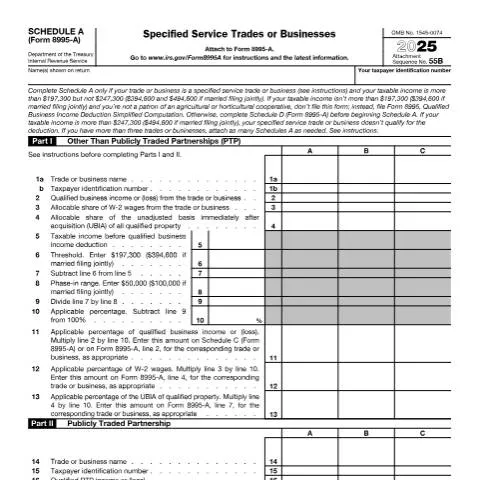
Navigating IRS Form 8995-AA: Understanding Its Impact on Your Tax Return
When it comes to tax filing in the United States, precision is crucial, particularly for small business owners and self-employed individuals. Among the myriad of forms available, IRS Form 8995-AA plays a significant role in determining the allowable deductions for qualified business income (QBI). Understanding this form is essential for maximizing your tax benefits and ensuring compliance with IRS regulations.
Decoding the Structure of Form 8995-AA
IRS Form 8995-AA is specifically designed to facilitate the Qualified Business Income Deduction (QBID) as outlined under Section 199A of the Internal Revenue Code. This deduction can provide substantial tax relief, allowing business owners to deduct up to 20% of their qualified business income from their taxable income. However, the form has specific requirements and implications depending on your income level and business type.
Who Needs to File Form 8995-AA?
- Individuals or entities engaged in a specified service trade or business.
- Taxpayers whose taxable income exceeds certain thresholds.
- Those with multiple business activities needing to calculate QBI for each separately.
To illustrate, if your taxable income is more than $197,300 ($394,600 for married couples filing jointly), then you must complete this form alongside your tax return. In contrast, if your income sits below these thresholds, you will use Form 8995 instead.
Form 8995-AA’s Role in Tax Calculations
At its core, Form 8995-AA serves as a mechanism to differentiate between businesses that qualify for the QBI deduction and those that do not. Specifically, the form allows for the identification of specified service trades or businesses (SSTBs), such as health, law, accounting, and consulting professions. The IRS imposes limitations on the deductions available to SSTBs as income increases, necessitating the accurate completion of this form to determine your eligibility.
Breaking Down the Completion Process
Completing Form 8995-AA requires meticulous attention to detail. A solid understanding of the form’s structure and required information drastically improves the accuracy of your filing.
Step-by-Step Instructions for Filling Out Form 8995-AA
- Identify Your Trade or Business: Begin with the name and taxpayer identification number (TIN) of your business. This information is vital as it links your business activities to your tax ID.
- Calculate Your Qualified Business Income: Determine your QBI, which includes the net income generated by your business activities. Accurate calculations at this stage are critical as they directly impact the deduction amounts.
- Determine Your W-2 Wages: If you have employees, report the total wages paid; this figure is crucial for calculating phase-out limits and the allowable deduction.
- Assess Your Unadjusted Basis of Qualified Property: This includes the cost of any property used in the business, which can also affect your deduction eligibility.
- Completion of Threshold Calculations: Report your taxable income and calculate the phase-in ranges accurately to determine your potential deduction.
- Final Steps: Once all the lines are filled out, double-check your figures for accuracy to avoid potential penalties or audits.
Scenarios Requiring Special Consideration
Not all tax situations are straightforward. Several scenarios necessitate additional attention when dealing with Form 8995-AA.
Complex Business Structures
For taxpayers operating multiple businesses, each entity must be reported separately. In such cases, using additional Schedules A for each trade or business is required. The IRS does allow you to combine income from similar trades, but clear documentation and adherence to guidelines are vital.
Non-Resident Aliens and Foreign Entities
Eligibility for the QBI deduction may differ significantly for non-resident aliens and foreign entities. It is critical to establish whether income is effectively connected with a U.S. trade or business. If not, the taxpayer may not qualify for the deduction regardless of income.
Handling Errors or Missing Information
Errors on Form 8995-AA can lead to significant complications. If you discover mistakes after submission, form amendments can be filed using Form 1040-X. Additionally, if your filing is missing information, such as required schedules or calculations, the IRS may issue a notice, which should be addressed promptly to avoid penalties.
Consequences of Incomplete or Incorrect Filings
Filing Form 8995-AA carries significant weight and can have lasting implications for taxpayers. Failure to accurately complete this form may result in disallowed deductions, increasing overall taxable income and tax liabilities.
Understanding Potential Repercussions
- Increased Tax Liability: An incorrect filing could mean that you miss out on valuable deductions, leading to a higher tax bill.
- Penalties and Interest: If the IRS discovers discrepancies or errors, taxpayers may face penalties and interest on unpaid taxes.
- Audit Risks: The IRS might flag your return for audit if they identify inconsistencies or missing information.
Where to Submit Your Form 8995-AA
Once completed, Form 8995-AA needs to be submitted alongside your annual tax return. It's important to note that the submission methods can vary based on your preferences and filing requirements.
Filing Channels Explained
| Filing Method | Details | Pros and Cons |
|---|---|---|
| Electronic Filing | Submit through authorized e-file providers or IRS e-services. | Fast processing, immediate confirmation; however, may require software fees. |
| Paper Filing | Send completed form by mail to the address listed in the IRS instructions. | Simpler for those less tech-savvy; processing time may be longer. |
| In-person Submission | Take your documents to a local IRS office. | Direct interaction can resolve issues on the spot; limited locations and may require an appointment. |
Closing Thoughts on Form 8995-AA
IRS Form 8995-AA is more than just another tax document—it's a crucial element in ensuring that you maximize your allowable deductions while minimizing your tax obligations. The complexities surrounding its completion and submission underline the importance of careful planning and adherence to IRS guidelines.
For those navigating this terrain, remember that the IRS website provides up-to-date information and resources that can guide you through each step. As tax laws evolve, staying informed is not just beneficial; it's essential for maintaining compliance and securing the best possible outcomes for your finances.
Understanding the Eligibility Criteria for Form F8995-AA
Form F8995-AA is a crucial document for taxpayers who wish to claim the Qualified Business Income (QBI) deduction under Section 199A. Understanding the eligibility criteria is essential for a successful claim. The primary criteria include the type of business, income levels, and the taxpayer's filing status.
Business Type: The form is primarily aimed at pass-through entities such as partnerships, S corporations, and sole proprietorships. Each entity type has its own rules regarding how income should be reported. Taxpayers must ensure that their business qualifies under the IRS definitions applicable to QBI.
Income Thresholds: For tax year 2023, the QBI deduction begins to phase out for single filers with taxable income exceeding $170,050 and for married couples filing jointly at $340,100. Taxpayers must be aware of their taxable income, as exceeding these thresholds could affect the amount of deduction available.
Filing Status: The filing status of the taxpayer can impact the eligibility for claiming the deduction. For instance, certain limitations apply to those with incomes above the thresholds mentioned previously, specifically in specified service trades or businesses (SSTBs). It is crucial for taxpayers to identify their business's classification to understand how it impacts their deduction eligibility.
Understanding these criteria will not only prepare taxpayers for filling out Form F8995-AA but also ensure they maximize their available deductions while remaining compliant with IRS regulations.
Filling Out Form F8995-AA: Step-by-Step Guide
Filling out Form F8995-AA can be intimidating, especially for first-time claimants. This section provides a detailed, step-by-step guide to assist taxpayers in completing the form accurately.
Obtain the Form: Download the latest version of Form F8995-AA from the IRS website. Ensure you are using the correct version for the tax year you are filing, as forms are updated regularly.
Personal Information: The first section requires the taxpayer's personal information, including name, address, and Social Security Number (SSN) or Employer Identification Number (EIN) for businesses. Ensure this information matches your IRS records to avoid processing delays.
Income Determination: In Part I of the form, taxpayers must report their total income from the qualified business. This should reflect the net amount after expenses. Be sure to gather all necessary documents, including profit and loss statements, to support your calculations.
Calculating QBI: In Part II, taxpayers must determine their Qualified Business Income. This calculation may require knowledge of specific deductions tied to each business entity type. It's advisable to refer to IRS Publication 535 for guidance on deductible expenses related to business operations.
Phase-out Adjustments: If your income exceeds the specified thresholds, you will need to make adjustments. Follow the instructions carefully in Part III to calculate the phased-out amount. If uncertain, consider using IRS resources or consulting a tax professional for clarification.
Final Review and Submission: Once completed, review the entire form for accuracy. Check for any mathematical errors and ensure that all sections are filled out appropriately. Submit the form with your annual tax return (Form 1040) by the filing deadline, typically April 15.
By following this step-by-step guide, taxpayers can minimize errors and ensure that they maximize their QBI deduction under the guidelines of Form F8995-AA.
Common Mistakes to Avoid When Filing F8995-AA
Filing Form F8995-AA is critical for many taxpayers, yet several common mistakes can lead to delays or denied claims. This section aims to highlight these pitfalls and how to avoid them.
Incorrect Business Classification: One of the most frequent mistakes involves misclassifying the type of business. Taxpayers often confuse their business structure (e.g., LLC vs. sole proprietorship) which can lead to incorrect income reporting. Always verify your business classification against IRS guidelines to ensure correct reporting.
Neglecting Documentation: Failing to maintain adequate documentation can result in claims being questioned. Taxpayers must retain all records related to QBI calculations, including income statements, receipts for eligible business expenses, and any correspondence with the IRS. Organized records can be invaluable in the event of an audit.
Ignoring Phase-out Rules: Many taxpayers overlook the income thresholds that affect their QBI deduction. It's essential to understand how these thresholds impact your filing. If you believe your income may exceed these limits, consider consulting with a tax professional before filing.
Rounding Errors: Simple mathematical errors can lead to problems. Ensure that all calculations are verified and double-checked for accuracy. Using a calculator or tax preparation software can help mitigate these mistakes.
Late Filing: Missing the filing deadline can result in penalties that are easily avoidable. If you believe you cannot file on time, consider filing for an extension. However, remember that any taxes owed are still due by the original deadline.
By being aware of these common mistakes and taking proactive steps to address them, taxpayers can improve their chances of successfully navigating the complexities of Form F8995-AA.