Understanding IRS Form 8960: A Deep Dive into the Net Investment Income Tax
The Internal Revenue Service (IRS) Form 8960 plays a pivotal role for certain taxpayers in the United States, reflecting a specific financial landscape that requires diligent reporting and compliance. This form is mandatory for individuals, estates, and trusts that fall under the Net Investment Income Tax (NIIT) provision. The NIIT, established under the Affordable Care Act, seeks to impose a 3.8% tax on net investment income for high-income earners. Understanding the intricacies of Form 8960 is crucial for ensuring accurate tax filings and compliance with federal regulations.Who Needs to File Form 8960? Examining the Taxpayer Profiles
Form 8960 is targeted at various taxpayer groups, each with distinct considerations and requirements.Individual Taxpayers
Individuals must file Form 8960 if they have net investment income and their modified adjusted gross income (MAGI) exceeds certain threshold amounts. The thresholds are determined by filing status:- Single Filers: $200,000
- Married Filing Jointly: $250,000
- Married Filing Separately: $125,000
Estates and Trusts
For estates and trusts, Form 8960 becomes necessary when the estate or trust has net investment income and adjusted gross income exceeding $12,750 for 2025. This requirement ensures that these entities also contribute to the tax based on their investment earnings. It’s important for fiduciaries to be aware of these limits to correctly file on behalf of the entity.Exemptions and Special Cases
Certain taxpayers may find themselves exempt from filing this form. For instance, non-resident aliens are not required to file Form 8960. Additionally, individuals who do not have any net investment income or whose MAGI is below the respective thresholds are also exempted. Understanding these exceptions can save taxpayers from unnecessary filing burdens and potential penalties.Timeline for Compliance: Key Dates and Deadlines
When it comes to IRS filings, adhering to deadlines is paramount. For Form 8960, the timeline is aligned with the general tax filing schedule.Filing Deadline
The typical due date for filing Form 8960 is April 15th, coinciding with the deadline for filing individual tax returns using Form 1040. However, if this date falls on a weekend or a holiday, taxpayers can submit their forms on the next business day.Extensions
Taxpayers seeking additional time to complete their returns may apply for an automatic six-month extension using Form 4868. Although the extension allows for more time to file, it does not extend the time to pay any taxes due. Failing to pay the owed taxes by April 15 can result in penalties and interest.Post-Filing Considerations
Once Form 8960 is filed alongside the tax return, taxpayers should be on the lookout for any correspondence from the IRS, as audits or additional requests for information may follow. Keeping thorough records of investment income and tax documents is advised for at least three years post-filing in case of discrepancies.Submission Channels: Navigating the Filing Process
The IRS provides various channels for submitting Form 8960, each with unique advantages and considerations. Understanding how to navigate these options ensures taxpayers comply efficiently.Filing Online
The most streamlined method for submission is through electronic filing (e-filing). Many tax preparation software options are available that guide users through the completion of Form 8960, capturing necessary calculations and ensuring accuracy. E-filing tends to be faster, and taxpayers often receive confirmation of receipt from the IRS more quickly than with paper submissions.Paper Filing
For those who prefer traditional methods, Form 8960 can be completed and mailed directly to the IRS. It’s important to use the correct mailing address, which can vary depending on whether the taxpayer is enclosing a payment. When filing by paper, it is advisable to use certified mail or another trackable service to ensure the IRS receives the submission.In-Person Options
While most taxpayers choose e-filing or mail submissions, some may opt to visit a local IRS office. However, it is essential to schedule an appointment in advance. Visiting a local office can provide personalized assistance, particularly for complex tax situations or if the taxpayer has questions regarding their filing.Deciphering the Form: Step-by-Step Completion of Form 8960
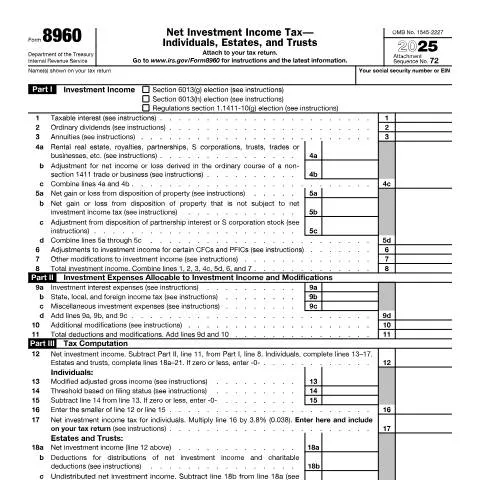
Completing Form 8960 requires careful attention to detail. The form can be divided into three main parts, each necessitating specific information.Part I: Reporting Investment Income
In this section, taxpayers must report various forms of taxable investment income including:- Taxable interest
- Ordinary dividends
- Annuities
- Rental income and royalties
- Net gain or loss from property sales
Part II: Investment Expenses
Taxpayers can also report investible expenses related to the income reported in Part I. This section allows for deductions that can lower the net investment income to be taxed. Common deductions include:- Investment interest expenses
- State and local income taxes
- Miscellaneous investment expenses
Part III: Tax Calculation
In the final section, the actual tax owed is calculated based on the information provided in the previous parts. Here, the taxpayer will determine their net investment income and apply the 3.8% tax rate. It's crucial for individuals and fiduciaries to correctly assess which line items to include in their final calculations to avoid errors that could lead to additional tax liabilities or audits.Investment Income and Special Cases: Unique Considerations for Filing
In some scenarios, taxpayers may encounter unique circumstances that necessitate a deeper understanding of Form 8960 and its implications.Foreign Investments and Taxation
For U.S. citizens and residents with foreign investments, navigating the complexities of international taxation can be daunting. Income derived from foreign sources may also be subject to NIIT, complicating the reporting process. Taxpayers must ensure they are aware of foreign tax credits and treaties that may affect their net investment income calculations.Trusts and Estates: Navigating Complexities
Filing for estates and trusts often involves additional complexities. The fiduciary must ensure accurate reporting of income and deductions to comply with both federal and state tax regulations. Understanding how distributions affect the net investment income tax for trusts is essential, especially since beneficiaries may also have tax obligations associated with distributions received.The Regulatory Framework Behind Form 8960
To appreciate the purpose of Form 8960 fully, it’s vital to understand the regulatory framework that governs it. The Net Investment Income Tax is a product of the Affordable Care Act and aims to generate additional revenue for Medicare and other health-related initiatives.The Legislative Background
Enacted in 2013, the NIIT applies to taxpayers with high incomes to contribute toward funding for health care. This form is a direct result of a broader fiscal strategy aimed at ensuring that higher earners pay their share in supporting federally mandated programs.Future Implications and Changes
Given the often-changing landscape of tax legislation, staying informed about any potential changes or adjustments to Form 8960 or the NIIT is crucial. Taxpayers should remain vigilant and consult updated IRS guidelines or tax professionals to ensure compliance with current laws.Final Thoughts on Navigating IRS Form 8960
In conclusion, IRS Form 8960 represents a critical compliance tool for individuals, estates, and trusts navigating the complexities of the Net Investment Income Tax. By understanding the filing requirements, potential exemptions, and the nuances of completing the form, taxpayers can avert unnecessary complications and ensure they meet their tax obligations fully. Maximizing deductions and staying informed about the broader regulatory environment will further empower taxpayers in their financial decision-making and tax planning strategies. Taxation can be complex, but approach it with diligence, and every taxpayer can navigate their requirements in peace.Understanding the Implications of Form 8960 on Your Tax Obligations
Form 8960, officially titled "Net Investment Income Tax—Individuals, Estates, and Trusts," is crucial for taxpayers whose income derives significantly from investments. This tax was introduced under the Affordable Care Act and applies to individuals with a modified adjusted gross income (MAGI) over certain thresholds. For single filers, this threshold is $200,000; for married couples filing jointly, it is $250,000. Understanding how to compute your net investment income (NII) is essential, as it directly impacts your overall tax liability.
Net investment income includes, but is not limited to, interest, dividends, capital gains, rental income, and certain royalties. However, it’s vital to note that not all investment income counts towards this tax. For instance, income derived from tax-exempt municipal bonds is excluded, as are distributions from retirement accounts. Furthermore, taxpayers must also consider the specific categories of allowable deductions against this income to accurately fill out Form 8960.
Understanding how to properly report these figures requires a careful assessment of your financial situation, particularly how various forms of income interact with one another. Taxpayers might consider working with a tax advisor to navigate complicated situations, especially if you have multiple sources of investment income, or if you're experiencing significant fluctuations in income that could affect your MAGI from year to year.
Common Mistakes When Filing Form 8960 and How to Avoid Them
Filing Form 8960 can be challenging, and many taxpayers make common errors that could lead to delays or increased tax liabilities. Here are some typical mistakes and how to avoid them:
- Incorrect Calculation of Modified Adjusted Gross Income (MAGI): Many taxpayers mistakenly overlook certain income sources while calculating their MAGI. Ensure that you are accounting for all income types correctly. It is advisable to double-check your prior year tax returns and consult IRS guidelines to ensure compliance.
- Failing to Report Exemptions: Not every form of investment income is subject to the Net Investment Income Tax. For instance, as mentioned, tax-exempt income should not be included in your NII calculations. Familiarize yourself with what qualifies as exempt income to avoid unnecessary tax exposure.
- Omitting Deductions: You may be eligible for specific deductions related to your investment income. Failing to account for these can lead to a higher tax bill. Make sure to review IRS Publication 925 for guidance on allowable deductions that can help reduce your NII.
- Relying Solely on Tax Preparation Software: While tax software can assist in filing your taxes, they may not cover all specific situations related to Form 8960 accurately. If your investment portfolio is complex, hiring a tax professional who understands the intricacies of NII can save you time and potential penalties.
When to Seek Professional Help with Form 8960
While many taxpayers can successfully file Form 8960 on their own, there are specific scenarios where seeking professional assistance may be well warranted. If you find yourself in any of the following situations, it may be a good idea to consult a tax professional:
- Substantial Investment Income: If your investment income makes up a considerable part of your overall income, the calculations for NII can become complex. Professionals can provide tailored advice to optimize tax strategies that align with your financial goals.
- Changes in Filing Status: If you've recently changed your filing status—such as from married to single or vice versa—it's essential to understand how these changes impact your MAGI and, subsequently, your tax obligations. A tax expert can help navigate these changes.
- Complicated Investment Situations: Taxpayers with diverse investments, such as foreign investments, partnerships, or real estate, should seek professional help. These situations can complicate the net investment income reporting process, making it critical to ensure compliance with all laws and regulations.
- Absence of Tax Records: If you've lost essential tax documentation or if your financial records are incomplete, a tax professional can assist in reconstructing your financial history to support a complete and accurate filing.
By being mindful of your individual circumstances and the nuances of tax law, you can effectively navigate the complexities of Form 8960. Always prioritize staying informed and proactive regarding your tax responsibilities to minimize risks and ensure compliance with federal regulations.