Navigating the Waters of IRS Form 11-C: Your Guide to Occupational Tax on Wagering
When it comes to the world of wagering, understanding the regulatory framework is crucial for anyone involved in this industry. Among the essential documents that players in this arena must be familiar with is the IRS Form 11-C, or the Occupational Tax and Registration Return for Wagering. This form serves multiple critical functions in ensuring compliance with federal tax laws, and its importance cannot be overstated. If you’re involved in accepting wagers, whether as a principal or an agent, knowing how to navigate this form can save you from penalties and complications down the line.
The Purpose and Scope of Form 11-C
Form 11-C is more than just a bureaucratic hurdle; it is a necessary step in registering to operate legally in the wagering industry. Potential filers include:
- Principals: Those who accept wagers for their own account.
- Agents: Individuals who accept wagers on behalf of a principal.
The form not only registers you with the IRS but also requires you to pay an occupational tax on wagering. Depending on the nature of the wagers, the tax can either be $50 or $500. It’s essential to accurately identify your business type and the nature of the wagers you are accepting to determine your tax obligation correctly. Misclassifying your operation can lead to serious legal repercussions.
Filing Requirements and Deadlines: What You Need to Know
For anyone in the wagering business, timely filing is critical. The rules are straightforward:
- Initial Filing: The first return must be submitted before you start accepting wagers. This ensures that you are registered and compliant from the get-go.
- Renewal Returns: After your initial filing, the IRS requires a renewal return by July 1 each year. This is essential to maintain your registration status.
Failing to file on time can result in penalties and may complicate your ability to operate legally. Additionally, keep in mind that if you are filing a first return, it should reflect not only your initial intention to accept wagers, but also the anticipated duration of your operations.
Understanding the Sections of Form 11-C: A Closer Look
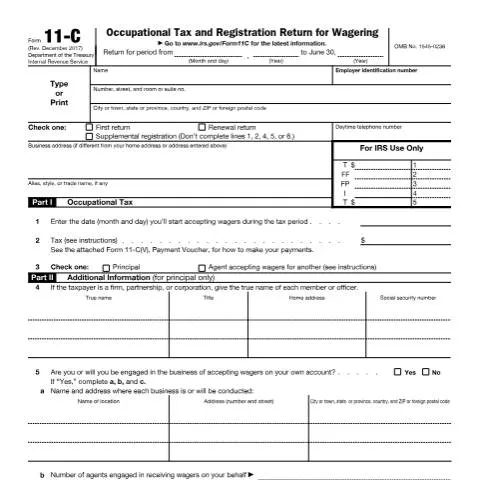
Form 11-C is divided into several parts, each of which serves a specific purpose. Understanding these sections is crucial for a smooth filing process.
Part I: Occupational Tax
This section requires the effective start date of accepting wagers during the tax period. Ensure you fill this out accurately.
| Section | Description |
|---|---|
| Line 1 | Enter the date you'll begin accepting wagers. This is critical for your tax period. |
| Line 2 | Input the appropriate tax amount, $50 or $500, based on your operation type. |
Pay close attention to how you classify your business. Incorrect classifications can lead to errors in tax amounts, leading to penalties.
Part II: Additional Information for Principals
In this part, principals must disclose information about the business structure. This includes:
- Names and titles of all officers.
- Business addresses.
- Social Security numbers (SSNs) for verification purposes.
Completing this section correctly is essential to establish your legitimacy as a business entity. Any discrepancies can lead to unnecessary delays or rejections in processing your application.
Part III: Information for Agents
If you are an agent accepting wagers on behalf of a principal, this part is vital. Here, you must provide the true names, addresses, and employer identification numbers of those you represent.
Failure to accurately list this information can lead to complications in your registration, potentially jeopardizing your ability to operate legally.
Part IV: Supplemental Registration
This section is for those who are filing a supplemental registration. Reasons for supplementation can vary widely, and clarity here is key.
Be prepared to explain why you are submitting this additional information, including the date of the event necessitating the supplemental registration. This could involve changes in operations or expansions of your business.
Strategies for Successful Submission: Avoiding Common Pitfalls
As with any government form, there are common barriers that can hinder successful completion of Form 11-C. Here are several strategies to help you navigate these pitfalls:
- Double Check Dates: Ensure all dates are accurate, especially the start date for wagers, as this can affect your tax period.
- Cross-verify EINs: Employer Identification Numbers (EINs) must be accurate to avoid delays in approval.
- Seek Guidance: Utilize IRS resources to clarify any uncertainties before submission.
Remember, your submission serves as a legal declaration; thus, any inaccuracies may not only lead to tax liabilities but also potential legal consequences.
Post-Submission: Following Up and Handling Issues
After submitting Form 11-C, you may wonder what the next steps are. Here’s a practical roadmap:
- Confirmation: You should receive confirmation from the IRS regarding your filing. Keep an eye on this, as it serves as proof of your registration.
- Review Status: You can periodically check the status of your application by contacting the IRS directly. This ensures you stay informed on any potential issues.
- Respond Promptly: Should the IRS require additional information or clarification, respond as quickly as possible to mitigate any delays.
Being proactive post-submission can prevent unnecessary headaches in the future.
Dealing with Errors or Rejections: Your Options
If your Form 11-C is rejected or you discover an error post-submission, it’s vital to address this swiftly:
- Documentation: Gather all relevant documents and communications with the IRS as you prepare to remedy the issue.
- Correction Process: You may need to submit a corrected form or additional documentation, depending on the nature of the error.
- Consultation: If you find yourself in a complex situation, consider consulting a tax professional who can guide you through the corrections process.
Timeliness is crucial; the sooner you act, the better your chances of resolving any issues effectively.
Final Thoughts: The Implications of Compliance
Completing and submitting IRS Form 11-C is an essential step for anyone involved in wagering activities in the United States. With the stakes high in this industry, not only financially but legally, understanding the nuances of this form can make all the difference between operating smoothly and facing substantial penalties.
Stay informed, seek help when necessary, and ensure that each detail on your Form 11-C is correct. This diligence not only safeguards your business but also enhances your standing in a heavily regulated industry.
For the latest updates or changes to Form 11-C, always refer to the official IRS website at www.irs.gov/Form11C.
Understanding IRS Form F11C: Who Needs to File?
IRS Form F11C, officially known as the "Federal Insurance Contributions Act (FICA) Tax Return for Employees," is specifically designed for employers who have withheld FICA taxes from their employees. Understanding who is required to file this form is crucial for compliance with federal tax laws. Generally, any employer who pays wages to employees is obligated to file this form if they meet specific thresholds for withholding FICA taxes.
Employers need to keep in mind that FICA taxes comprise Social Security and Medicare taxes. Employers are responsible for withholding these taxes from their employees’ wages and for contributing an equal amount themselves. Therefore, if your business has employees and you withhold FICA taxes, you will typically need to file Form F11C.
However, there are exceptions. For instance, certain small employers, such as those with fewer than five employees or those whose total wages paid were below the annual limit set by the IRS, may not need to file. It's essential to check the latest IRS publications or consult with a tax professional to determine your specific filing requirements, as these can change yearly.
Navigating Common Errors When Filing Form F11C
Filing IRS Form F11C can be straightforward, but many employers encounter common pitfalls that can lead to delays or penalties. Understanding these errors and how to avoid them can save both time and money.
One common mistake is failing to report wages accurately. Employers must ensure that the total wages reported match the actual amounts paid to employees. This includes not only base salaries but also bonuses, overtime, and other forms of compensation. Discrepancies can lead to audits and additional scrutiny from the IRS.
Another frequent issue is incorrect employee information. Form F11C requires accurate taxpayer identification numbers (TINs). Employers should verify that they have the correct Social Security Numbers (SSNs) for all employees, as errors can result in penalties. Consider utilizing the IRS’s TIN Matching Program, which can help identify discrepancies before submission.
Additionally, employers often overlook the deadlines for filing Form F11C. The form is typically due at the same time as the employer's income tax return, which usually falls on April 15. Late filings can incur penalties, so it's crucial to mark your calendar and ensure timely submission. If you anticipate difficulties meeting the deadline, consider applying for an extension through the IRS, but be aware that an extension to file is not an extension to pay any taxes owed.
Amending a Previously Filed Form F11C
If you discover an error after submitting IRS Form F11C, it's essential to act quickly. The process of amending a previously filed form can be straightforward, but it requires careful attention to detail to avoid further complications.
To amend Form F11C, you must file a corrected version of the form, indicating the changes made. Include a statement explaining the amendments and the reasons for the changes. Be sure to highlight the specific sections that have been altered, as this can facilitate the review process by the IRS.
Submitting an amendment can trigger additional scrutiny from the IRS, especially if there are significant discrepancies in reported wages or withheld taxes. It’s advisable to maintain thorough documentation of all payroll records and tax withholdings to support your amendments. This includes keeping copies of previous filings, W-2 forms, and any correspondence with the IRS.
Employers should also be aware that penalties can apply for underreporting and failing to correct mistakes in a timely manner. Therefore, consulting a tax professional when amending any IRS forms can ensure compliance and offer guidance on best practices to avoid similar issues in the future.