Navigating IRS Form 1118SJ: A Comprehensive Overview
When dealing with international tax compliance, understanding IRS Form 1118SJ is crucial for corporations. This form plays a vital role in determining foreign tax credits and ensuring equitable taxation for U.S. companies operating abroad. Failure to accurately complete this form can lead to significant financial repercussions. This guide delves into the details of form 1118SJ, offering insights into its purpose, who needs to file it, and how to correctly navigate its complexities.
The Importance of Form 1118SJ in Corporate Tax Strategy
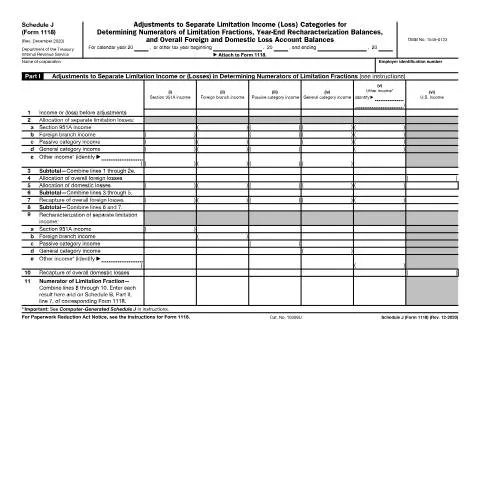
IRS Form 1118SJ, also known as Schedule J, is an attached form used in conjunction with Form 1118. It is essential for corporations that are calculating the foreign tax credit, which allows taxpayers to reduce their U.S. tax obligation based on the taxes paid to foreign governments. This form specifically focuses on the adjustments to separate limitation income or losses, which are crucial for determining the numerator of limitation fractions necessary to compute eligible foreign tax credits.
The significance of this form can be summarized by several key components:
- Foreign Tax Credit Calculation: The form assists in accurately calculating the claim for foreign tax credits, ensuring that U.S. corporations do not face double taxation on income earned abroad.
- Compliance with IRS Regulations: Proper completion of Form 1118SJ is vital for meeting IRS compliance requirements, avoiding potential audits or penalties.
- Impact on Financial Statements: Accurate tax reporting can affect a corporation's financial standing and stakeholder perception, making this form critical for corporate governance.
Who Must File Form 1118SJ?
Understanding your obligation to file Form 1118SJ is fundamental for compliance. Generally, U.S. corporations that earn income from sources outside the United States are required to prepare this form as part of their tax filings. Here are the primary categories of entities that need to be aware of this requirement:
- Domestic Corporations: Corporations subject to U.S. taxation must file this form if they claim foreign tax credits.
- Controlled Foreign Corporations (CFCs): U.S. shareholders of CFCs reporting income need to incorporate Form 1118SJ into their filings to track foreign income and taxes accurately.
- Corporations with Foreign Branches: Any U.S. corporation operating foreign branches that incur foreign taxes will need to submit this form to claim relevant credits.
Understanding the Sections of Form 1118SJ
To effectively navigate Form 1118SJ, it is essential to break down its sections. The form comprises various parts, each designed to gather specific information regarding foreign income, losses, and tax credits. Here's a detailed overview:
Part I: Adjustments to Separate Limitation Income or (Losses)
This section requires the corporation to provide details on its income or loss before adjustments, categorized by type. Understanding the different categories is critical to ensuring accurate reporting.
- Section 951A Income: Includes items such as Global Intangible Low-Taxed Income (GILTI).
- Foreign Branch Income: Relevant for branches operating outside the U.S.
- Passive Category Income: Income from investments that do not involve active management.
- General Category Income: This typically includes all other income sources.
Corporations need to accurately fill out the allocation of income and losses in this section to ensure clarity in the numerator of limitation fractions.
Part II: Year-End Balances of Future Separate Limitation Income
Here, corporations report future expected income that must be recharacterized. This part is crucial to manage expectations for future foreign tax credits and ensure proper tracking.
Part III: Overall Foreign Loss Account Balances
This section gathers data on overall foreign losses that can affect the corporation's ability to claim credits in the future. It is important to provide accurate opening and closing balances and account for current year additions and reductions.
Part IV: Overall Domestic Loss Account Balances
Similar to Part III, this section focuses on domestic losses. Understanding how domestic losses interact with foreign income is essential for maintaining tax compliance and optimizing tax strategies.
A Step-by-Step Guide to Filling Out Form 1118SJ
Completing IRS Form 1118SJ involves several precise steps. Here’s a detailed walkthrough to guide you through the filing process:
- Gather Required Information: Collect all necessary financial records, including foreign income statements, tax payments, and prior year tax returns. This preparation phase is essential for ensuring accuracy.
- Complete Part I: Start by calculating your income or loss before adjustments. Pay close attention to how you allocate income among different categories.
- Fill Out Part II: Report your year-end balances for future separate limitation income. This involves assessing projections based on your income-generating activities.
- Complete Parts III and IV: Document your overall foreign and domestic loss account balances accurately, ensuring that you reflect any recaptures from prior periods.
- Double-Check Entries: Review each entry for potential errors, ensuring compliance with IRS guidance and accuracy in calculations.
- Attach to Form 1118: After completing Form 1118SJ, you must attach it to Form 1118 before submission.
Handling Errors or Missing Information
Encountering errors or missing information while filing Form 1118SJ can be daunting, but addressing these issues promptly is vital. Here are steps to take if you find discrepancies:
- Identify the Error: Review the form to pinpoint where the error occurred, whether in calculations or missing documentation.
- Gather Necessary Documentation: Assemble supporting documents to rectify the error. This may include financial statements or tax payment receipts.
- File an Amended Return: If the return has already been submitted, consider filing an amended return using Form 1120-X to correct any mistakes.
- Consult a Tax Professional: If the error is complex or the amount involved is substantial, it's advisable to seek assistance from a tax expert.
Case Studies: Unique Situations Requiring Special Attention
Various circumstances can complicate the filing of Form 1118SJ. Here are several scenarios where unique considerations apply:
Situation 1: Foreign Income from Multiple Jurisdictions
Corporations operating in multiple countries must navigate the complexities of foreign tax laws. Accurate reporting of income from each jurisdiction is crucial, as tax treaties and local tax laws may impact how you complete the form.
Situation 2: Changes in Ownership or Structure
If a corporation undergoes a merger or acquisition, the implications for foreign tax credits and losses need to be carefully assessed. The corporation must evaluate how changes in ownership affect its tax liabilities and credits moving forward.
Situation 3: Economic Downturns
In times of economic uncertainty, corporations may experience significant losses, affecting their ability to claim foreign tax credits. It’s essential to track these losses accurately to maximize potential credits in future tax years.
Conclusion: Ensuring Accurate Compliance with IRS Form 1118SJ
Successfully navigating IRS Form 1118SJ is a critical component of corporate tax strategy for entities engaged in international business. Understanding its sections, completing it accurately, and addressing potential issues proactively can safeguard against compliance risks and optimize tax benefits. For U.S. corporations operating in the global market, investing time in mastering this form is not just advisable—it's essential for sound financial management and regulatory adherence. The implications of misreporting can be profound, making diligence in this area pivotal for long-term success.
Understanding IRS Form 1118-SJ: Key Objectives and Filing Requirements
IRS Form 1118-SJ, officially known as the "Foreign Tax Credit - Corporations" form, is designed for U.S. corporations that operate internationally. This form allows corporations to claim a credit for foreign taxes paid, which can offset U.S. tax liability. Understanding its primary objectives is crucial for corporations looking to maximize their tax benefits and ensure compliance with U.S. tax laws.
The primary objective of Form 1118-SJ is to provide a structured way for corporations to report foreign tax credits effectively. Companies engaged in international business must navigate various tax implications, including double taxation. The U.S. government allows for foreign tax credits to alleviate this burden, which is particularly important for corporations that derive income from overseas sources.
Filing requirements for Form 1118-SJ are generally mandated for corporations that have paid foreign taxes on income that is also subject to U.S. tax. This includes income received through foreign branches or subsidiaries. To qualify for the credit, corporations must ensure that the foreign taxes paid are legal and final, meaning they cannot be refunded or subject to adjustment in the future. Additionally, the taxes must be assessed during the tax year for which the corporation is filing.
When preparing Form 1118-SJ, corporations must provide detailed information regarding foreign income earned, taxes paid to foreign governments, and any relevant deductions. It is essential to maintain meticulous records to substantiate the foreign tax credits claimed, as the IRS may require documentation during audits. Corporations must also be aware of the foreign tax credit limitation, which caps the credit based on the proportion of foreign income to total income.
Navigating Foreign Tax Credit Limitations
One crucial aspect of using IRS Form 1118-SJ is understanding the limitations imposed on foreign tax credits. The IRS has established a limitation to ensure that the credit does not exceed the amount of U.S. tax liability on foreign-sourced income. This limitation can be particularly challenging for corporations with diverse international operations, as each country’s tax rates and structures differ significantly.
The limitation, often referred to as the "FTC limitation," is calculated by multiplying the total U.S. tax liability by the ratio of foreign-source income to total income. This calculation can be intricate, especially for multinational corporations with various sources of income across different jurisdictions. As a result, corporations may need to prepare detailed calculations to accurately determine their foreign tax credit limits.
Furthermore, corporations must consider the impact of any carryover provisions. If a corporation’s foreign tax credits exceed the limitation in a given tax year, they may be eligible to carry those credits backward to the previous year or forward to future tax years. However, the carryover period is limited to one year for carrybacks and up to ten years for carryforwards. Companies need to plan strategically as they maximize their foreign tax credits over the applicable years.
Companies should also keep in mind that the foreign tax credits claimed must be allocated between passive and general income categories. This allocation can influence the amount of credit a corporation can use in each category and should be carefully calculated to optimize tax benefits.
Impact of International Tax Reform on Form 1118-SJ Filings
The landscape of international taxation has evolved significantly in recent years, particularly with the enactment of tax reforms such as the Tax Cuts and Jobs Act (TCJA). These changes have substantial implications for how corporations complete IRS Form 1118-SJ and claim foreign tax credits. Understanding these reforms is vital for corporations engaged in international business.
One of the most significant changes from the TCJA was the introduction of a territorial tax system for U.S. corporations. This system aims to reduce the tax burden on foreign income and encourages companies to repatriate foreign earnings without incurring additional U.S. tax liabilities. While this shift has various benefits, it also complicates the filing process for Form 1118-SJ. Corporations must now navigate the interactions between the foreign tax credit and the new rules regarding repatriated earnings.
Additionally, the TCJA introduced specific provisions to prevent base erosion and profit-shifting (BEPS). These measures require corporations to keep detailed records of their foreign tax payments and assess the impact of foreign taxes on their earnings more rigorously. As a result, companies may need to invest in updated tax software or accounting practices to ensure compliance with the evolving regulatory landscape.
Moreover, the international tax reform has prompted the IRS to enhance its guidance on the use of Form 1118-SJ, aiming to clarify reporting requirements and limitations associated with foreign tax credits. Corporations are advised to closely monitor updates from the IRS and consult tax professionals to ensure their filings remain compliant amidst the changing tax environment.
In conclusion, while IRS Form 1118-SJ serves a vital role for U.S. corporations seeking foreign tax credits, navigating its complexities requires a thorough understanding of both the form itself and the broader international tax context. By comprehensively preparing for the implications of international tax reforms, corporations can better manage their tax liabilities and optimize their financial strategies.