Navigating the 400-ITR and 440-EMO Instructions: Essential Guidance for Tax Filers in Trinidad and Tobago
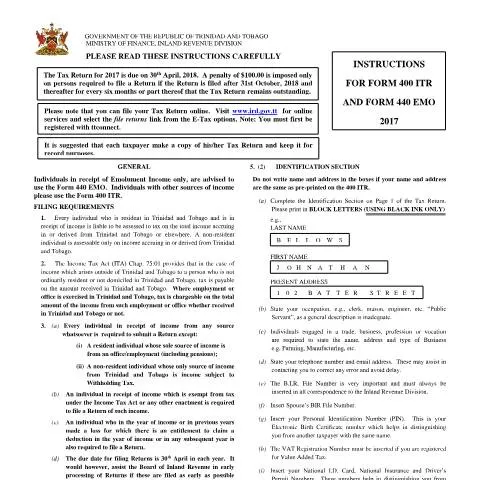
Understanding the intricacies of the tax system in Trinidad and Tobago is essential for residents and non-residents alike. The 400-ITR and 440-EMO Instructions provide critical insights into the Income Tax Return process, specifically designed for individuals receiving Emolument Income and those with multiple income streams. This guide will unravel the complexities of the forms, illustrate how they interconnect with other documents, and equip you with practical steps to ensure compliance.
The Importance of Distinguishing Between the Two Forms
At the crux of Trinidad and Tobago's tax return filing is the distinction between Form 400 ITR and Form 440 EMO. While both forms serve the purpose of tax assessment, they cater to different profiles of taxpayers:
- Form 440 EMO: This form is tailored for individuals whose income is solely derived from employment. It simplifies the filing process for those who do not have additional income sources.
- Form 400 ITR: Designed for individuals with various income streams, this form requires a more comprehensive disclosure of income sources, gains, or profits.
Each form has specific filing requirements outlined in the Income Tax Act, ensuring that all residents and non-residents who generate income comply with the law. Notably, non-residents are taxable only on income accrued within Trinidad and Tobago.
When to Use Each Form: A Practical Guide
Understanding when to use the appropriate form can save time and ensure compliance:
| Condition | Form 440 EMO | Form 400 ITR |
|---|---|---|
| Income source exclusively from employment | Yes | No |
| Income includes other sources (e.g., rental, investments) | No | Yes |
| Non-resident status with income subject to Withholding Tax | No | Yes |
Filing Requirements and Critical Deadlines
All individuals receiving income in Trinidad and Tobago must file a tax return, with a notable exception for residents whose sole income source is from employment. The due date for filing returns is consistently set for April 30th of each year. The Board of Inland Revenue encourages early filing to facilitate quicker processing.
Taxpayers must be particularly vigilant regarding tax penalties. Failing to file by the due date can result in a $100 penalty for late submissions, compounded every six months thereafter. Such financial repercussions emphasize the need for timely compliance with tax obligations.
Documenting Changes: Updating Registration Information
Changes in personal circumstances such as name or address must be reported on the tax return. Taxpayers are required to:
- Tick the change box at the top of Page 1 of the form.
- Provide supporting documents for any name changes (e.g., Marriage Certificate, Deed Poll).
- Ensure accuracy in the Identification Section, including using block letters in black ink.
This step is crucial as it affects the accuracy of communication with the Inland Revenue Division, which relies on correct details to process returns efficiently.
Understanding the Identification Section
The Identification Section of the form is pivotal for ensuring correct identification and processing of tax returns. Key details required include:
- Your full name and address, unless pre-printed on the form.
- Your occupation with specific details—general terms like "Public Servant" are insufficient.
- Contact information, including telephone and email, to facilitate communication regarding your tax return.
- Your BIR File Number, which is essential for all correspondence with the Inland Revenue Division.
Missing or incorrect information in this section can lead to delays in tax return processing and potential penalties. Therefore, ensuring completeness and accuracy cannot be overstated.
The Role of the Declaration: Ensuring Accountability
Completing and signing the General Declaration on the 400-ITR or 440-EMO forms is a critical step. This declaration not only confirms the accuracy of your submitted information but also places accountability on the taxpayer:
- Any individual who knowingly makes a false statement on their tax return may face severe legal consequences.
- Failure to sign the return will result in processing delays, complicating your tax situation further.
Thus, it is imperative to understand the weight of this declaration and the repercussions of providing inaccurate information.
Common Misinterpretations and Pitfalls in Filing
While the 400-ITR and 440-EMO Instructions are designed to provide clarity, certain aspects can lead to misinterpretation:
- Assuming sole employment income exempts you from filing is misleading. Some exemptions exist, but it is essential to review your circumstances carefully.
- Confusing residency requirements can lead to incorrect tax filings. Remember, a resident must spend at least 183 days in the country to qualify for tax credits.
- Neglecting to include all income sources may lead to penalties. Comprehensive reporting is critical.
Awareness of these common pitfalls can help taxpayers avoid costly mistakes in their filings.
Leveraging Online Resources for Filing
To ease the tax filing process, the Inland Revenue Division offers e-Tax, a digital platform that simplifies filing returns. Taxpayers can access online services and submit their returns electronically. However, registration through ttconnect is essential to utilize these features.
Utilizing online filing not only expedites the process but also allows taxpayers to keep informed about their tax obligations and any changes in regulations.
Conclusion: Your Path to Tax Compliance in Trinidad and Tobago
Utilizing the 400-ITR and 440-EMO Instructions effectively is vital for meeting tax obligations in Trinidad and Tobago. From understanding which form to use, adhering to deadlines, and accurately completing the necessary sections, each aspect plays a crucial role in tax filing compliance. By following these guidelines and leveraging available resources, taxpayers can confidently navigate the tax landscape and mitigate potential issues associated with incorrect filings or missed deadlines.
Understanding the 400-ITR Tax Return for Individuals
The 400-ITR form, known as the 'Individual Tax Return,' is crucial for taxpayers in Trinidad and Tobago who need to report their income and any applicable deductions to the Board of Inland Revenue (BIR). Individuals must submit this form annually, with the due date falling on April 30th of the year following the end of the fiscal period.
When filling out the 400-ITR, it is essential to be aware of the different income categories that must be reported. This includes employment income, business income, rental income, and investment earnings. Additionally, taxpayers should be prepared to detail any allowable deductions they plan to claim, such as contributions to pension plans, educational expenses, or medical costs. The BIR provides a comprehensive guide to what constitutes allowable deductions, which can be found on their e-Tax portal.
Failure to file the 400-ITR can result in penalties and interest on unpaid taxes, making it imperative for individuals to adhere to the deadline. In cases where citizens are unable to file by the due date, the BIR allows for extensions, provided that a request is submitted and approved. Taxpayers can utilize their ttconnect ID to access e-Tax services, which simplifies the filing process and improves compliance.
Navigating the 440-EMO Instructions for Employment Tax Withholding
The 440-EMO, or 'Employer Monthly Obligation Report,' is an essential document for employers in Trinidad and Tobago. This report is submitted monthly to the BIR and outlines the taxes withheld from employee salaries, including Pay As You Earn (PAYE) taxes. Understanding the requirements and instructions for this form is crucial for maintaining compliance with tax regulations.
Employers are required to provide accurate information regarding the total gross salaries paid, along with the corresponding amount withheld for tax purposes. The 440-EMO form also necessitates detailing any statutory deductions, such as National Insurance contributions, which are vital for employees' welfare benefits.
Employers must be diligent in ensuring that the report is submitted by the 15th of the following month to avoid penalties. If an employer fails to submit the 440-EMO or submits incorrect information, they may face significant fines and potential audits from the BIR. Furthermore, maintaining accurate payroll records is critical not only for the submission of the 440-EMO but also for any potential future inquiries from the BIR.
For ease of access, employers can utilize the e-Tax platform to file the 440-EMO electronically. This online system not only streamlines the submission process but also provides a secure way to manage tax obligations. Employers are encouraged to register for online services and to familiarize themselves with the digital tools available through the BIR website.
Key Considerations for Filing Tax Returns as a Self-Employed Individual
Self-employed individuals in Trinidad and Tobago face unique challenges when it comes to filing their tax returns, particularly with the 400-ITR form. Unlike salaried employees, self-employed individuals must be proactive in calculating their tax liabilities, keeping comprehensive records, and understanding the implications of their business income on their overall tax obligations.
One of the most significant considerations for self-employed taxpayers is maintaining accurate and organized financial records throughout the year. This includes tracking income, expenses, and any applicable deductions that can reduce taxable income. Self-employed individuals should consider retaining receipts and invoices or using accounting software to streamline this process.
Moreover, self-employed persons are required to make estimated tax payments if their tax liability exceeds a certain threshold, as established by the BIR. These payments are typically made quarterly and help prevent underpayment penalties at the end of the fiscal year. Therefore, understanding the timeline for these estimated payments is essential for financial planning.
Another important aspect is the potential for claiming deductions specific to self-employment, such as home office expenses, equipment depreciation, and business-related travel costs. It is advisable to consult with a tax advisor who can provide guidance on maximizing deductions while ensuring compliance with the tax code.
Finally, self-employed individuals should be aware of the significance of filing the 400-ITR accurately and on time. Errors or omissions can lead to audits and penalties; therefore, a thorough review of the completed tax return is essential before submission. Utilizing the BIR’s online resources can provide additional support and clarification during the filing process.