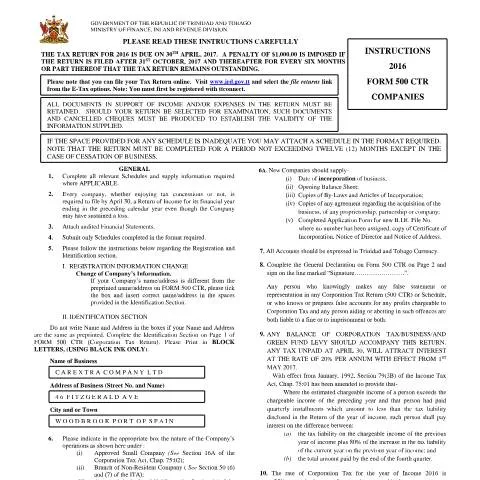
Understanding the 500-CTR Instructions: A Comprehensive Overview
When navigating the intricacies of corporate taxation in Trinidad and Tobago, the 500-CTR Instructions play a pivotal role for businesses across various sectors. This guide is not just a set of rules, but a critical resource to ensure compliance with the law and to facilitate the submission of corporate tax returns effectively. Understanding the nuances contained within this document can help businesses avoid penalties and optimize their tax obligations.
Key Sections of the 500-CTR Instructions
To fully leverage the 500-CTR Instructions, one needs to grasp the key sections detailed within it. Each part serves a distinct purpose that aligns with specific procedural requirements:
- General Guidelines: Offers foundational principles applicable to all companies.
- Registration Information Change: Details on updating company information.
- Identification Section: Specific instructions on how to accurately present company details.
- Declaration and Signatures: Emphasizes the importance of honesty in reporting.
- Tax Obligations: Outlines the critical tax rates relevant for the reporting period.
General Guidelines: Essential Compliance
The general guidelines provide a roadmap for companies to follow while compiling their tax returns. Here are some of the crucial points:
- Complete Relevant Schedules: Companies must fill out all applicable schedules as required by the guidelines.
- Mandatory Filing Obligation: Every company, irrespective of its financial performance, must file a tax return by April 30 of the following year; this includes those that may have incurred losses.
- Attachment of Audited Financial Statements: Auditors must verify the financial statements attached to ensure accuracy and compliance with accounting standards.
Navigating Registration Changes
Change is a constant in the corporate world, and keeping your company registration details up to date is vital. The instructions address how to amend company information:
- Companies experiencing changes in their name or address must indicate these changes in the identification section.
- It's crucial to present this information clearly, ensuring that the preprinted name/address is modified wherever necessary.
Identification Section: Clarity is Key
Accurate identification is fundamental when submitting tax returns. The instructions specify how to fill out this section properly:
- Companies need to provide their business name and address in BLOCK LETTERS using black ink.
- Only indicate changes if the preprinted information requires modification; otherwise, it can be left unchanged.
- The nature of operations must be specified from a provided list, which aids in categorizing the business type.
Exploring the Legal Framework Behind the Returns
The completion of the 500-CTR is not merely a procedural formality; it is embedded within a broader legal context dictated by the Corporation Tax Act. Understanding this legal framework can help businesses comprehend their obligations and rights. The Act outlines various categories under which companies may operate, including:
- Approved Small Companies
- Branch of Non-Resident Companies
- Charitable Organizations
Each category comes with its own set of regulations and tax implications, making it necessary for companies to identify their classification accurately.
Incorporating New Companies
For companies newly incorporated in Trinidad and Tobago, the instructions detail specific requirements that differ from established entities. New companies must include:
- Date of incorporation.
- Opening balance sheet.
- Copies of by-laws and articles of incorporation.
Additionally, they should submit any agreements related to the acquisition of the business, further solidifying their operational legitimacy within the jurisdiction.
Common Misinterpretations: Avoiding Pitfalls
One of the significant challenges businesses face when utilizing the 500-CTR Instructions lies in interpreting the details correctly. Some common misinterpretations include:
- Overlooking Filing Obligations: Many companies neglect to file returns when sustaining a loss, assuming it is unnecessary, which can lead to penalties.
- Misunderstanding Tax Rates: A lack of clarity around the applicable tax rates for specific industries can result in incorrect filings.
- Neglecting Required Attachments: Failing to include audited financial statements or other necessary documentation can lead to the rejection of a tax return.
Awareness of these pitfalls is crucial for compliance and to avoid unnecessary penalties.
Penalties for Non-compliance
Consequences of failing to adhere to the stipulated guidelines can be severe. The 500-CTR Instructions outline significant penalties:
- A flat penalty of $1,000.00 is imposed for returns submitted after the October 31 deadline.
- Additional fines accrue for each six-month period that the return remains outstanding, compounding the financial burden on the business.
Moreover, corporations that don’t meet their tax obligations can face interest charges on unpaid taxes, calculated at an annual rate of 20%. This can severely impact a company's financial health, making compliance an imperative.
Practical Steps for Filing Your 500-CTR Return
Filing a tax return may seem daunting, but breaking it down into manageable steps can simplify the process:
- Gather Essential Documentation: Collect audited financial statements and any other supporting documents.
- Complete the Required Schedules: Follow the outlined steps to fill in the relevant sections of 500-CTR.
- Review for Accuracy: Double-check all entries to ensure they align with actual business activities and financial data.
- Submit Before the Deadline: Ensure that the return is filed by April 30 of the following year to avoid penalties.
By adhering to these practical steps, businesses can navigate the complexities of tax filing with greater confidence and ease.
Digital Submission: Streamlining the Process
Trinidad and Tobago’s Inland Revenue Division has increasingly embraced technology to facilitate tax submissions. Businesses can leverage the e-Tax system for online filing, making the process more efficient. The benefits of submitting electronically include:
- Immediate Confirmation: Instant acknowledgment of submission can provide peace of mind.
- Accessibility: The platform can be accessed from anywhere, allowing for flexibility in filing.
- Reduced Errors: Electronic systems often have built-in checks that can catch common mistakes before submission.
Document Retention: A Vital Practice
Maintaining thorough records is a critical aspect of compliance. The 500-CTR Instructions emphasize the importance of retaining all documents that support income and expenses reported in the tax return:
- These include bank statements, receipts, and contracts that substantiate financial activities during the reporting period.
- In case of an examination by the Inland Revenue Division, it is imperative to be able to provide supporting documentation to validate the information provided.
By keeping accurate and comprehensive records, businesses can ensure they are well-prepared for any inquiries and can demonstrate compliance effectively.
Conclusion: Empowering Compliance Through Knowledge
The 500-CTR Instructions serve as an essential guide for companies operating within Trinidad and Tobago. By understanding its components, adhering to legal requirements, and preparing diligently for tax filings, businesses can mitigate risks and foster a culture of compliance. Whether you are a new company navigating the system for the first time or an established business refining your processes, leveraging the information contained in the 500-CTR can lead to informed decisions that streamline operations and ensure adherence to fiscal responsibilities.
Understanding the 500-CTR Submission Process
When dealing with various financial transactions and reporting obligations in Trinidad and Tobago, businesses and individuals may find themselves required to submit a 500-CTR, or Currency Transaction Report. The primary aim of this report is to facilitate the monitoring of large cash transactions, which can be indicative of money laundering or other illicit activities. To ensure compliance with local laws, it is crucial to understand the specifics of the submission process.
The 500-CTR must be submitted to the Financial Intelligence Unit (FIU) of Trinidad and Tobago whenever cash transactions exceed TT$25,000. This threshold applies to a single transaction, or a series of transactions that appear to be linked. It is advisable for businesses to implement robust internal controls that can identify and flag any such transactions to maintain compliance and avoid potential penalties.
To submit the 500-CTR, the relevant entity must fill out the designated forms accurately, specifying details such as the nature of the transaction, the parties involved, and the source of the funds. This information is critical not only for the FIU's analysis but also for the entity's own compliance records. The submission must be carried out within 72 hours of the threshold being met, ensuring that the authorities receive timely information for monitoring and investigation if necessary.
Entities can use their central ttconnect ID to access the electronic submission portal, where they can upload their completed forms. It's imperative to maintain copies of all submitted documents, as well as any supporting documentation, for at least five years in line with regulatory requirements. This practice not only aids in compliance but also provides a crucial audit trail should it be needed in the future.
Common Challenges in 500-CTR Reporting
While the necessity of submitting a 500-CTR is straightforward, various challenges can arise during the reporting process. Understanding these challenges can help entities prepare better and mitigate potential issues.
One common challenge faced is the identification of transactions that meet the reporting threshold. Smaller businesses, in particular, may not have systems in place to track large cash transactions effectively. It is recommended that businesses invest in accounting software or hire experienced financial professionals who can help monitor cash flow and ensure compliance with the reporting requirements.
Another significant issue is the incomplete or inaccurate information provided on the 500-CTR forms. The FIU places a high emphasis on the quality and accuracy of the data submitted. Errors can lead to delays in processing, requests for additional information, or even fines. As such, it is crucial for those filling out the reports to be meticulous and to double-check the information before submission.
Additionally, there can be apprehension among employees when it comes to reporting what may be perceived as “suspicious” transactions. It is vital for businesses to foster a culture of compliance and clarity around the importance of these reports. Training staff on recognizing cash transaction patterns and the ramifications of non-reporting can empower them to act confidently and in compliance with legal requirements.
Lastly, understanding the repercussions of non-compliance is essential for all entities. Failure to report cash transactions over the designated amount can result in substantial penalties, including fines or even legal repercussions. Therefore, establishing a compliance program that includes regular training and review of transaction reporting is advisable for all businesses operating within Trinidad and Tobago.
Best Practices for Effective 500-CTR Compliance
To effectively manage the requirements surrounding the 500-CTR, organizations should adopt best practices that streamline the reporting process and enhance compliance. Implementing a structured approach not only aids in improving the accuracy of submissions but also fosters a culture of regulatory adherence within the organization.
First and foremost, entities should establish clear internal policies regarding cash transactions. This includes defining what constitutes a cash transaction, setting thresholds for reporting, and outlining the procedures for documenting and reporting such transactions. Clear guidelines will ensure that all employees understand their responsibilities and the importance of compliance.
Regular training sessions should be conducted for staff to keep them informed about the latest regulations and best practices for cash transaction reporting. By equipping employees with the necessary knowledge, organizations can significantly reduce the likelihood of errors and omissions in their 500-CTR submissions.
Moreover, leveraging technology can significantly enhance compliance efforts. Many organizations are moving towards automated systems that can track cash transactions in real-time. This allows for quicker identification of transactions that may require a 500-CTR report, ultimately leading to more timely submissions.
Audits and reviews of cash transaction processes should be implemented periodically to assess compliance with 500-CTR requirements. This can serve as a proactive measure to identify areas for improvement and ensure that reporting practices align with regulatory expectations.
Finally, maintaining open lines of communication with the FIU can be invaluable. Should there be uncertainties about specific transactions or submissions, reaching out for clarification can prevent missteps and foster a cooperative relationship with regulatory authorities. By adopting these best practices, entities can position themselves as compliant and responsible participants in Trinidad and Tobago's financial landscape.