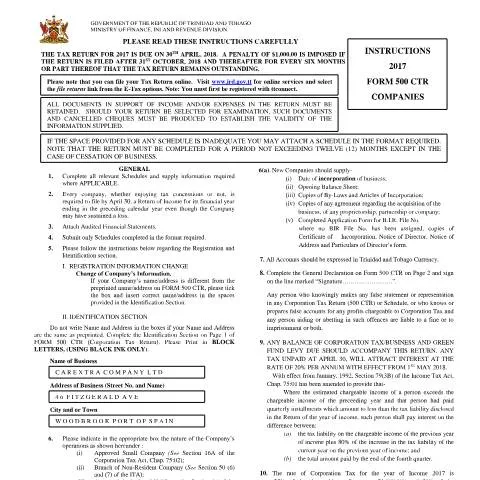
Understanding the 500-CTR Instructions: A Comprehensive Overview
The 500-CTR Instructions play a critical role in guiding companies in Trinidad and Tobago through the complexities of filing Corporation Tax Returns. This document serves as a vital resource, ensuring that businesses navigate their tax obligations efficiently. With deadlines and penalties looming, understanding the nuances offered within this guide is paramount for compliance.
Key Components of the 500-CTR Instructions
The 500-CTR Instructions laid out by the Ministry of Finance outline several essential elements that every business must adhere to when submitting their tax returns. Understanding these components can prevent potential pitfalls and unnecessary penalties.
1. Mandatory Filing Requirements
- All companies, regardless of tax concessions, must file a Return of Income by April 30 following the financial year-end.
- This requirement holds even if the company has reported a loss for the financial year.
- The guide emphasizes the necessity of attaching audited financial statements to the return.
2. Registration and Identification Adjustments
It is crucial for companies to ensure that their registration information is up-to-date. If there are any changes to the company’s name or address from what is pre-printed on the FORM 500 CTR, these must be corrected directly in the Identification Section. Companies should also be meticulous in completing the identification sections, especially when printing their name and address to avoid discrepancies.
Understanding Company Operations: Classifications and Definitions
The 500-CTR Instructions categorize companies into specific operational classifications. This classification is essential for determining the applicable tax rates and obligations.
Nature of Company Operations
- Approved Small Company
- Branch of Non-Resident Company
- Approved Agricultural Holdings
- Regional Development Company
- Investment Company
- Close Company
- Approved Activity Company
- Non-Resident Company
- Charitable Organization
- Small and Medium Enterprise listed on the Trinidad & Tobago Stock Exchange
Each classification comes with specific tax treatments, and it is vital for businesses to understand where they fit within this framework. Failing to do so could lead to miscalculations in tax liabilities.
Navigating the Tax Rates and Financial Obligations
Central to the 500-CTR Instructions are the details regarding tax rates and the financial obligations of companies, which can be quite intricate.
Tax Rates for Corporations
Corporation Tax rates are set at 25% for chargeable profits up to $1,000,000 and 30% for those exceeding this threshold. However, certain industries face different rates:
| Industry | Tax Rate |
|---|---|
| Liquefaction of Natural Gas | 35% |
| Manufacture of Petro-Chemicals | 35% |
| Transmission and Distribution of Natural Gas | 35% |
| Wholesale Marketing of Petroleum Products | 35% |
Companies must be diligent in understanding these tax rates, as they will directly impact their financial statements and liabilities.
Business and Green Fund Levies
Additionally, companies are subjected to Business Levy and Green Fund Levy:
- Business Levy: 0.6% of Gross Sales/Receipts.
- Green Fund Levy: 0.3% of Gross Sales/Receipts.
Understanding these levies is critical for accurate financial forecasting and planning. Companies that fail to account for these could face significant fiscal penalties.
Common Misinterpretations and Procedural Missteps
Even with detailed guidance, misunderstandings surrounding the 500-CTR Instructions can lead to costly mistakes. Awareness of these common misinterpretations can help mitigate risks.
1. Misunderstanding the Submission Deadline
One frequent error is miscalculating the deadline for filing returns. For the financial year ending in the previous calendar year, returns are due by April 30, and late submissions attract penalties which increase over time.
2. Inadequate Financial Documentation
Companies are required to retain all documents supporting their income and expenses. In the event of an audit, failure to produce these documents can result in penalties and fines.
3. Incorrect Classification of Company Type
Misclassifying the type of company can lead to inappropriate tax treatments and liabilities. It is imperative to accurately select the classification that corresponds to the company’s operations.
Using the 500-CTR Instructions Effectively: A Step-by-Step Approach
To maximize the utility of the 500-CTR Instructions, companies should adopt a systematic approach to filing their returns.
Step 1: Gathering Financial Records
- Collect audited financial statements for the relevant financial year.
- Ensure all receipts and documentation for expenses are organized and accessible.
Step 2: Updating Company Information
- Verify the accuracy of the company’s name and address as printed on the FORM 500 CTR.
- Make necessary updates in the Identification Section if there are discrepancies.
Step 3: Completing the Return Form
- Fill out the return form with all relevant details, ensuring that all schedules are completed accurately.
- Double-check that the classification of the company aligns with the nature of operations.
Step 4: Submission
- Submit your completed return by the deadline of April 30, ensuring all required documents are attached.
- Retain copies of the submitted return and documentation for your records.
Special Considerations for New Companies
Newly established businesses have additional requirements outlined in the 500-CTR Instructions. Understanding these can aid in smoother compliance from the outset.
Essential Documentation for New Companies
- Date of incorporation of the business.
- Opening balance sheet.
- Copies of By-Laws and Articles of Incorporation.
- Any agreements related to the acquisition of the business.
- Completed Application Form for B.I.R. File No., if applicable.
New companies must ensure all necessary documents are submitted along with their returns to avoid future administrative hurdles.
Final Thoughts: Leveraging the 500-CTR Instructions for Business Success
Knowledge of the 500-CTR Instructions and adherence to their guidelines is essential for any company operating in Trinidad and Tobago. By understanding the requirements, processes, and common pitfalls associated with Corporation Tax Returns, businesses can protect themselves from penalties and ensure compliance with local tax laws.
Ultimately, the 500-CTR Instructions are more than just guidelines; they are a crucial tool for maintaining good standing and operational transparency within the framework of Trinidad and Tobago’s tax system.
Understanding the 500-CTR: Key Requirements and Compliance
The 500-CTR, or the Currency Transaction Report, is a crucial component in the regulatory landscape of Trinidad and Tobago, particularly for financial institutions and businesses engaged in significant cash transactions. This report must be filed when a business conducts a cash transaction exceeding TT$50,000. The objective is to prevent money laundering and other financial crimes by ensuring that large cash transactions are monitored and reported. This section aims to delve deeper into the essential requirements for filing the 500-CTR, the compliance obligations for businesses, and the consequences of failing to adhere to these regulations.
Firstly, businesses must ensure that they have a robust internal control system in place to identify and record any cash transactions that meet the reporting threshold. This includes training staff to recognize suspicious activities and implement the necessary checks to ascertain the legitimacy of large cash transactions. Additionally, businesses are encouraged to maintain thorough documentation of all transactions, including the source of funds, to substantiate the legitimacy of the cash flow. This documentation will serve as evidence should any inquiries arise from the Financial Intelligence Unit (FIU) or other regulatory bodies.
Filing the 500-CTR requires a specific format and set of information, which must be submitted electronically through the e-Tax portal. Businesses must provide details such as the amount of cash received, the date of the transaction, the identity of the person or entity involved, and any relevant identification documentation. Failure to file the 500-CTR in a timely manner can result in hefty fines and potential criminal charges for the individuals responsible for compliance. Therefore, understanding the nuances of the reporting requirements is paramount.
Exceptions and Special Cases in 500-CTR Reporting
While the 500-CTR is generally applicable to most businesses, there are certain exceptions and special cases worth noting. These exceptions are often subject to specific criteria and conditions that must be met to qualify for exemption. One prominent exception involves transactions conducted by certain government entities or recognized non-profit organizations, which may not be required to file a 500-CTR under specific circumstances. For instance, cash transactions related to government grants or public welfare programs may not fall under the reporting obligation.
Moreover, businesses that engage in transactions with family members or close associates may also encounter different reporting requirements. If the transaction is deemed to be a gift or an informal loan between parties who share a familial relationship, it may not necessitate the completion of a 500-CTR. However, it is crucial for businesses to document the relationship and nature of the transaction to avoid potential scrutiny from authorities.
Another significant exception pertains to transactions that are deemed to be "routine" in the context of the business's operations. For example, a retail business that regularly receives large cash deposits from sales may have an established pattern that could exempt it from filing a 500-CTR for every transaction, provided that the transactions do not appear unusual or suspicious. These exceptions are not universally applied and must be assessed on a case-by-case basis, considering the unique circumstances surrounding each transaction.
Best Practices for Ensuring Compliance with 500-CTR Regulations
Adhering to the 500-CTR regulations involves implementing best practices that not only ensure compliance but also foster a culture of financial integrity within an organization. One of the best practices is the establishment of an Anti-Money Laundering (AML) compliance program. This program should include risk assessment protocols, training for employees, and regular auditing of cash transaction processes.
Employers should prioritize training sessions to educate employees about the importance of proper cash handling and the implications of non-compliance. Regular assessments and updates to training materials can keep staff informed about changes in legislation or regulatory expectations. Furthermore, businesses should maintain open lines of communication with compliance officers or legal advisors to clarify any uncertainties related to the 500-CTR and ensure that the organization remains compliant with all reporting obligations.
Another essential practice is the use of technology to enhance monitoring and reporting processes. Automated tools can be employed to flag transactions that meet the reporting threshold, thereby streamlining the identification process. Businesses should also invest in secure digital platforms for storing transaction data and generating reports, ensuring that sensitive information is protected while remaining accessible for compliance purposes.
Finally, conducting regular internal audits can help identify potential gaps in the reporting process and facilitate corrective actions before they lead to non-compliance issues. These audits will not only reinforce an organization’s commitment to regulatory standards but will also instill confidence among stakeholders that the business operates with integrity and transparency.