Understanding the Property Tax Exemption Application for Non-Residential Properties in Singapore
Singapore’s Inland Revenue Authority of Singapore (IRAS) offers a specific application process for property owners seeking exemption from property tax for non-residential properties such as offices, shops, factories, and other designated uses. This guide provides a comprehensive overview of the application form, its purpose, required documentation, and submission procedures to assist property owners in navigating this process efficiently.
Objective of the Application Form
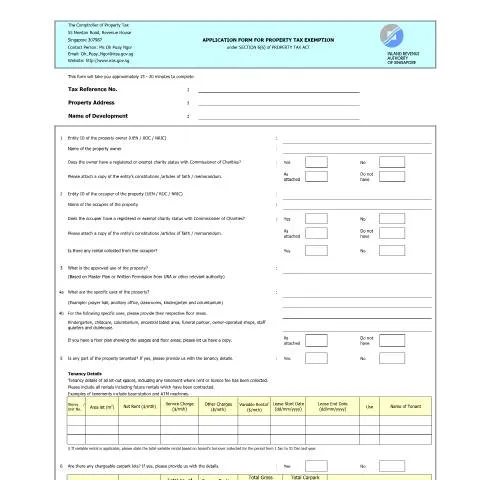
The primary goal of the Application for Property Tax Exemption (form code: APPLICATION-FORM-FOR-PROPERTY-TAX-EXEMPTION) is to enable eligible property owners to claim exemption from property tax for properties used for specific purposes, including educational, religious, charitable, or community activities. This exemption aims to support organizations that serve public or community interests by alleviating their financial burdens related to property ownership.
Preparing Your Submission
Gathering Necessary Documentation
Applicants should prepare the following documents before completing the form:
- Proof of ownership, such as the entity’s registration number (UEN, ROC, or NRIC) and relevant legal constitutions, articles of association, or memoranda.
- Details of the property, including the address and floor plan indicating usage and floor areas, if available.
- Information about the occupier, including their legal status and, if applicable, their registration with the Commissioner of Charities.
- Details of tenancy agreements, if any part of the property is rented out, including tenant information, rental amounts, and tenancy periods.
- Details of carpark lots associated with the property, including the number of lots and parking fees, if relevant.
Completing the Form
The form is primarily digital and accessible via the IRAS website. It requires detailed information about the property, its usage, tenancy, and ownership. Specific sections include:
- Ownership details, including entity ID (UEN, ROC, or NRIC) and ownership documentation.
- Occupier information, especially if different from the owner, including legal status and documentation.
- Property usage, based on Master Plan or written permission from the Urban Redevelopment Authority (URA).
- Details of specific uses, such as prayer halls, classrooms, or columbarium, with respective floor areas.
- Tenancy details for rented-out spaces, including rental amounts and tenancy periods.
- Carpark lot information, if applicable.
- Declaration section, where the applicant affirms the accuracy of the provided information and understands the legal implications of false declarations.
Submission Procedures
Online Submission via FormSG
The application must be submitted electronically through the IRAS portal, which is accessible via the official IRAS website. The digital form is designed to facilitate a streamlined process, typically taking approximately 15 to 20 minutes to complete. Applicants are encouraged to ensure all information is accurate and all supporting documents are attached before submission.
Required Authentication
Applicants must authenticate their identity using Singpass, which ensures secure access to government services. This process verifies the applicant’s authority to submit the application on behalf of the property owner or organization.
Processing and Follow-up
Once submitted, IRAS will review the application for completeness and eligibility. The processing time may vary based on the complexity of the case and the volume of applications. Applicants will be contacted if additional information or clarification is needed.
Successful applicants will receive a notification of exemption approval, which can be used to inform relevant parties and to adjust property tax assessments accordingly. If the application is denied, IRAS will provide reasons and guidance on possible next steps.
Contacts and Useful Resources
For assistance during the application process or to seek clarification, applicants can contact Ms. Oh Puay Ngor at IRAS via email: [email protected]. Additional information and updates are available on the official IRAS website: http://www.iras.gov.sg.
Property owners are advised to review the detailed instructions and legal requirements on the IRAS website before submitting their application to ensure compliance and a smooth process.