Understanding the Application for Owner-Occupier Tax Rates for Residential Properties in Singapore
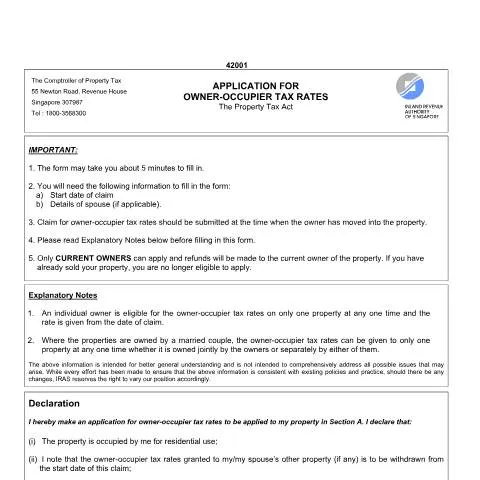
The application process for owner-occupier property tax rates in Singapore is a crucial step for property owners seeking to benefit from lower tax rates on their residential properties, such as HDB flats, condominiums, or landed housing. Managed by the Inland Revenue Authority of Singapore (IRAS), this process ensures that eligible owners can declare their occupancy status and enjoy the appropriate tax relief. This article provides a comprehensive overview of the purpose, eligibility, required information, and procedural steps involved in submitting the application form designated as APPLICATION-FOR-OOTR-(2024).
When to Use the Application Form
The form is intended for current property owners who occupy their residential property for personal use. It is particularly relevant when owners move into a property or change their occupancy status. The application should be submitted at the start of occupancy to qualify for owner-occupier tax rates, which are generally lower than standard property tax rates. Owners must also submit a new application if they cease to occupy the property to ensure the tax rates are correctly adjusted.
It is important to note that only current owners are eligible to apply. If the property has been sold, the previous owner cannot request the owner-occupier rate anymore, and refunds or adjustments will not be applicable to former owners.
Key Information Required for the Application
Filling out the form involves providing specific details to verify ownership and occupancy status. The main sections include:
- Particulars of the Property: including property tax reference number (if known), street name, storey-unit number, and postal code.
- Particulars of the Owner: full name, identification type (such as NRIC, FIN, passport), identification number, and marital status. If applicable, details of the spouse, especially if ownership is joint or separate.
- Start Date of Claim: the date from which the owner claims the owner-occupier tax rate, typically the move-in date.
Additional notes specify that the application must be accurate and complete, as incomplete submissions will be rejected. Owners should also be aware that the claim applies only to one property at a time, even if they own multiple properties jointly or separately.
Step-by-Step Submission Process
The application is primarily submitted online via the IRAS property tax portal, accessible through the gov.sg platform. Owners are required to authenticate using Singpass, ensuring data security and identity verification. The process involves:
- Logging into the mytax.iras.gov.sg portal.
- Selecting the relevant property under the "Property" menu.
- Choosing the option to "Apply/Withdraw owner-occupier tax rates."
- Completing the digital form with accurate details, including the start date of occupancy.
- Submitting the application and receiving confirmation from IRAS.
It is advisable to submit the application promptly, especially when moving into a property, to ensure the owner-occupier rate is applied from the correct date. Owners should also notify IRAS within 15 days of ceasing occupancy to avoid penalties or incorrect tax assessments.
Points of Attention and Best Practices
- Accurate Data Entry: Double-check all personal and property details before submission to prevent rejection or delays.
- Timely Notification: Notify IRAS within 15 days of occupancy changes to maintain correct tax rates and avoid penalties.
- Supporting Documentation: While the form primarily relies on self-declaration, keep relevant documents (e.g., move-in date proof) for reference, especially if IRAS requests verification.
- Legal Declaration: The applicant must confirm that all information provided is true and complete, understanding that false declarations may lead to penalties, including fines or imprisonment.
Conclusion
The application for owner-occupier tax rates is a straightforward yet essential process for property owners in Singapore wishing to benefit from lower property tax rates. By accurately completing the APPLICATION-FOR-OOTR-(2024) form and adhering to the submission guidelines, owners can ensure their occupancy status is correctly reflected in their property tax assessments, leading to potential savings and compliance with IRAS regulations.