Understanding the Letter of Undertaking for Development of Four or Less Residential Units in Singapore
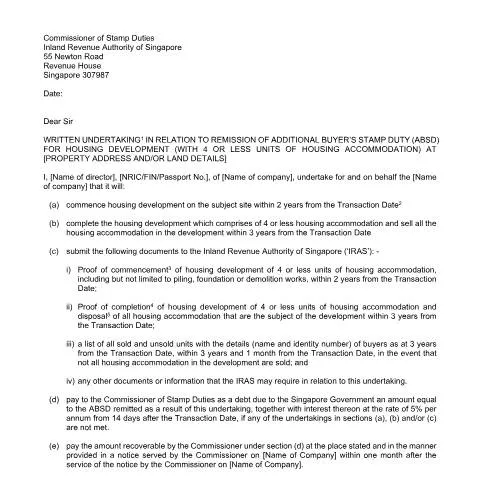
The Letter of Undertaking (LOU) issued by the Inland Revenue Authority of Singapore (IRAS) is a critical document for developers involved in housing projects comprising four or fewer residential units. This official form, identified by the code (B)-LETTER-OF-UNDERTAKING-FOR-DEVELOPMENT-OF-4-OR-LESS-RESIDENTIAL-UNITS-(NEW)_2017-09-20, is designed to facilitate the remission of Additional Buyer’s Stamp Duty (ABSD) under specific conditions. It is primarily aimed at developers who wish to benefit from the stamp duty relief when developing small-scale residential projects.
Objective of the Form
The primary purpose of this form is to serve as a formal commitment by the developer to comply with the conditions necessary to qualify for ABSD remission. Specifically, it ensures that the developer will:
- Commence housing development within two years from the transaction date;
- Complete and sell all units within three years from the transaction date;
- Submit the necessary documentation to IRAS evidencing progress and completion;
- Repay any ABSD remitted if the conditions are not met.
This undertaking is essential for developers seeking to optimize their tax obligations while ensuring compliance with Singapore’s housing development regulations.
Preparing Your Submission
Before submitting the Letter of Undertaking, developers should gather all relevant documentation to support their commitments. This includes:
- Proof of commencement of the housing project, such as permits or declarations from URA (Urban Redevelopment Authority), BCA (Building and Construction Authority), or professional engineers indicating the start of structural works.
- Proof of completion of the development, including certificates of statutory completion or temporary occupation permits issued by BCA.
- Details of the units sold or unsold at the three-year mark, including buyer information such as name and NRIC/FIN/Passport number.
- Any additional documents requested by IRAS to verify compliance with the undertaking.
It is advisable to review the specific requirements outlined in the form instructions, available on the official government portal, to ensure completeness and accuracy.
Filing the Form
The Letter of Undertaking must be submitted digitally via the IRAS online portal, using the secure Singpass authentication system. This process involves:
- Logging into the IRAS portal with Singpass credentials;
- Completing the form online, providing all necessary details and declarations;
- Uploading supporting documents as required;
- Submitting the form electronically for processing.
Developers should ensure they retain copies of all submissions and confirmation receipts for their records.
Follow-up and Compliance
After submission, IRAS will review the documentation to verify compliance with the commitments made in the undertaking. Developers are required to:
- Provide additional information if requested by IRAS;
- Submit progress reports and proof of sale within the specified timeframes;
- Ensure all units are sold within three years from the transaction date to qualify for the ABSD remission.
If the developer fails to meet the stipulated conditions, IRAS will notify them of the repayment obligations. The amount of ABSD remitted, along with interest at 5% per annum from 14 days after the transaction date, may be recoverable by IRAS.
Contacts and Further Assistance
Developers seeking assistance or clarification can contact IRAS directly through their official channels. It is recommended to consult the IRAS website or the relevant government portals for the latest updates and detailed guidance on the process and documentation requirements.
In summary, the Letter of Undertaking for the development of four or fewer residential units is a vital document that supports developers in managing stamp duty obligations while ensuring compliance with Singapore’s housing development policies. Proper preparation, timely submission, and diligent follow-up are essential to benefit from the scheme and avoid penalties.