Understanding the Preparation Checklist for Overseas Vendors Supplying Low-Value Goods in Singapore
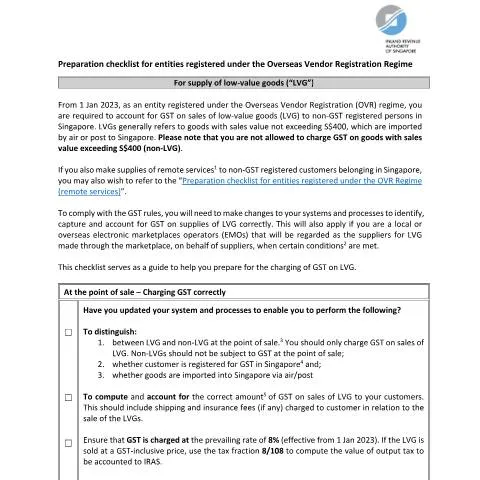
Effective from 1 January 2023, entities registered under the Overseas Vendor Registration (OVR) regime are required to comply with Goods and Services Tax (GST) obligations concerning low-value goods (LVG) imported into Singapore. This regulation aims to ensure proper tax collection on imports valued at S$400 or less, primarily transported via air or post. This article provides a comprehensive overview of the official preparation checklist issued by the Inland Revenue Authority of Singapore (IRAS), guiding overseas vendors in aligning their systems and processes with these new requirements.
Scope and Purpose of the Checklist
The checklist serves as a practical guide for overseas vendors and electronic marketplace operators (EMOs) to prepare for charging and accounting for GST on LVG sales. It emphasizes the importance of system updates, process adjustments, and staff training to ensure compliance at every stage—from point of sale to post-sale procedures.
Key Aspects for GST Compliance at the Point of Sale
To correctly charge GST on LVG sales, vendors must ensure their systems can:
- Differentiate between LVG and non-LVG goods at the point of sale, charging GST solely on LVG sales.
- Identify whether the customer is registered for GST in Singapore.
- Determine if goods are imported via air or post into Singapore.
Once these distinctions are made, vendors need to calculate the GST amount accurately, including any shipping and insurance fees charged to the customer. The prevailing GST rate is 8% from 1 January 2023, increasing to 9% from 1 January 2024. For goods sold at a GST-inclusive price, the tax fraction (8/108 or 9/109) should be used to compute the GST component.
Special Considerations for Electronic Marketplace Operators and Redeliverers
Marketplace operators and redeliverers must also ensure their systems can:
- Charge and account for GST on LVG sales made through their platforms, whether the suppliers are registered for GST or not.
- Identify whether the goods are shipped as a single consignment, which affects the application of the entry value threshold.
Applying the Entry Value Threshold
Vendors with full oversight and control over shipping and delivery processes may elect to apply the entry value threshold on a per-consignment basis. To do so, they must submit the relevant election forms via the go.gov.sg platform, such as:
- https://go.gov.sg/lvg-entryvalue-election for the per-consignment threshold election.
- https://go.gov.sg/lvg-entryvalue-election for using the CIF (Cost, Insurance, and Freight) value instead of sales value to determine if goods fall within the S$400 threshold.
Procedures at Importation to Prevent Double Taxation
Vendors must update their systems to transmit specific GST-related information to logistics providers, including:
- Whether GST has been paid for each LVG item.
- The vendor’s GST registration number.
This data helps ensure that import GST is not paid twice, aligning with Singapore Customs regulations. Shipping non-LVG and LVG separately is also recommended as a best practice to facilitate accurate tax treatment.
Post-Sale Responsibilities and Record-Keeping
After completing sales, vendors should:
- Train staff on the quarterly filing of GST returns.
- Maintain detailed business and accounting records for at least five years, available for IRAS review upon request.
- Update systems to process refunds where evidence shows import GST has been paid or where GST has been incorrectly charged.
Assessing Eligibility for Exceptions
Vendors may qualify for certain exceptions, such as:
- Applying the import value of goods to determine if they fall within the S$400 threshold.
- Charging GST on LVG imported via sea or land, provided they can determine the mode of shipment at the point of sale.
To apply for these exceptions, vendors must submit specific forms through the IRAS online portals, such as:
- https://go.gov.sg/lvg-import-sealand for approval to charge GST on goods imported via sea or land.
Resources and Support
IRAS provides detailed guidance, including the e-Tax guide on GST for taxing imported low-value goods under the OVR regime. Vendors are encouraged to consult these resources to understand their obligations thoroughly and ensure compliance with Singapore’s GST laws.
In summary, this checklist is an essential tool for overseas vendors to align their operational processes with Singapore’s GST requirements for low-value goods, minimizing compliance risks and facilitating smooth trade transactions.