Understanding the IRAS Request for Relief of GST on Goods or Services Supplied Before GST Registration
The Request for Relief of GST on Goods or Services Supplied is an official form issued by the Inland Revenue Authority of Singapore (IRAS). It is designed for businesses that have supplied goods or services prior to their GST registration date but wish to seek relief from paying GST on those supplies. This process ensures that newly registered businesses or their customers are not unfairly taxed for transactions that occurred before the supplier's GST registration was effective.
Who Should Use This Form?
This form is applicable primarily to businesses that:
- Have supplied goods or services before their GST registration date, and
- Want to claim relief from paying GST on these supplies, or
- Are customers who have incurred GST on supplies made before the supplier's GST registration date and wish to seek relief from claiming input tax.
It is important to note that the form must be completed by both the customer and the supplier, with each party filling out designated sections. The completed form is kept by the supplier as part of their business records and is only submitted to IRAS upon request.
How to Fill Out the Form
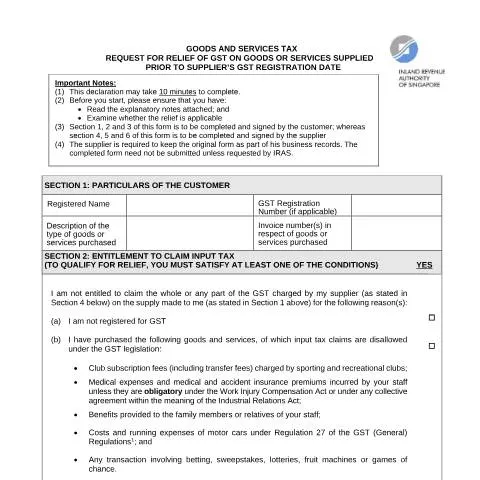
Section 1: Customer Particulars
In this section, the customer provides their registered name, GST registration number (if applicable), a description of the goods or services purchased, and the invoice numbers related to those supplies. Accurate details are essential to establish the context of the supply and the basis for relief claim.
Section 2: Entitlement to Claim Input Tax
The customer must specify whether they are not entitled to claim GST input tax, citing reasons such as:
- Not being GST-registered at the time of supply,
- Purchases involving disallowed expenses (e.g., club subscriptions, medical expenses, benefits to family members, costs related to motor vehicles, or transactions involving games of chance),
- GST incurred not attributable to taxable or out-of-scope supplies,
- Purchases for non-business activities.
The customer indicates their eligibility by ticking the relevant checkboxes and providing supporting explanations.
Section 3: Customer Declaration
The customer signs and dates the declaration, affirming that the information provided is true and complete. They acknowledge the penalties for false declarations as per Singaporean law.
Section 4: Supplier Particulars
The supplier completes this section by providing their registered name, GST registration number, a description of the goods or services supplied, and invoice numbers.
Section 5: Supplier Obligations
The supplier confirms they have performed necessary checks, such as verifying the customer's GST status and ensuring supplies were made before their GST registration date. Both parties must sign this section to attest that all conditions are met.
Section 6: Supplier Declaration
The supplier signs and dates the declaration, confirming compliance with all obligations outlined in the previous section. They acknowledge the legal implications of providing false information.
Key Considerations and Common Errors
Before completing the form, ensure you have read the explanatory notes provided by IRAS and verified your eligibility for relief. Common mistakes include:
- Incorrectly identifying the supply date as after GST registration when it was before;
- Failing to verify the GST registration status of the customer or supplier;
- Not providing complete or accurate invoice details;
- Neglecting to sign all required sections.
Submission and Record-Keeping
The completed form does not need to be submitted to IRAS unless requested. However, the supplier must retain the original document as part of their business records for audit purposes. If IRAS requests the form, the supplier must provide it promptly to support their relief claim.
Conclusion
The IRAS Request for Relief of GST form is a vital tool for ensuring fair tax treatment for supplies made before a business’s GST registration. Proper completion and record-keeping help prevent disputes and ensure compliance with Singapore’s GST legislation.