Understanding the Self-Review Checklist for Charities and Non-Profit Organizations in Singapore
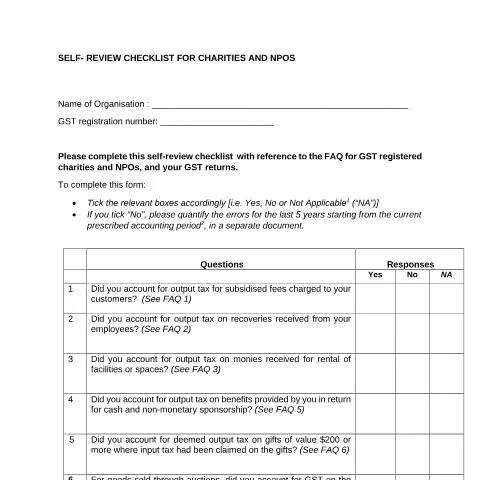
The Self-Review Checklist for Charities and NPOs issued by the Inland Revenue Authority of Singapore (IRAS) is a crucial compliance tool designed to assist registered charities and non-profit organizations in ensuring their Goods and Services Tax (GST) obligations are correctly fulfilled. This document guides organizations through a systematic review of their GST-related transactions, helping to identify potential errors and maintain accurate tax records.
Purpose and Scope of the Checklist
This self-assessment form serves as a comprehensive audit instrument that covers various GST scenarios relevant to charities and NPOs. It is intended to promote voluntary compliance by encouraging organizations to review their GST accounting practices, particularly focusing on output and input tax calculations. The checklist is aligned with the FAQ for GST-registered charities and NPOs, providing clarity on the specific transactions that require GST accounting.
Who Should Use the Self-Review Checklist?
The form is mandatory for all GST-registered charities and NPOs that need to verify their compliance with GST regulations. Organizations should complete this checklist as part of their routine financial review, especially when preparing for GST audits or when discrepancies are suspected in their GST returns.
How to Complete the Checklist
Completion of the form involves a step-by-step process:
- Tick the relevant boxes: For each question, select Yes, No, or Not Applicable (NA).
- Quantify errors if applicable: If any answer is "No," organizations must quantify the errors related to the last five years, starting from the current prescribed accounting period. This quantification should be documented separately.
Key Sections and Common GST Transactions Covered
Output Tax Considerations
The checklist prompts organizations to review whether they have correctly accounted for output tax in various scenarios, including:
- Subsidized fees charged to beneficiaries
- Recoveries from employees
- Rental income from facilities or spaces
- Benefits provided in exchange for sponsorships
- Gifts of value over $200 where input tax was claimed
- Sales via auctions, including the valuation method
- Part payments or deposits based on supply timing
- Charity coupons sold
Input Tax Claims and Apportionment
Organizations must verify their input tax claims, ensuring they have:
- Claimed input tax based on valid GST invoices
- Excluded disallowed input tax under Regulation 26 and 27
- Properly apportioned input tax for subsidized activities
- Included non-business receipts like grants and donations in their apportionment calculations
- Accounted for reverse charge on overseas services and imported low-value goods (LVG)
Implications of the Self-Review
If discrepancies are identified during the review, organizations are advised to conduct a detailed analysis of their GST returns. Any errors, such as under-claimed output tax or over-claimed input tax, should be disclosed voluntarily to IRAS to ensure compliance and avoid penalties.
Documentation and Record-Keeping
All quantifications of errors and supporting calculations must be documented separately. This documentation should include:
- Details of the errors identified
- Amounts involved for each period
- Basis for recalculations and adjustments
Conclusion and Next Steps
Completing the Self-Review Checklist is an essential part of maintaining GST compliance for charities and NPOs in Singapore. It helps organizations identify potential issues proactively, ensuring accurate reporting and adherence to IRAS regulations. Organizations should review their GST processes regularly and update their records accordingly, especially when errors are discovered. If necessary, they should seek professional advice or contact IRAS for guidance on rectifying discrepancies.