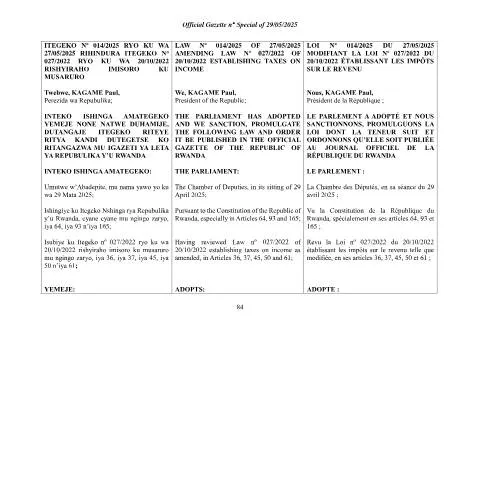
Overview of the Law Amending the 2022 Income Tax Law in Rwanda
The Law Amending the 2022 Income Tax Law, officially published in the Official Gazette n° Special of 29 May 2025, represents a significant update to Rwanda's fiscal legislation. This law, designated as Law nº 014/2025, was enacted by the Parliament of Rwanda and signed into law by President Paul Kagame on 27 May 2025. Its primary purpose is to modify specific provisions of the original Law nº 027/2022, which established the framework for income taxation in the country.
Context and Scope of the Amendments
The amendments introduced by this law focus mainly on adjusting the capital gains tax rate and clarifying procedures related to the withholding and declaration of this tax. These changes are part of Rwanda’s broader efforts to enhance tax compliance, streamline fiscal procedures, and optimize revenue collection in line with the country's economic policies. The modifications are applicable to all taxpayers involved in the sale or transfer of assets such as shares, licenses, debt instruments, and similar financial assets within Rwanda.
Key Provisions of the Law
Increase in Capital Gains Tax Rate
One of the central changes involves the rate applied to capital gains. According to Article 36 of the original Law nº 027/2022, the tax rate on capital gains has been increased to 10%. This rate applies to the profit realized from the sale or transfer of assets such as shares, securities, or other similar assets. The law stipulates that this rate is calculated as 10% of the capital gain, aligning Rwanda’s taxation policy with regional standards to ensure fair taxation of capital transactions.
Clarification on Withholding and Declaration Procedures
Further, the law revises Article 37, which deals with the withholding and declaration obligations related to capital gains tax. It specifies that:
- The tax on capital gains resulting from the direct or indirect sale or transfer of shares, licenses, debt securities, options, guarantees, and similar assets must be withheld by the resident company or individual involved in the transaction.
- This withholding must occur within 15 days following the month in which the sale or transfer takes place.
- The company, shareholder, or buyer involved in such transactions is responsible for declaring and paying the tax to the Rwanda Revenue Authority (RRA) within this timeframe.
Exemptions and Reporting Obligations
The amendments also specify certain exemptions from capital gains tax. Notably, companies, shareholders, or buyers involved in transactions that qualify under specific conditions are exempted from paying the capital gains tax. However, they are still required to declare any applicable gains and settle the tax within 15 days after the transaction month, ensuring transparency and compliance with tax laws.
Legal and Administrative References
This law is rooted in the constitutional provisions of the Republic of Rwanda, particularly Articles 64, 93, and 165, which empower the Parliament to legislate on fiscal matters. The amendments are implemented through the Rwanda Revenue Authority (RRA), which oversees tax collection and enforcement. The RRA ensures that taxpayers are aware of their obligations and facilitates the online declaration and payment processes via the digital government platform, Irembo, enhancing accessibility and efficiency.
Implications for Taxpayers and Stakeholders
Taxpayers involved in the transfer of assets within Rwanda should review these amendments carefully. The increased capital gains tax rate and clarified procedures for withholding and declaration mean that individuals and corporate entities must ensure timely compliance to avoid penalties. The provisions also promote transparency, as all transactions subject to capital gains tax must be properly documented and reported to the RRA.
In summary, the Law nº 014/2025 marks a strategic effort by the Rwandan government to refine its tax regime, making it more effective and aligned with regional standards. Stakeholders are encouraged to consult official resources and utilize the RRA’s online platforms to remain compliant with these new legal requirements.