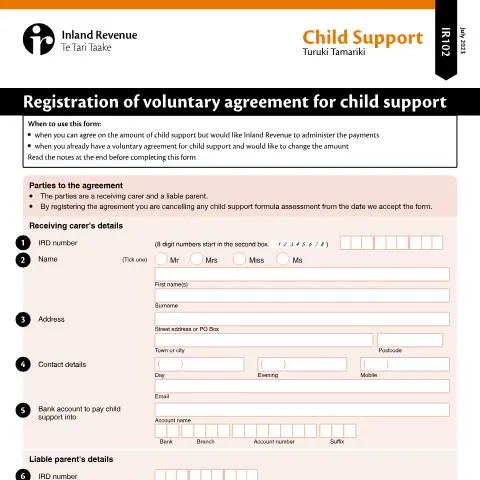
Navigating Child Support in New Zealand: Understanding the IR102 Form
For many families, child support can be a crucial aspect of maintaining stability and ensuring that children's needs are met. The Registration of Voluntary Agreement for Child Support (IR102) serves as an essential document that facilitates this process. Both receiving carers and liable parents benefit from understanding its purpose, how it works, and the implications of filing it.
Who Are the Key Players in a Voluntary Child Support Agreement?
To fully grasp the significance of the IR102 form, it's vital to identify the parties involved:
- Receiving Carer: This individual receives child support payments. They can be a biological parent, step-parent, or guardian who primarily looks after the child.
- Liable Parent: This individual is responsible for making the payments to support the child, often a biological parent.
Before registering an agreement, both parties must reach a consensus on the amount of support to be provided. By completing this form, any existing child support formula assessment is cancelled retroactively from the date the IR102 is accepted.
The Journey of Completing and Submitting the IR102 Form
Understanding when and how to use the IR102 form involves several steps:
- Agreement Formation: Ensure both parties agree on the payment structure, which should be for at least $10 per week.
- Gather Necessary Information: This information includes the IRD numbers, names, addresses, and contact details from both parties.
- Child Details: Include the details of children receiving support, including their names, dates of birth, and IRD numbers.
- Signature Requirement: Both parties must sign the document, affirming that the information provided is accurate.
- Submission Channels: The completed form must be sent to Child Support, PO Box 39010, Wellington Mail Centre, Lower Hutt 5045.
Understanding the Key Sections of the IR102 Form
The IR102 form contains specific sections that must be addressed meticulously:
- Receiving Carer's Details: This section requires personal information from the receiving carer, including:
- IRD Number
- Name and contact details
- Bank account information for payments
- Liable Parent's Details: Similarly, details must be provided for the liable parent, mirroring the information collected from the receiving carer.
- Child Support Agreement Details: This crucial part needs individual child data, including their ages and the amount payable.
Addressing Special Situations: Unique Cases for Child Support Agreements
Many families face unique circumstances that require consideration when completing the IR102 form:
- Children with No IRD Number: If a child does not have an IRD number, the responsible party must apply for one using the IR595 form.
- Multiple Children: If agreements involve more than three children, their details must be documented on an additional page attached to the IR102.
- Child's Age and Status: Agreements must pertain to children under 18 or those aged 18 attending a registered school.
- Unsupported Child’s Benefit Recipients: If the receiving carer is receiving child benefits, they can only register a voluntary agreement if it meets or exceeds the formula assessment amount.
Validating the Agreement: Signatures and Authenticity
One of the critical components of the IR102 form is the requirement for both parties to sign it. This not only affirms the authenticity of the information provided but also signals mutual agreement on the terms laid out in the document. The following guidelines should be adhered to when signing:
- Both Parties Must Sign: It is imperative for both the receiving carer and the liable parent to confirm that the information is true to the best of their knowledge.
- Future Changes: Should either party wish to alter the agreement later, they must draft a new IR102 and follow the same submission process.
Submission Options: Navigating the Channels for the IR102
Upon completion, the IR102 form can be submitted in various ways, each having its unique advantages:
| Submission Method | Pros | Cons |
|---|---|---|
| Online | Quick and efficient processing | Requires access to a stable internet connection and RealMe ID |
| Paper Submission | Allows for more careful review before sending | Longer processing time, potential postal delays |
| In-Person at Child Support Office | Direct confirmation of receipt | Time-consuming; requires physical presence |
Next Steps: What Happens After Filing the IR102?
Once the IR102 form is submitted, both parties can expect a few important steps in the process:
- Confirmation of Registration: Inland Revenue will confirm the acceptance of the form and the details of the voluntary agreement.
- Payment Schedule: Payments will be administered monthly, allowing for a reliable financial structure for the receiving carer.
- Updates: If circumstances change (e.g., changes in financial situations or custody arrangements), either party can seek to revise the agreement.
Challenges and Solutions: What to Do in Case of Issues with the Agreement
In situations where issues arise regarding the IR102 form, whether due to missing information or disputes between the parties, it's essential to know how to proceed:
- Missing Documents: If additional documentation is required during the review, Inland Revenue will reach out for clarification. Ensure all records are accurate at the time of submission.
- Disagreements: If one party disagrees with the terms of the voluntary agreement, open communication is key. Consider mediation before escalating to formal channels.
- Refusals: If the IR102 is rejected, review the reasons provided and rectify any discrepancies before re-submitting the form.
The Importance of Compliance and Privacy in Child Support Agreements
Understanding the obligations under the Child Support Act 1991 is crucial for both parties. Compliance not only ensures a seamless child support process but protects personal information as well:
- Accurate Information: Providing precise information helps Inland Revenue assess obligations effectively and mitigate future disputes.
- Privacy Protections: Personal data is safeguarded under privacy regulations, and any data shared with other agencies is for specific purposes only.
In conclusion, the IR102 form plays a pivotal role in establishing a structured and fair child support arrangement in New Zealand. By understanding the intricacies of this form, parties can navigate the complexities of child support more effectively, ensuring a brighter future for their children.
Understanding the Child Support System in New Zealand
Child support in New Zealand is governed by the Child Support Act 1991, which aims to ensure that children receive adequate financial support from both parents. The system is designed to be fair and transparent, taking into account both parents’ incomes, the amount of time the child spends with each parent, and the needs of the child. To effectively navigate the child support system, it is crucial to understand the different types of arrangements available, including voluntary agreements.
A voluntary agreement for child support allows parents to come to their own arrangement regarding financial support for their children without the need for official assessment by the Inland Revenue Department (IRD). Such agreements can be beneficial for parents who prefer flexibility and want to tailor their contributions to their unique circumstances. It is important, however, that such agreements align with the best interests of the child, ensuring that their needs are met.
Steps to Create a Voluntary Child Support Agreement
Creating a voluntary child support agreement involves several key steps. First and foremost, parents should communicate openly and honestly about their financial situations and the child's needs. Here’s how to draft a comprehensive agreement:
- Assess Financial Situations: Both parents should provide a clear picture of their financial situations, including income, expenses, and any other financial commitments. This transparency will help in determining a fair amount for child support.
- Identify the Child’s Needs: Consider the specific needs of the child, including education, healthcare, and general living expenses. Discuss how these needs might change over time as the child grows.
- Draft the Agreement: Put all agreements in writing, detailing the amount of support to be paid, the payment frequency, and any other relevant conditions. It’s advisable to use clear language to avoid misunderstandings.
- Incorporate Flexibility: Include provisions for reviewing and adjusting the agreement as circumstances change, such as changes in income or the needs of the child.
- Seek Legal Advice: While it’s not mandatory, obtaining legal advice can help ensure that the agreement is fair and legally binding, and that all potential issues have been considered.
Once the agreement is drafted, both parties should sign it. While it's not necessary to register the agreement with IRD for it to be valid, doing so can provide additional security and help prevent future disputes.
Dispute Resolution for Child Support Agreements
Even with a well-structured voluntary agreement, disputes may arise over child support payments. The Ministry of Social Development (MSD) provides resources and support for parents who find themselves in disputes regarding child support arrangements. Here are some avenues for resolution:
- Mediation: Mediation services are available to help parents come to a mutually acceptable agreement. A neutral third party can facilitate discussions, helping to resolve conflicts without going to court.
- Revising Agreements: If financial circumstances change significantly (e.g., job loss or increased living costs), parents may wish to revise their current agreement. It’s important to communicate with each other and renegotiate the terms in good faith.
- Legal Action: If disputes cannot be resolved through mediation or discussion, parents may seek legal remedies. This often involves approaching the Family Court, which can enforce child support obligations and modify existing agreements if necessary.
Ultimately, the aim of child support arrangements is to ensure that the child's welfare is prioritized. Regular communication and a willingness to adapt to changing circumstances can help both parents fulfill their responsibilities effectively.