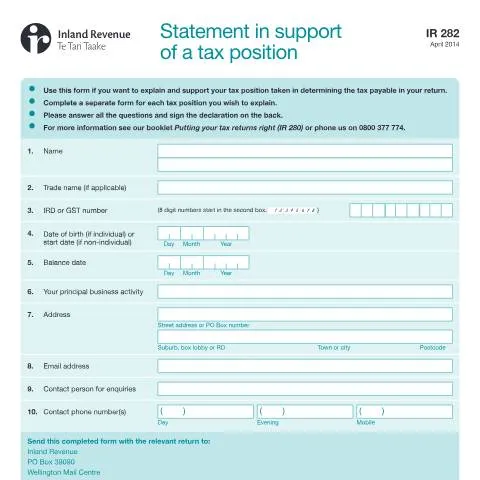
Understanding the Purpose of the IR282 Form in Tax Management
In the complex world of taxation, clarity and precision are paramount. The IR282, or the Statement in support of a tax position, is designed for individuals and entities navigating the intricate landscape of tax obligations in New Zealand. It serves a vital role in substantiating the tax positions taken by taxpayers when submitting their tax returns. This form is particularly useful for those who wish to explain the rationale behind their reported tax calculations.
Who Needs to Submit the IR282?
Any taxpayer, whether an individual or a business entity, may require the IR282, especially if their tax position is not straightforward. This includes:
- Individuals with unique or complex tax circumstances, such as those claiming deductions or credits that may require clarification.
- Businesses that have adopted specific tax postures that differ from standard practices.
- Entities undergoing tax audits or those that anticipate scrutiny from the Inland Revenue Department (IRD).
Notably, each tax position must be supported by a separate form, ensuring clarity and comprehensive documentation for the IRD.
Detailed Breakdown of Completing the IR282 Form
To ensure a successful submission, it’s essential to complete the IR282 form meticulously. Here’s a breakdown of each section:
- Name: Provide your full name as registered with the IRD.
- Trade name: If applicable, include the name under which your business operates.
- IRD or GST number: Enter your eight-digit tax number, ensuring it is accurate.
- Date of birth or start date: Use the date format Day/Month/Year, depending on whether the taxpayer is an individual or a non-individual entity.
- Balance date: Similar to the above, specify your balance date accurately.
- Principal business activity: Clearly describe your main business activity, which aids in contextualizing your tax position.
- Address: Ensure your contact address is up-to-date to receive any correspondence from the IRD.
- Email address: Providing an email facilitates faster communication.
- Contact person for enquiries: Assign a representative if you aren't the primary contact.
- Contact phone number(s): Include a day, evening, and mobile number for versatility in communication.
The completion of the tax position details is where the form truly comes to life. You are required to outline your tax position comprehensively:
- Provide an overview of the tax position taken.
- Detail the legal basis for your position, referencing case law, legal opinions, or IRD public statements.
- Specify the relevant tax types and the corresponding periods they pertain to.
- Reference any IRD public or binding rulings that support your position.
- Include any necessary calculations that elucidate how your position was determined.
For more complex cases, you may continue on a separate piece of paper.
Submission Process: From Completion to Approval
Once you’ve filled out the IR282, the next step is submission. Here's how:
Send the completed form along with your tax return to: Inland Revenue PO Box 39090 Wellington Mail Centre Lower Hutt 5045
Upon receipt, the IRD will evaluate your submission, and you can track its status using your RealMe digital ID. It's crucial to retain copies of all documents submitted for your records.
What Happens After Submission? Navigating the Timeline
The timeline following your submission of the IR282 can vary significantly based on various factors:
| Action | Timeline |
|---|---|
| IRD Acknowledgment of Receipt | 1-2 weeks post-submission |
| Review Period | 4-8 weeks (varies by complexity) |
| Response to Queries (if any) | 2-4 weeks (depends on your response time) |
| Final Decision | 8-12 weeks (completion of review) |
It's essential to be patient during this process. If your submission is complex, the IRD may take additional time to ensure they understand your position thoroughly.
Handling Discrepancies and Refusals: Your Rights and Options
Occasionally, the IRD may challenge your submitted tax position or request additional information. Here’s how to navigate these situations:
- In the event of a refusal, you will receive a detailed notice explaining the reasons. You have the right to appeal this decision.
- If there are discrepancies, promptly provide any requested documentation or clarification to settle matters swiftly.
- Maintaining open communication with the IRD is crucial. If you disagree with their stance, a formal dispute resolution process is available.
Don't hesitate to seek guidance from a tax professional if the situation escalates or if you require expertise in your appeal.
Distinguishing the IR282 from Other Tax Forms
The IR282 is often confused with forms that serve different purposes. Understanding what sets it apart can help ensure you're using the right form for your needs:
| Form | Purpose | When to Use |
|---|---|---|
| IR282 | Support a specific tax position | When your tax return involves unique interpretations or non-standard claims |
| IR 270 | Tax return for individuals | For standard tax reporting |
| IR 501 | GST Return | When reporting Goods and Services Tax |
Having the right form is a critical first step in ensuring compliance and clarity in your tax obligations.
The Regulatory Framework Behind the IR282
The IR282 is underpinned by New Zealand’s extensive tax laws and regulations. Understanding this framework can provide context and enhance your confidence in using the form:
- Official Information Act 1982: This act establishes the public's right to access information, ensuring transparency in tax matters.
- Plain Language Act 2022: It promotes the use of clear and accessible language in official communication, including tax documents.
This legal backdrop not only supports the validity of the IR282 but also reinforces the IRD's commitment to accessible administration of tax laws.
Integrating the IR282 into Broader Tax Management Practices
The IR282 does not exist in isolation; it’s part of a larger framework of tax management and compliance strategies. Integrating its use into your overall tax workflow can enhance both efficiency and accuracy:
- Maintain organized records of all tax-related documents, including prior IR282 submissions and supporting documentation.
- Regularly review your tax position, ensuring that it aligns with current laws and practices. This proactive approach can minimize potential disputes.
- Engage with tax professionals who can provide insights and guidance tailored to your specific circumstances.
By embedding the IR282 into a comprehensive tax strategy, you’ll be better positioned to navigate the complexities of tax compliance in New Zealand.
Understanding the Importance of a Statement in Support of a Tax Position
In New Zealand, a Statement in Support of a Tax Position is a vital document that can significantly influence the outcome of discussions with the Inland Revenue Department (IRD). This statement is essentially a formal representation of an individual's or a business's stance regarding a specific tax issue. It is crucial for demonstrating the rationale behind your tax treatment or claims to ensure compliance with New Zealand tax obligations.
Taxpayers may find themselves needing to present this statement when they wish to contest or clarify their tax position, particularly during audits, disputes, or when applying for tax relief. The statement should include a clear articulation of the tax position and provide supporting arguments, including relevant facts, legislative references, and any applicable case law.
Moreover, the Statement in Support of a Tax Position is also a tool that signals good faith to the IRD. By proactively explaining your stance, you may foster a more cooperative dialogue with tax authorities. This is particularly important if your tax position is complex or involves interpretations of tax laws that are not straightforward.
How to Effectively Prepare Your Statement
Preparing an effective Statement in Support of a Tax Position involves strategic planning and a clear, methodical approach. Begin by gathering all relevant documentation, including your tax returns, financial records, and any correspondence with the IRD. Detail the specific tax position you are advocating for, ensuring that it aligns with tax laws and guidelines provided by the IRD.
Your statement should include the following elements:
- Introduction: Briefly outline the purpose of the statement and the specific tax issue at hand.
- Detailed Explanation: Provide a comprehensive explanation of the facts surrounding your tax position. This should include the context, applicable legislation, and how your circumstances apply to these laws.
- Supporting Evidence: Attach any documents or records that support your claims. This could include contracts, invoices, or expert opinions.
- Conclusion: Summarize your position and clearly indicate the resolution you seek from the IRD.
When drafting your statement, it's important to keep the language clear and straightforward, adhering to the principles of plain language as outlined in the Plain Language Act 2022. This will not only aid in the IRD’s understanding of your position but also reflect your commitment to transparency.
Common Mistakes to Avoid
While preparing a Statement in Support of a Tax Position, taxpayers often make several common mistakes that can hinder their efforts. Being aware of these pitfalls can help ensure that your statement is effective and persuasive.
- Vague Statements: It's essential to be precise in your assertions. Avoid ambiguous language and ensure that each point is backed up with concrete evidence or legislative references.
- Ignoring IRD Guidelines: Familiarize yourself with the relevant sections of the IRD website that deal with the specific tax issue you are addressing. Ignoring these guidelines can weaken your position.
- Overcomplicating the Issue: While tax matters can be complex, clarity is paramount. If possible, simplify your explanation and avoid jargon that may confuse the discussion.
- Neglecting to Follow Up: Once your statement is submitted, maintain communication with the IRD. Following up can help reinforce your commitment to resolving the issue and ensure that your case is being actively considered.
By avoiding these common mistakes, you can enhance the effectiveness of your Statement in Support of a Tax Position and contribute to a smoother interaction with the IRD.